Continue from the take you accepted
A continuation prompt needs to account for what happened in the accepted take. Seedance 2.0 Skill OS documents that approach: its release notes say continuation examples begin from the take's actual observed state rather than a planned ending. For someone preparing connected clips, that is a concrete reason to consider the workflow.
Seedance 2.0 Skill OS is an agent skill for planning shots, binding references and continuing from an accepted clip. Your provider still generates the video and handles its costs. Consider it if organizing those instructions is useful to you. Avoid choosing it as a local video generator or on the expectation of demonstrated quality gains.
The supplied README identifies v6.7.0. Our sandbox ran commit 4668457; the measurements below should not be read as a test of the release tag.
What happened when we ran it
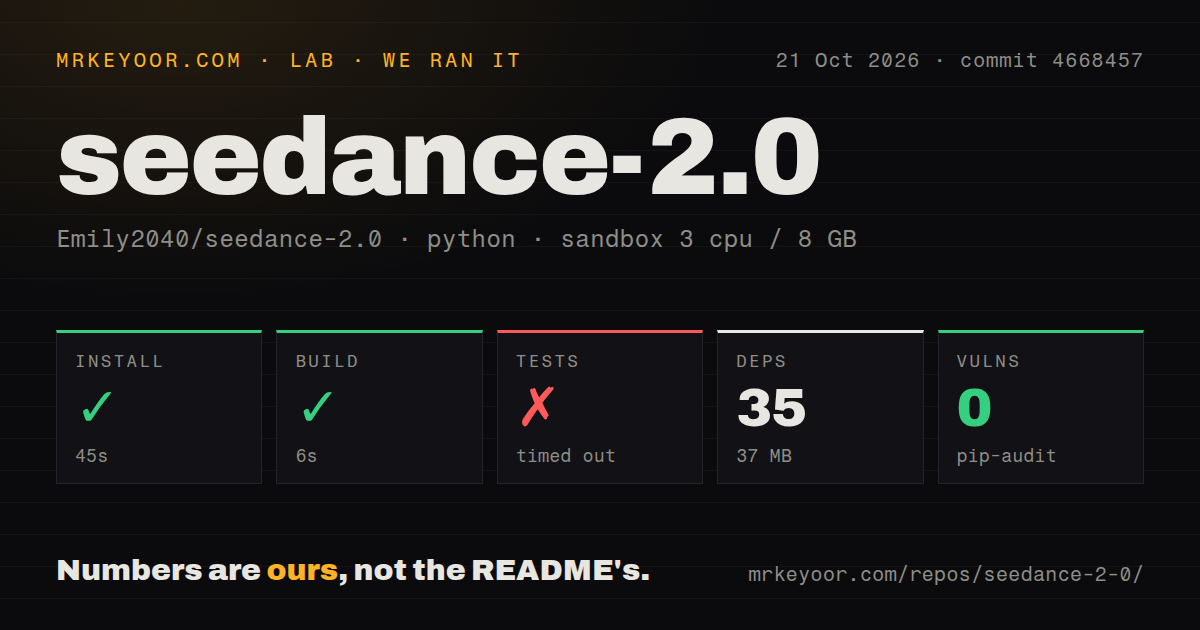
Our sandbox installed commit 4668457 in 45 seconds, recorded 35 dependencies and used 37 MB on disk. The build succeeded in 6 seconds. Tests timed out at 900 seconds. The run was recorded on October 21, 2026, with 3 CPUs and 8g RAM. The container image label does not verify the actual interpreter or operating-system version.
The supplied test tail reaches 41%, followed by more progress characters, skips and F markers. It does not identify the failing cases or show their tracebacks. The evidence supports reporting an unfinished suite with visible failure markers, but it does not support a diagnosis or a passing-test count. A completed build also does not establish whether generated footage follows a prompt.
Pip-audit reported 0 known vulnerabilities in the recorded audit. That result does not certify the package or its agent host as secure. The checkout contained 343 files, about 78,418 source lines and 26.5 MB of data. The scan recorded 3 CI workflow files, a tests directory and no Dockerfile.
Dependency installation is also different from skill discovery. These measurements do not show an agent client loading the skill or following its instructions. Setup ease and client compatibility therefore remain unassessed.
Planning ends before provider generation
The documented workflow covers shot planning, reference binding and continuation. The provider handles generation and its costs. That division matters when deciding whether the package addresses your problem: it can help organize a brief, while the supplied evidence does not establish provider access, current prices or accepted upload formats.
For a first trial, describe the ending of one accepted take and ask for a continuation tied to that observed state. Review the proposed action and reference instructions before submitting the prompt to your provider. This is a suggested trial, not a workflow executed in our sandbox.
Rendered results remain pending
The README states that live model scores and rendered-pilot results remain pending. It also distinguishes repository checks from a rendered-quality verdict. The supplied evidence therefore does not demonstrate better footage or fewer paid retakes.
The README's introductory showcase describes generated clips, but individual examples in the supplied extract are labeled as not rendered yet. Treat those prompt examples as material to inspect, rather than proof of completed footage.
Issue 155 tracks source-registry re-verification. Its stated boundary is that checking recorded dates, labels and source markers does not fetch URLs or verify upstream claims live. If your decision depends on current provider prices or model identifiers, this review does not establish those facts.
Release information has a narrower meaning
The supplied repository metadata records the last push on October 3, 2026. The latest-release metadata identifies v6.7.0, published August 6, 2026. Neither fact resolves our test timeout or establishes maintainer response quality.
The v6.7.0 release notes describe Windows launcher validation and CI coverage for CPython 3.11, 3.12 and 3.13. That is a statement about the release's described checks, not evidence of the current README's complete runtime support policy or our sandbox's actual runtime.
Choose by the work you need to do
ComfyUI provides a node graph for generating media. Consider it when you need a media-generation workflow with model and parameter controls.
Remotion uses React code as the source of truth for video. Consider it when you want to manage video compositions in code. Its README says a company license is required in some cases, so check the applicable terms.
The supplied Post Production Skill review describes a narrower Seedance 2.5 prompt skill for a warm 1990s studio look. This review addresses a different decision: whether Seedance 2.0 Skill OS's connected-clip planning workflow is useful despite incomplete local checks and pending rendered results.
How the ratings are limited
Maturity is rated 2/5 under this review's rubric: documented workflows with unresolved validation evidence. The local suite timed out at 900 seconds, and rendered-pilot results remain pending. This rating concerns the evidence available for adoption, not the quality of generated footage.
Setup ease, documentation and community are unassessed. The supplied material does not verify client discovery, provide enough installation documentation to assess setup guidance as a whole, or establish support outcomes. These dimensions receive no numerical score.
Try the skill if planning from an accepted take's observed ending would help your work. If your decision depends on better footage or fewer paid retakes, the supplied evidence does not answer that question.