One 11-second visual system is the whole product
Post Production Skill is easier to judge once you ignore the broad repository name. It writes prompts for one specific look: a live-action creator in a warm 1990s home studio, surrounded by dark wood, cream hardware, amber practical lights, CRT displays, and editing controls that appear as physical objects. The default sequence lasts about 11 seconds in 16:9 and moves through five connected shot phases.
That narrowness is useful. Instead of asking a model for something vaguely cinematic, the skill forces continuity across the face, outfit, room, desk, monitor, product, and moving camera. Floating interfaces need perspective, reflection, refraction, occlusion, focus depth, tracking, and parallax. Transitions need a visible physical cause. The final image must hold as a clean hero frame instead of dropping to black. These details give a reviewer concrete failure points.
What happened when we ran it
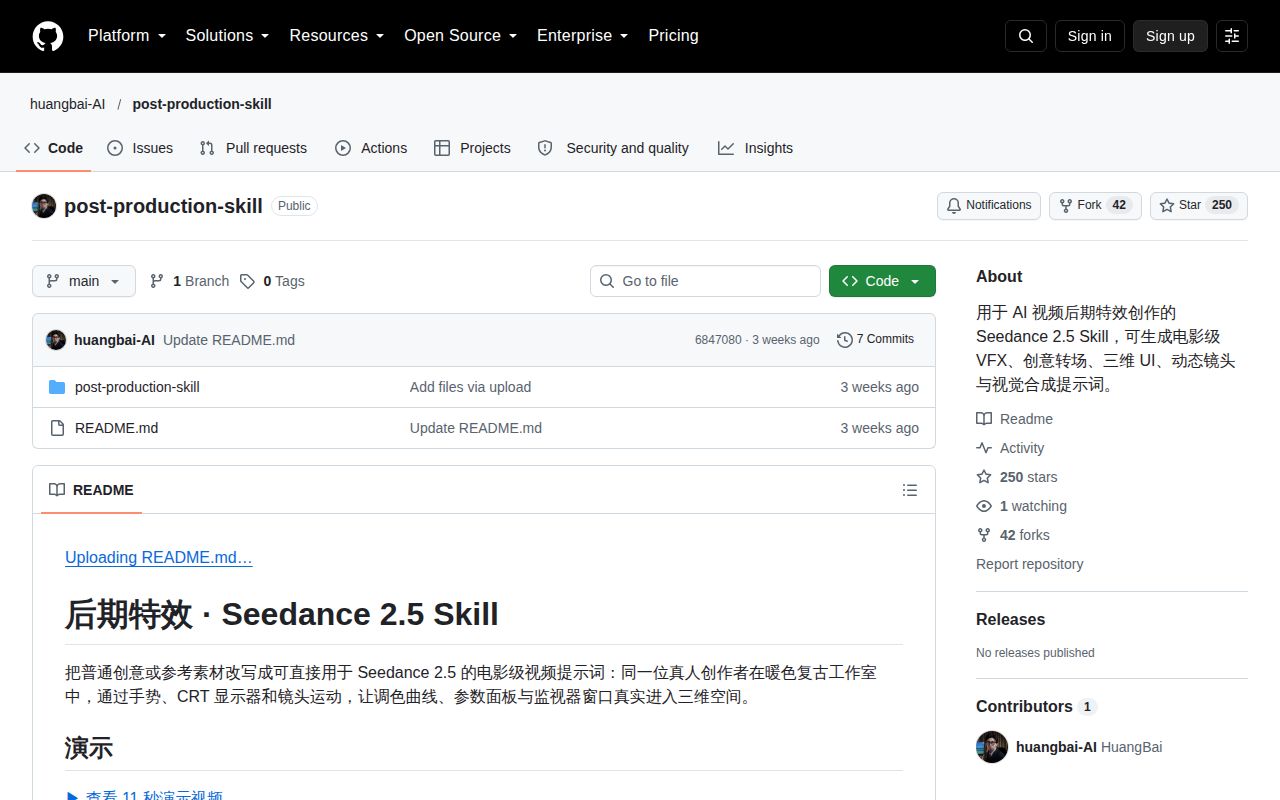
We did not execute commit 6847080 in our sandbox. The lab found no supported software ecosystem and no Dockerfile. This is a collection of Markdown instructions, references, metadata, and one MP4 demonstration rather than an application with an install target. There is no measured dependency count, build result, test result, or security audit for us to report.
The repository tree makes that scope plain. The working bundle contains SKILL.md, an OpenAI metadata file, Chinese and English master prompts, a short adaptation guide, and a 15,348,727-byte demo video. Installation is a folder copy into Codex's skill directory followed by reopening the client. No command compiles or validates the generated prompt. The operator reads it and chooses whether to send it to a video service.
A text-only skill can still be tested, but this one supplies no fixtures or expected-output checks. A useful harness would feed the same brief through several changes, then verify timeline coverage, reference duties, prohibited text, identity rules, and section presence. Visual judgment would still require generated clips. Until those checks exist, the demo proves that one authored concept has an example, not that every adaptation holds together.
Three edit modes keep changes inside the template
The skill offers faithful reuse, style adaptation, and targeted repair. Faithful reuse keeps all five shot phases and changes only requested details. Style adaptation retains the retro studio, warm palette, physical UI, motivated transitions, and continuity rules while rewriting timing. Targeted repair leaves the user's prompt intact and addresses contradictions in timing, cameras, transition cause, continuity, or negative constraints. That is a sensible distinction for repeat work.
The canonical prompt still exerts a strong pull. Its opening uses a temporary multi-arm composite, moves into a close fisheye and split screen, lets interfaces emerge from a CRT, orbits toward an overhead angle, and ends with fingertip control of grading panels. The soundtrack target is modern electronic music around 120 to 135 BPM. If your brand does not want that visual grammar, adapting every invariant is harder than starting from a different skill.
Reference roles are explicit, but identity still needs review
A portrait reference controls face, hair, glasses, and clothing. A room image controls geometry and practical light. A product image locks shape, material, labels, and color. Video references supply rhythm or effect behavior, while audio can define music, narration, or sound design. When the user leaves a role unclear, the skill asks Codex to infer the narrowest useful role and state that choice in the prompt.
The instructions also say not to guess a real person's identity. One supplied portrait becomes the sole identity reference, and the prompt should demand the same face across every angle. That wording can reduce drift, but it cannot verify consent, likeness rights, or the generated result. The same limit applies to product labels and exact screen text. A written constraint is an instruction to the model, not proof that the output obeyed it.
The skill writes prompts and stops before generation
By default, the result is one copyable prompt. The skill says not to submit a generation job unless the user explicitly asks, which keeps model credits and external actions under user control. It also requires time ranges to begin at zero, meet without gaps or overlaps, and end at the requested duration. If narration will not fit, the duration must grow or the words must shrink.
This separation is the right product boundary for a small prompt bundle. It also means the repository does not manage uploads, moderation, model availability, retries, render settings, cost, or output review. Calling it a post-production tool would overstate the implementation. It is an art-direction and prompt-structuring tool aimed at a named video model. The actual production work begins after its output ends.
Seven commits and no license make reuse uncertain
GitHub showed 250 stars, zero open issues and pull requests, and no releases on October 7, 2026. The repository was created and last pushed on September 19, with seven visible commits that day. There are no CI workflow files, executable tests, or package metadata. More importantly, the repository has no license file and GitHub reports no license. Public visibility alone does not grant normal open-source reuse rights.
Use the skill as a small, readable pattern for one visual treatment. Its strongest work is the continuity checklist, not the retro props. The same person, room, product, timing, camera cause, spatial interface, and final frame each receive an explicit check. That discipline is worth borrowing only where your rights allow it. For a general video practice, choose a broader, licensed prompt library and validate the clips, not only the prose.