The public source stops at 2.5.0
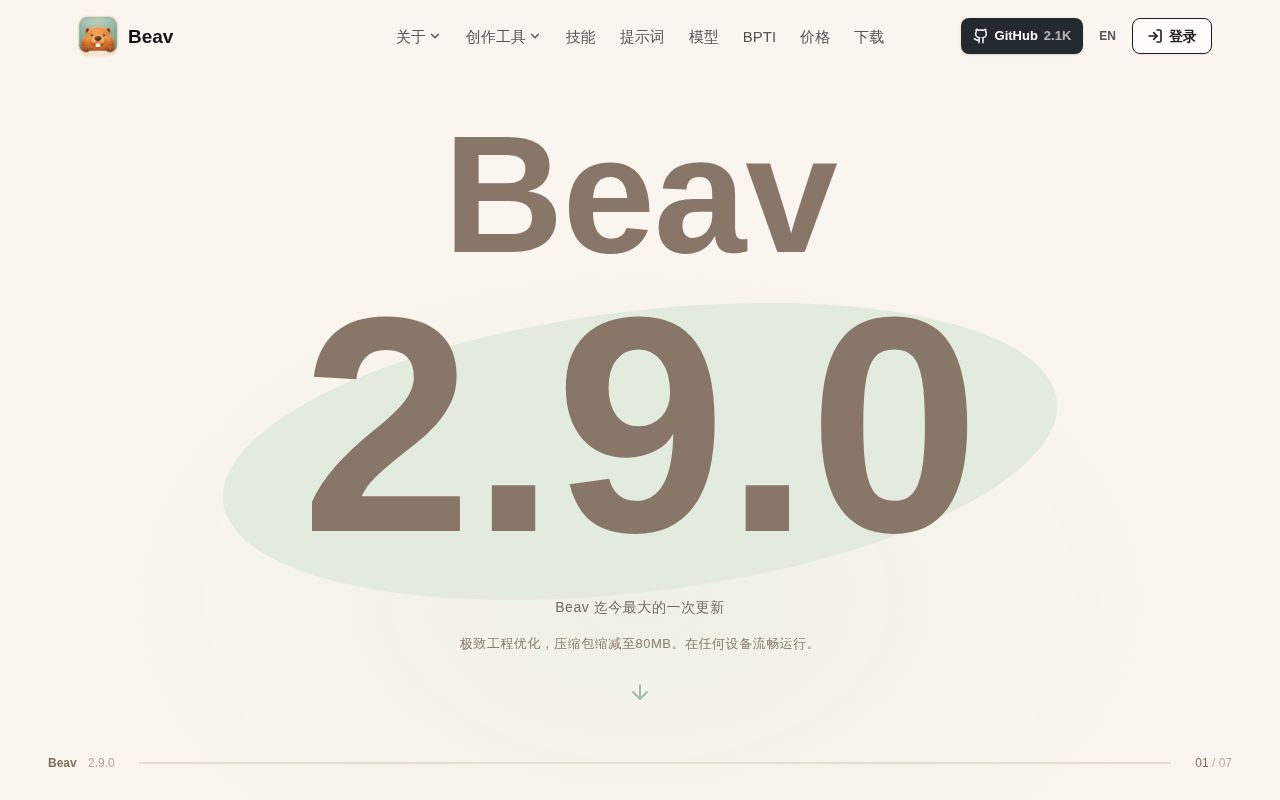
Clone Beav expecting the current creator workspace and you will get an older code baseline. The v2.9.5 release notice says the repository provides a Tauri/Rust 2.5.0 source snapshot while distributing separately maintained desktop installers. It explicitly warns that release-note features do not mean the corresponding source has been published. That is the first decision to settle before comparing its AI features.
Beav is primarily a Chinese-language project, with an English README available. Its documented product combines a source library with AI-assisted content creation and media work, particularly for workflows involving Xiaohongshu and WeChat. English documentation helps explain that scope, but it does not establish English interface coverage. We did not launch the desktop app or assess localization.
What happened when we ran it
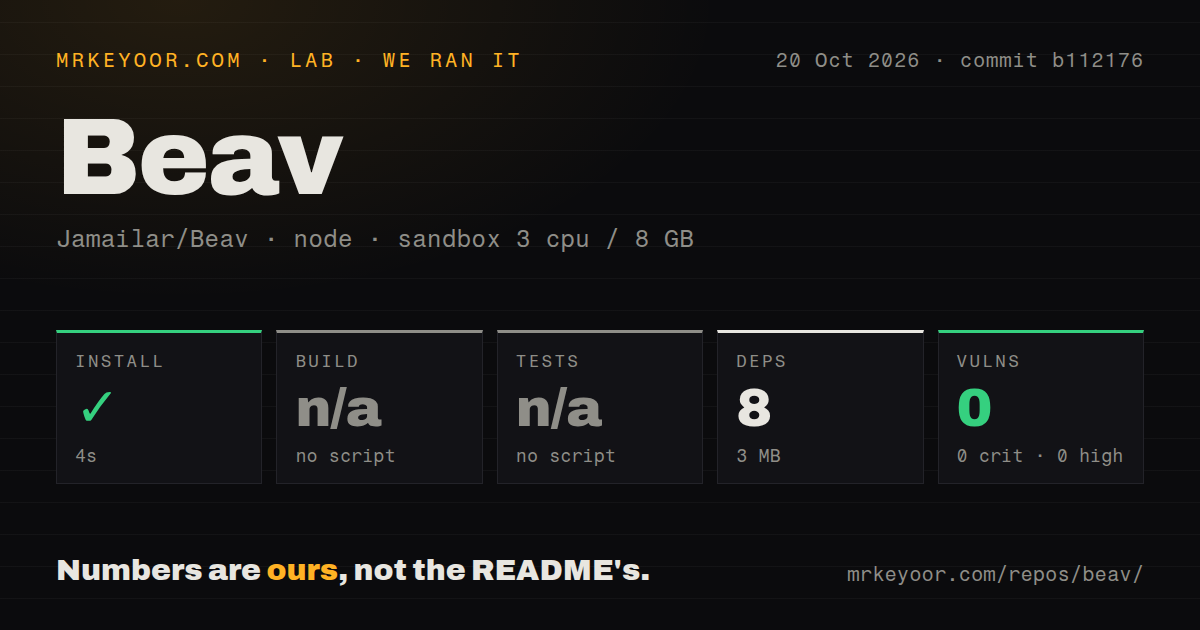
Our sandbox installed Beav commit b112176 in 4 seconds on October 20, 2026, recording 8 npm dependencies and 3 MB on disk. No build script or target was available, so the build step was skipped. There was also no test script or target, so tests were skipped. That result covers the npm step the harness found; it does not establish a working Rust/Tauri desktop application.
Npm audit reported 0 known vulnerabilities across critical, high, moderate, and low severities. The supplied summary gives no audited-package coverage count. It also provides no security assessment of the native application, downloaded installers, browser extension, or model connections. The npm dependency count cannot establish coverage of those components.
The checkout contained 1,237 files, about 354,564 source lines, and occupied 80.8 MB. Our scan found no CI workflow files, Dockerfile, or tests directory. The sandbox had 3 CPUs and 8 GB of RAM under image label lab-node:22. That label is not evidence of an actual Node or operating-system version. Neither the fast install nor the audit result resolves the gap between the public snapshot and the current product.
The documented workflow follows content between phone and computer
The English README describes saving shared links into a computer's knowledge base, turning sources into drafts and media, then collecting a publishing package on a phone through a QR code. The phone-and-computer flow uses the same Wi-Fi. This could reduce repetitive transfer work for a creator who already gathers ideas on mobile and writes on desktop. That benefit remains a proposed fit, not an outcome we measured.
The quick start uses packaged downloads for macOS, Windows, or Linux, creates a space for an account or brand, and selects either the official AI service or a configured model provider. This is a different route from our npm check. Before importing a working archive, establish which installer version contains the workflow you need and what its provider connection requires. The README itself warns that an installed version may differ from the page.
The English README describes MCP configuration for Claude Code and other external agents. That lets an existing agent work with Beav's materials rather than requiring every writing task to begin in its chat interface. It also expands the access you are granting. Use a disposable workspace to check what an agent can read and write before connecting manuscripts you cannot afford to lose.
Commercial source use needs permission
Beav's source license requires prior written permission for commercial use. The license file calls itself a custom source-available license and says it is neither standard MIT nor an OSI-approved open-source license. A developer who needs unrestricted commercial reuse should remove Beav's public source from the shortlist unless the author grants the required permission. The MIT-NC badge should not be read as ordinary MIT permission.
Official desktop installers have separate application terms. The source license expressly says downloading a release does not grant product rights under the source-code license. Decide whether you are evaluating the public code or the packaged service, then read the terms for that route. Our review does not establish that a particular business use is permitted.
Local workspaces also do not answer every privacy question. The quick start offers an official AI service or your own provider, so model selection matters alongside local file storage. We did not inspect network traffic, retention, or provider billing. Keep confidential source material out of an initial trial until you understand the selected model connection.
Joplin and Kdenlive cover narrower parts of the job
Joplin is an offline-first notes application with searchable notebooks and synchronization options. Choose it when collecting and organizing references is the main job and you do not need Beav's combined content workflow. An existing writing process may only need a reliable place to keep sources; adopting a separate agent workspace adds decisions about access and model services.
Kdenlive is a video editor built around MLT, Qt, and KDE frameworks. Choose it when editing the finished video is the part you need to improve. Neither recommendation claims to replace every Beav feature. They let you solve the immediate library or editing problem separately, without making current Beav installer behavior a requirement for the whole workflow.
Recent releases do not update the public code baseline
GitHub recorded Beav's last push and v2.9.5 release on October 19, 2026, with 15 open issues and PRs. Recent documentation pull requests, including PR 55, explicitly preserve the public 2.5.0 code baseline. That is evidence of current distribution and documentation work. It does not establish a current source mirror or the quality of user support.
Our documentation rating is 3/5: the workflow walkthrough is useful, but the English README lacks the explicit source-snapshot section found in the Chinese README and release notice. A 4 would require that boundary in the English quick start too. For a product trial, use an expendable source and inspect the resulting publishing package. For a source-based deployment, settle version scope and licensing before spending time on a build.