Eight page grammars force a choice before code
scrollcraft is built around 8 mutually exclusive page grammars: filmic one-shot, chaptered editorial, live surface, continuous world, typographic poster, gallery, split stage, and rhythmic cutlist. Each grammar requires and forbids different structural moves. That gives Claude Code a stronger constraint than a request for a premium page, which often changes colors and type while keeping the same hero, feature grid, testimonials, and call to action.
The repository shows 3 example builds with different navigation, pacing, and endings. A fingerprint gate compares each new plan with earlier work across 6 dimensions: grammar, navigation, hero, act shape, close, and signature move. A build must differ on at least 4. It also needs one interaction specific to that site. Recoloring a spotlight does not qualify. This is useful process design because sameness is rejected before implementation becomes expensive.
The skill budgets motion around one peak
Before sections exist, the agent writes a feeling curve that states the intended emotion and the on-screen cause for each act. Adjacent acts cannot repeat the same feeling. One moment receives the largest asset budget and most scroll space, while the approach creates contrast. The framework may sound theatrical, but it gives motion a job. Scroll can scrub video, pin an argument, pan a rail, assemble type, change the page ground, or drive a custom property for bespoke effects.
Visual rules are equally concrete: at most 2 type families, a 45 to 75 character measure, spacing on a 4 px base, 6 color roles with 1 accent, and 5 listed depth techniques. Brand guidelines override those defaults. The refusal list bans repeated feature-card grids, fake statistics, AI-purple gradients, gradient text, and other shortcuts. This opinionated stance will save some projects and frustrate teams whose existing system uses the forbidden patterns deliberately.
What happened when we ran it
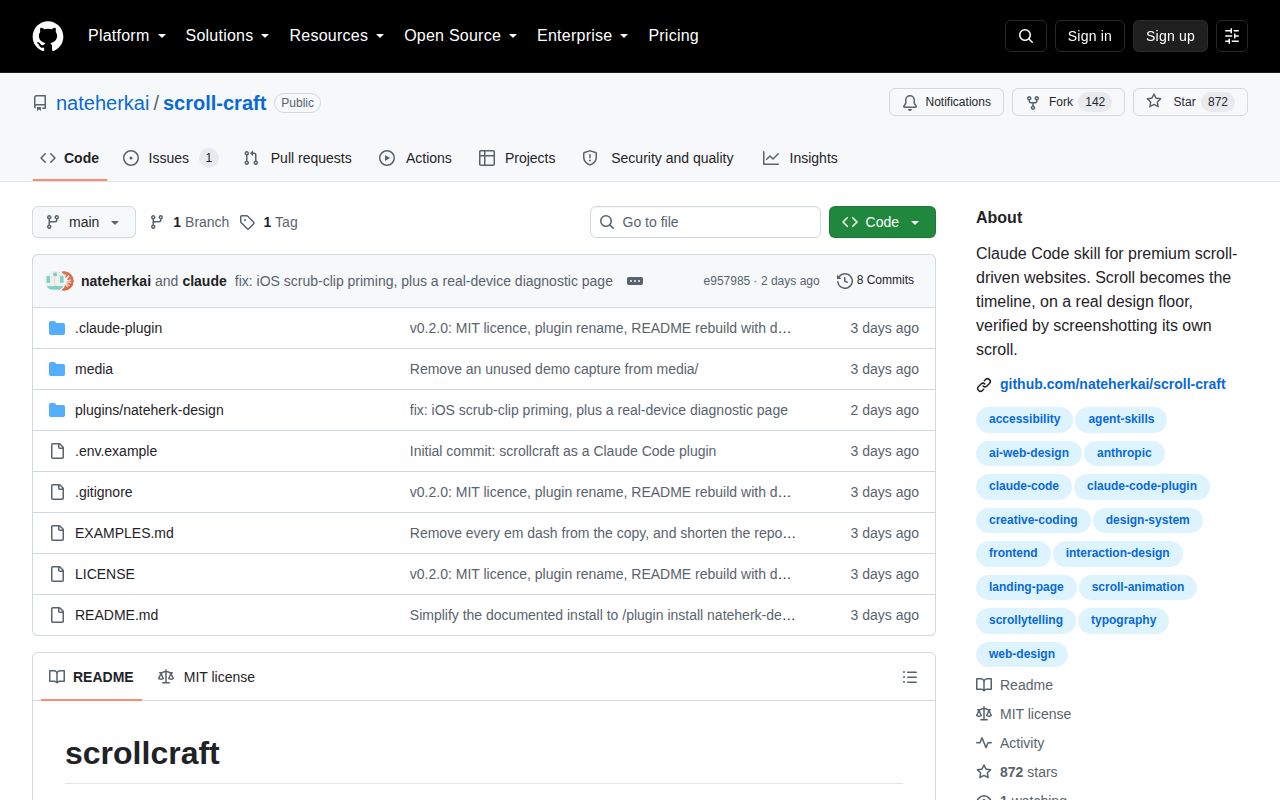
The lab classified the repository as having no supported executable ecosystem even though GitHub reports JavaScript, and it found no Dockerfile. There is no sandbox install, build, test, dependency, or audit result to quote. The repository does contain Node scripts and a browser verification workflow, but the harness did not recognize a supported project target from which to run them. That is a limitation of the available measurement, not proof that those scripts fail.
The README names Node 18 or newer, a full ffmpeg build, Chrome, and playwright-core as requirements. doctor.mjs checks the environment because stripped ffmpeg builds can lack filters or WebP support, and browser packages can resolve from the wrong folder. Our lab record does not confirm those checks on Debian. It only records JavaScript as the repository language, no supported ecosystem, and no Dockerfile.
Browser checks catch broken scrolling, not weak ideas
The verification pass walks the completed page across scroll positions and waits for media playheads to settle. It looks for scroll that changes nothing, cues that never become fully visible, text contrast against changing video frames, and clips that remain on a poster because decoding failed. It then writes a contact sheet. The README draws the right boundary: software can find mechanical defects, while a person must decide whether the page communicates anything worth remembering.
One open issue, filed on 2026-08-25, says data-sc-kinetic can be silently ignored when placed on a child of the cued element. That is exactly the sort of interaction bug a production review should probe. Generated markup can satisfy the broad design brief while attaching engine attributes to the wrong node. A visual pass, keyboard test, reduced-motion check, mobile check, and console review still belong after the skill's own verifier.
Windows is proven; macOS and Linux are search paths
The author says every completed build has run on Windows. Scripts search common ffmpeg and Chrome locations on Windows, macOS, and Linux, and environment variables can override both paths. Search code is useful, but it is not platform evidence. A Mac or Linux team should run doctor, build one example from local assets, verify video scrubbing, and inspect the contact sheet before committing a launch schedule.
Generated media adds another boundary. A continuous-world sequence with 10 legs can cost real money through the optional KIE AI integration. Using existing photography or footage needs no API key and is presented as a normal path. Teams should prefer owned assets when possible, then decide whether a signature moment justifies generation cost. The skill may allocate the budget, but it cannot approve licensing, likeness, or brand use.
A one-day-old project can still contain good process
The repository was created on 2026-08-22, last pushed on 2026-08-23, has no GitHub release, and showed 1 open issue. That is too little history to judge upgrade stability or cross-platform maintenance. It does not erase the quality of the written constraints. The changelog records failures and the rules added after them, which is more useful than a feature-only history for a design workflow.
scrollcraft is strongest as a demanding creative brief that can also generate code. Its 8 grammars, 4-of-6 uniqueness gate, fixed engine, and scroll verifier make repetition harder. The missing lab run and Windows-only build history keep it out of unattended production. Use it for a first draft with teeth, then make humans responsible for the final interaction, accessibility, media, and performance decisions.