mrkeyoor.com_
Thu 01 Oct 08:11 UTC
AI Toolsevaluationupdated 01 Oct 2026

RuiC-card-skill review

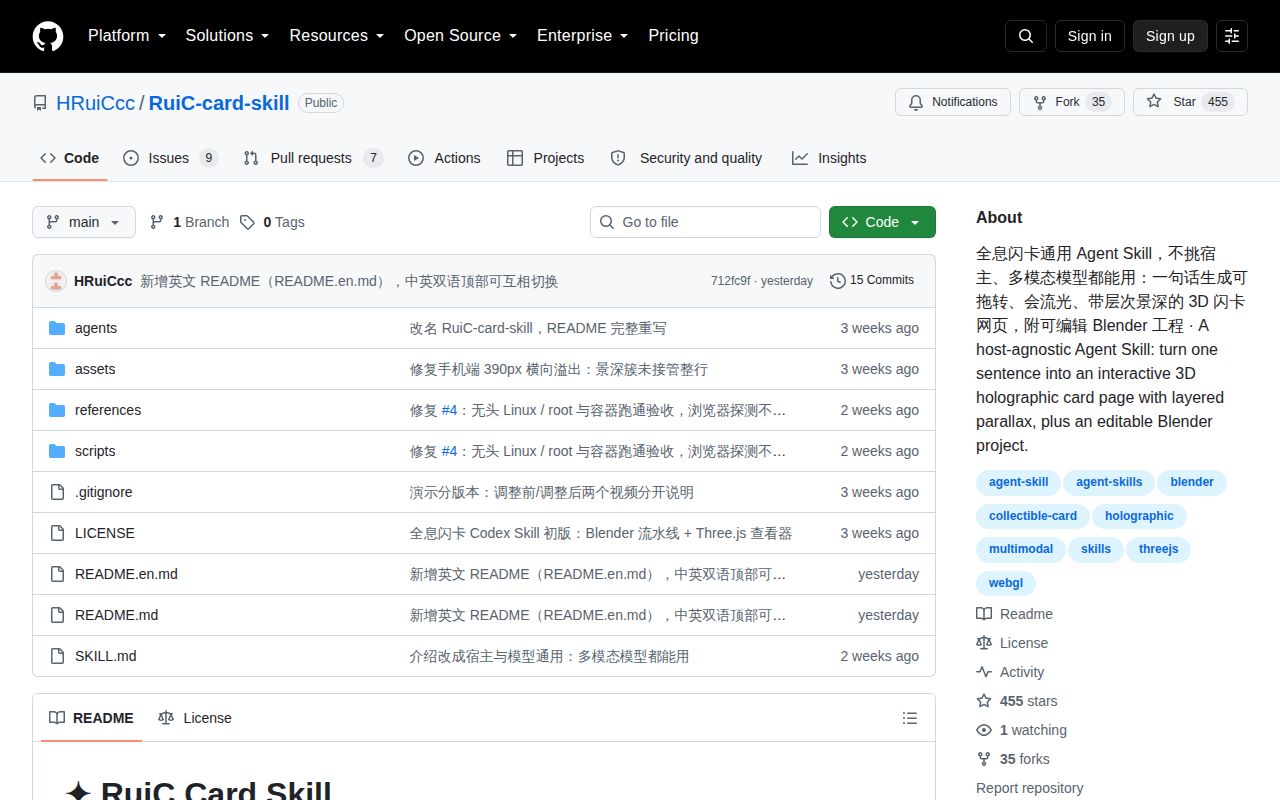
RuiC Card Skill's primary README is Chinese, and the repository also provides a full English README. It gives a multimodal coding agent a recipe and scripts for turning layered artwork into an interactive holographic card website, an editable Blender project, renders, and a browser verification report.

Verdict

Our RuiC Card Skill run installed 35 packages in 13 seconds and built in 3 seconds, but its real production path still depends on a multimodal agent, Blender, Chromium, and manual visual judgment. Try it for one-off collectible pages when editable 3D delivery matters. Hold it out of unattended batch work until issue 10's stale-artifact path is fixed and your own end-to-end card passes the browser verifier plus a human visual check.

We ran it

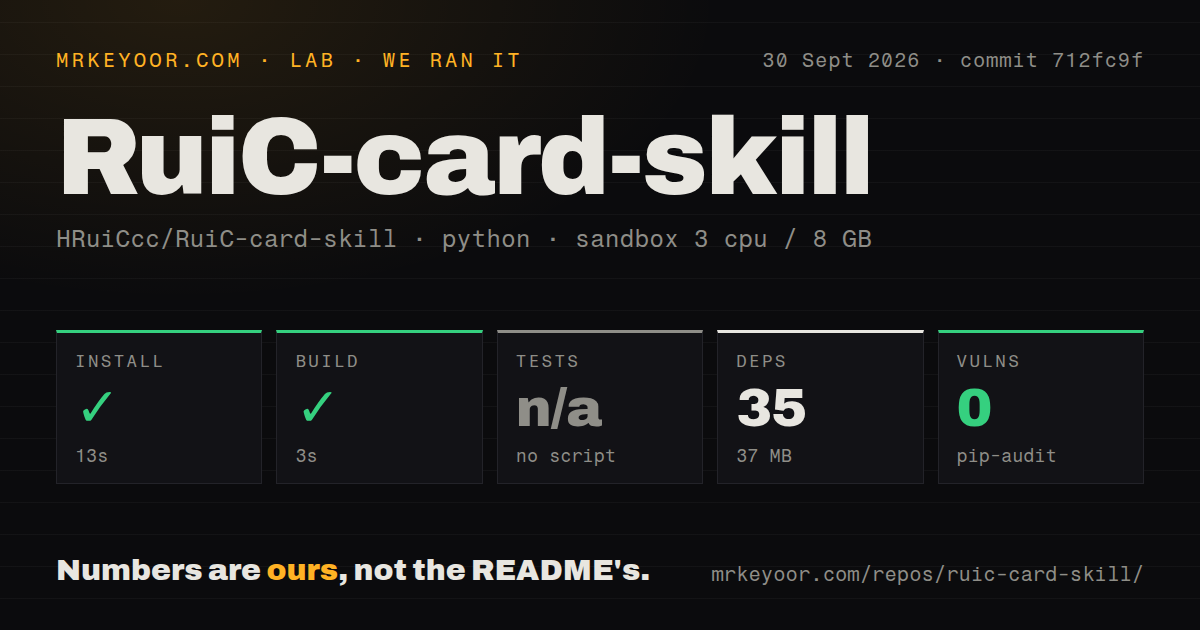
Lab card: what happened when we ran RuiC-card-skillScreenshot of RuiC-card-skill (github.com/HRuiCcc/RuiC-card-skill)
Install✓ · 13s35 packages · 37 MB
Build✓ · 3s
Testsn/ano test script
Known vulns0(pip-audit)
Repo34 files~34,806 lines of source · 5.7 MB · 0 CI workflows

Answers from our run

Does RuiC-card-skill build from source?

Dependencies installed in 13 seconds (35 packages), and the build succeeded in 3 seconds. We cloned commit 712fc9f into a clean Debian container with 3 CPUs and no project-specific setup.

Does RuiC-card-skill have tests you can run?

Not through a standard command: the project exposes no test script or target that our harness could run.

Does RuiC-card-skill have known vulnerabilities in its dependencies?

pip-audit found none in the dependency tree at the time of our run.

Who should not use RuiC-card-skill?

Text-only agents: the English README says the host must generate four artwork layers and inspect rendered frames.

What are the alternatives to RuiC-card-skill?

ComfyUI, React Three Fiber, Blender. Our RuiC Card Skill run installed 35 packages in 13 seconds and built in 3 seconds, but its real production path still depends on a multimodal agent, Blender, Chromium, and manual visual judgment.

Setup3/5Small base install, followed by Blender, browser, and image setup
Docs5/5Full Chinese and English guides with pipeline and verification detail
Community3/5455 stars and active reports, but seven open PRs await review
Maturity2/5No releases, and an open bug can pass stale build artifacts

Who it’s for

Agent users who can generate and inspect images, run local scripts, and review visual output themselves.
Designers who want the same layered card delivered as a Blender file and a draggable Three.js page.
Claude Code and other skill-capable agent users willing to keep Python, Node, Blender, and Chromium available.
Technical artists who want editable depth, foil, line-glow, and card-finish controls instead of one flattened image.

Who it’s NOT for

Text-only agents: the English README says the host must generate four artwork layers and inspect rendered frames.
Locked-down machines that cannot download or run Blender and Chromium: both are part of the documented production and verification path.
Repeat-build workflows that cannot tolerate stale output: open issue 10 shows run_pipeline.py can continue after a Blender script crash and export an older card.blend.
Users who need reliable automatic Blender bootstrap today: open issue 8 reproduces an HTTP 403 because the release-list request omits the downloader's User-Agent.
People expecting a broad template gallery or multi-card library: issue 2 asks for more templates, and the gallery proposed in issue 5 remains an open pull request.
Release-managed teams: the repository has no GitHub release despite active changes and 16 open issues and pull requests.

Setup reality

Our sandbox installed commit 712fc9f in 13 seconds, adding 35 packages and using 37 MB on disk. The build succeeded in 3 seconds. There was no test script or target, so tests were skipped; pip-audit found 0 known vulnerabilities.

Producing a card needs much more than the 37 MB install: Python 3.9 or newer with Pillow, Node and npm, a multimodal agent that can create and judge images, a Chromium-family browser, and Blender 4.5. The pipeline can download a project-local Blender build and verify its checksum.

The first Blender download needs network access, and a mirror is trusted to provide both the package and checksum. Open issues document a downloader 403, a false verification failure for missing optional layers, and stale artifacts after a Blender script crash.

Four 1,024 by 1,536 layers become one editable card

RuiC Card Skill starts with artwork rather than a finished flat image. Its normal canvas is 1,024 by 1,536 pixels, split into subject, background, line art, and typography, with an optional effects layer. The agent writes a card configuration, validates transparency and alignment, builds a Blender scene, exports glTF geometry, and assembles a Three.js viewer. The delivery includes the .blend file, source layers, renders, browser assets, and a verification folder.

Depth is the useful trick. The subject and background receive different parallax values while typography stays fixed to the card edge. Blender builds the editable version; the browser reconstructs the material in GLSL because glTF cannot carry Blender's custom node graph. That gives you two editable representations with similar behavior, though the skill correctly warns that they are not pixel-identical. Four finishes and browser sliders make the result more than a looping foil animation.

The 37 MB base install hides the heavy production tools

Our installed environment used 37 MB after adding 35 packages. A real card also needs Python 3.9 or newer with Pillow, Node and npm, a Chromium-family browser, and Blender 4.5. The skill can fetch an official portable Blender into each project and check its SHA-256 before execution. Generated images, Blender binaries, model exports, and renders sit outside the small repository footprint.

The model requirement is just as important as the software list. A host must generate transparent artwork layers, inspect frames, notice registration errors, and rerun failed work. The scripts do not call one named image API or carry a credential. That avoids vendor lock-in, but it also means output quality depends on the agent and image tool you pair with the skill. A text-only model cannot complete the documented workflow.

What happened when we ran it

Our fresh Debian sandbox installed commit 712fc9f in 13 seconds on 3 CPUs with 8 GB of RAM and no secrets. Installation succeeded with 35 packages and a 37 MB disk footprint. The build step completed successfully in 3 seconds. Pip-audit reported 0 known vulnerabilities in the installed Python dependency set.

The checkout held 34 files, about 34,806 lines of source, and occupied 5.7 MB. There was no test script or target, so the lab skipped tests. We found 0 CI workflow files, no Dockerfile, and no tests directory. The repository does include standalone regression scripts, but our measured command did not run them. Our result covers installation and build mechanics, not card generation, Blender download, rendering, or the 33-step browser verification described by the project.

One stale-artifact bug can turn a failed build green

Open issue 10 identifies the most consequential defect. Blender 4.5 background mode can print a script traceback yet return exit code 0. The current pipeline checks that card.blend exists, so a file left by an earlier successful build passes that condition. Export then continues from stale geometry, and the run can appear successful even though the requested card was never rebuilt.

That problem deserves a release gate because batch users may not notice a stale hero image. The issue proposes checking modification times for card.blend and the exported GLB. Until such a guard lands, use a clean output directory or record timestamps before each run, then confirm that every requested artifact changed. The verifier exercises browser behavior; it cannot prove that the browser contains the newest requested artwork if the pipeline fed it an old model.

Two open verifier defects complicate the green report

Issue 9 shows that absent optional layers can cap browser verification at 32 of 33 checks. The verifier counts a 1 by 1 placeholder texture alongside real layers, then reports mismatched canvas sizes. That is a false failure rather than a broken card. Issue 8 affects an earlier stage: Blender release discovery uses a bare Python request that the download host can reject with HTTP 403, even though the package downloader sets a User-Agent.

Both reports include narrow fixes, but they remained open on October 1, 2026. The repository had 9 open issues and 7 open pull requests, with no closed issue or pull-request history returned by the API. Recent activity is real: the last push was September 30, and several reports include controlled reproductions. The missing part is maintainer throughput. Detailed outside contributions only help users after they are reviewed or folded into main.

Host independence still requires an agent that can see

The repository provides a standard SKILL.md, plain Python scripts, and a Node verifier rather than a host-specific plugin binary. Its full English README also documents installation without tying the skill to one vendor directory. An issue reports a successful 33 of 33 run under a different agent harness on headless Linux after environment fixes. That is credible evidence of portability across skill-capable hosts.

Portability has a clear floor: the agent must make images, inspect images, run local programs, keep a server alive, and return to failed steps with judgment. Claude Code users with those tools can get an unusual editable artifact from one instruction. Unattended card factories should wait. With no tagged release and the stale-output path still present, the safe use is one card at a time, in a clean directory, followed by the automated report and an actual look at both tilt directions.

Alternatives

ProjectWhat it isPick it when
ComfyUI gh↗A node-based environment for repeatable image-generation workflows and custom model pipelines.pick this instead when controlled generation of the artwork matters more than delivering a 3D card viewer.
React Three Fiber gh↗A React renderer for building custom Three.js experiences inside web applications.pick this instead when the card must become one component in a larger React product.
Blender gh↗The full 3D authoring application that RuiC Card Skill automates through Python.pick this instead when an artist needs direct control over modeling, materials, lighting, and rendering.

What people are saying

  1. [velocity-scout] HRuiCcc/RuiC-card-skill

Sources

  1. RuiC Card Skill English README
  2. RuiC Card Skill instructions
  3. Issue 10: stale artifacts after a Blender script crash
  4. Issue 9: placeholder layers cause a verifier false failure
  5. Issue 8: Blender release discovery can return HTTP 403
  6. RuiC Card Skill repository metadata

More ai tools reviews

unigit-ecosystem · handraw-style · souchastnik · dlssg_for_sm86 · glm-flash-offline-client · cyber-resume-reviewer-skill · the whole board →