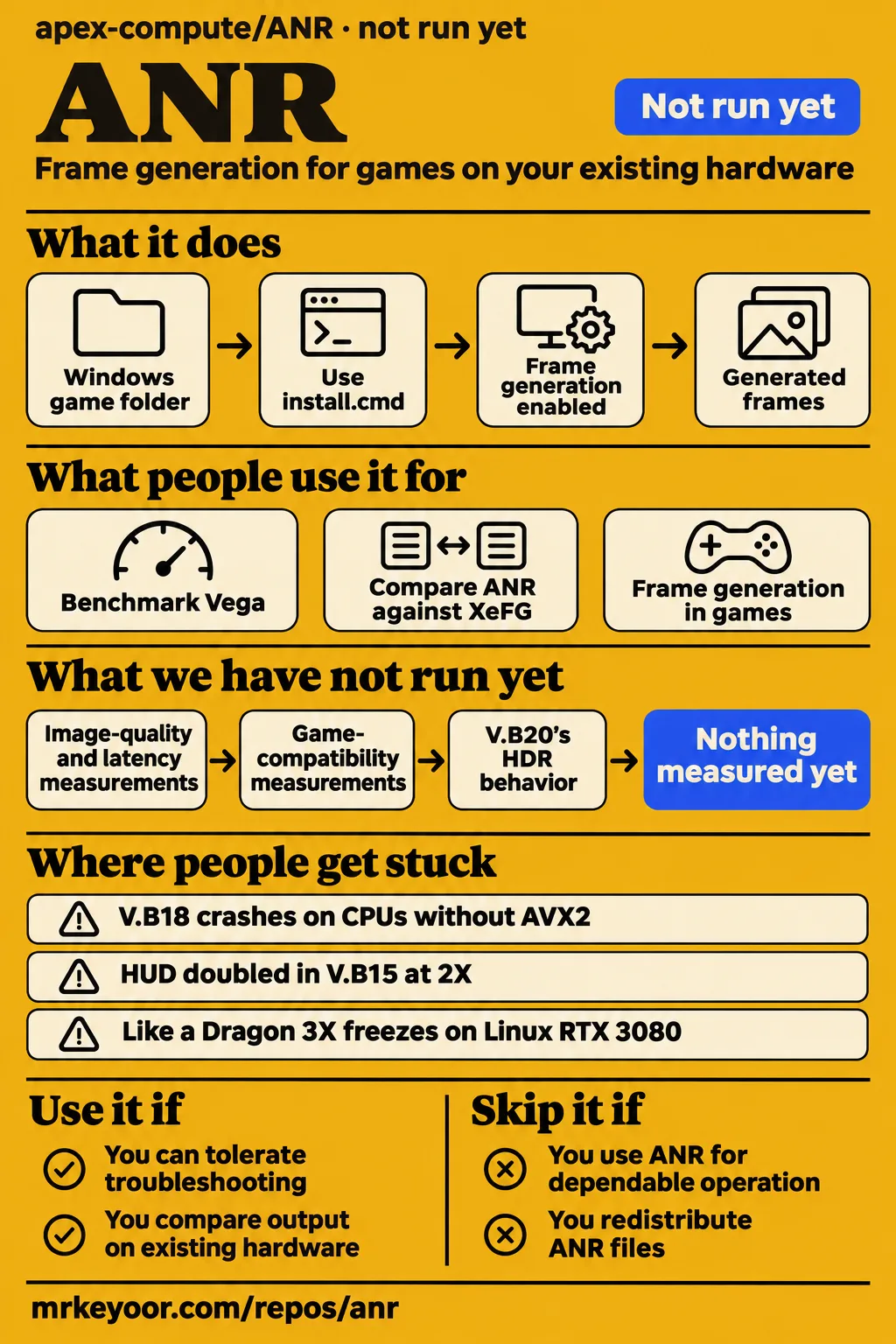
Short answer: try the beta only if you can tolerate game-specific failures
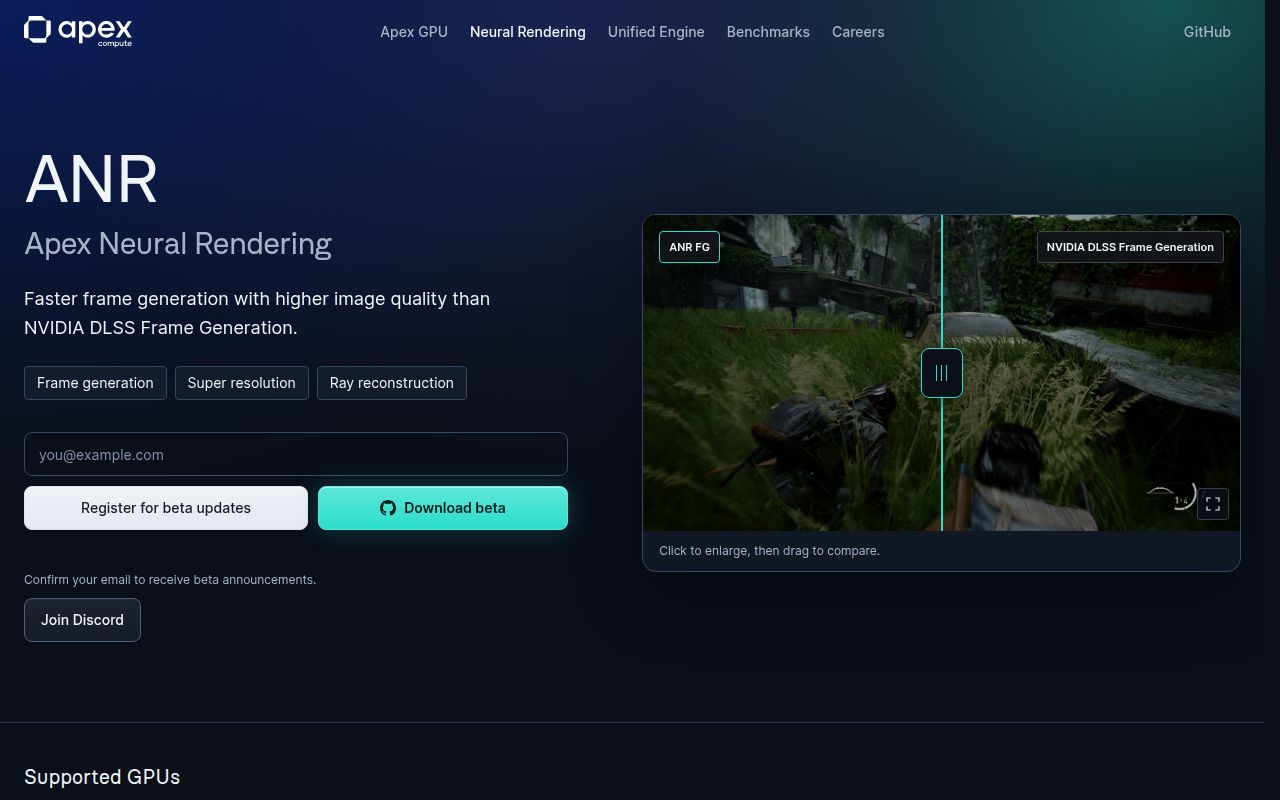
Try ANR for configuration-specific experimentation; skip it when dependable operation or permission to redistribute the runtime is a requirement. Apex Neural Rendering is Apex Compute's graphics project, and its README labels frame generation beta. The strongest reason to consider it is the opportunity to compare its output on your existing hardware. The strongest reasons to keep a working alternative are concrete reports of doubled interface elements, memory pressure and freezes at particular multipliers.
The decision changes with the game and package version. Sophia-Thickums returned with a Vega selector retest after a maintainer change, while G2309 returned with another 3X freeze after trying the suggested rendering path. Those follow-ups make this review a configuration guide rather than a winner announcement. A developer choosing a redistributable component faces a separate restriction: the ANR maintainer prohibits third-party redistribution pending the full release.
What people use ANR for
Users have reported ANR frame generation in Final Fantasy VII Rebirth, The Elder Scrolls Online and Like a Dragon: Infinite Wealth, as well as standalone Vega benchmarks. These uses answer different questions. A benchmark can compare execution paths against a reference image; a game session can expose interface artifacts or a freeze after sustained play. Keeping those outcomes separate makes the reported numbers useful without turning them into a general compatibility badge.
| Who tried it | What they did | What happened |
|---|---|---|
| Sophia-Thickums | Benchmarked Vega Frontier Edition and repeated a 4K 2X case on Instinct MI25 | The complete Vega kit recorded 112 runs, 0 failures, 34 unsupported cases and 27 passing parity cases. |
| Sophia-Thickums | Retested the Vega selector in V.B18 | Automatic selection returned portable; the 1080p 2X spot check used 64 frames. |
| The issue #11 reporter | Used V.B14 in Final Fantasy VII Rebirth at 4K on an RTX 3070 8 GB | About 13,000 generated frames had 0 generation errors, followed by VRAM pressure, severe slowdown and a crash. |
| Saros-12-42 | Used V.B15 at 2X in The Elder Scrolls Online through an OptiScaler fork | Scene motion was clean, but the HUD and open windows ghosted and doubled. |
| G2309 | Played Like a Dragon: Infinite Wealth on Linux with an RTX 3080 | V.B19 with packed still froze at 3X; several 2X sessions approached two hours without crashing. |
The Vega retest gives a particularly clear before-and-after account. The maintainer said V.B17 changed Linux Vega 10's default to portable. Sophia-Thickums then checked V.B18 on the same Vega Frontier Edition and reported the selector returning portable. The short retest recorded median frame times of 2.5385 ms for auto and 2.5207 ms for explicit portable, with both rows passing the reference-comparison bar. Those are the user's benchmark results, distinct from our lab attempt.
What happened when we ran it
Our November 21, 2026 run at commit 57a139a stopped before ANR executed because the sandbox had no supported C++ execution route and the checkout had no Dockerfile. The lab measurement records a configuration of 3 CPUs and 8 GB RAM, with no image specified. The November 22 records add a failed Compose safety step, a contradictory deployment summary and a successful teardown status.
| Question | Answer | Verdict | Why |
|---|---|---|---|
| Did the November 21 attempt execute ANR? | No; the harness recorded unsupported C++ and no Dockerfile. | Blocked before execution | The measurement records NOT RUN. |
| Did the November 22 safety step pass? | No; none of the four accepted Compose filenames existed. | Failed | A Compose file was required by that harness. |
| Does the November 22 summary document a successful deployment? | It says ANR was deployed with Docker Compose and ports bound to 127.0.0.1. | Contradictory record | That sentence conflicts with the failed Compose safety step. |
| What happened during teardown? | The teardown record says "ok". | Cleanup recorded | Teardown status describes cleanup. |
The failed safety step uses the phrase "unsafe repo" because the harness requires Compose. Its actual finding is the absence of compose.yaml, compose.yml, docker-compose.yaml and docker-compose.yml. The README describes installation into a game's executable folder, so the documented user workflow differs from the harness's deployment route. The contradiction between the failed step and the deployment summary is retained here rather than resolved by choosing the more favorable sentence.
Where people get stuck: HUD artifacts, CPU instructions and rendering paths
Issue #14 reports doubled interface elements in The Elder Scrolls Online with V.B15 at 2X, while issue #63 records a separate CPU-instruction problem addressed in V.B19. These are different failure classes. A clean moving scene can coexist with unreadable windows, and a GPU on the support list can coexist with an incompatible package build. The version, CPU, input route and rendering path belong beside the symptom.
| Problem and reporter | Maintainer response | Recorded outcome |
|---|---|---|
| Saros-12-42 reports HUD ghosting in The Elder Scrolls Online; #14 also concerns Witcher 3 HUD artifacts | Use Streamline inputs and HUDFix for now. | Interim workaround. |
| Issue #63 reports V.B18 crashes without AVX2, including 0xC000001D, and a missing find_dlssg.ps1 script | V.B19 packages and kits target x86-64-v2 and run without AVX2. | Maintainer-reported CPU compatibility fix. |
| BlockFrank reports 23 D3D12 execution failures and a separate packed parity miss on an RTX 4070 Laptop in #60 | The maintainer says V.B19 fixes auto fallback and attributes explicit linalg failures to driver 621.24. | Separate execution, fallback and parity findings. |
| The Final Fantasy VII Rebirth reporter describes accumulating native-bridge mirrors after resolution changes in #11 | The maintainer reports releasing a fix. | Mirror leak addressed in the maintainer's response. |
| A commenter reports Pragmata freezing in #28 | Open a separate issue with the nr_fg log. | Diagnostic information requested. |
BlockFrank's benchmark makes the execution-versus-output distinction explicit. With Developer Mode off, 196 cases produced 95 passes, 101 unsupported results and 0 failures. With it on, the same total produced 136 passes, 37 unsupported results and 23 failures. The execution failures comprised 15 linalg cases and 8 auto cases sharing compute-pipeline error 0x8007000E. Separately, a packed case returned an image below the parity bar. These are standalone kit results from issue #60, not game-session results.
Longer sessions expose problems a frame counter misses
G2309 reports that V.B19 with the packed path still froze at 3X in Like a Dragon: Infinite Wealth, while several 2X sessions approached two hours without crashing. One 3X failure happened about 30 seconds after changing from 2X; another happened after a few minutes from a 3X start. The logs ended with an approximately 517 ms frame spike and Xid 109 CTX SWITCH TIMEOUT remained the reported error.
The earlier account describes a full desktop freeze requiring a forced power-off. After restarting the game without rebooting, another freeze followed about 10 minutes later, with a 516.75 ms real-frame spike at the end of the log. G2309 also reported approximately 30 minutes of Cyberpunk 2077 without problems on the same machine. The useful distinction is the actual game and multiplier: the reporter's successful Cyberpunk session and Like a Dragon 2X sessions sit alongside the failing 3X attempts.
Final Fantasy VII Rebirth provides a different failure sequence. Its V.B14 reporter recorded approximately 1.5 ms of GPU time per generated frame while memory lasted, then approximately 350 ms per pair during the slowdown. Resolution changes recreated the frame-generation feature and accumulated mirror resources. The reporter also described the large model exceeding the RTX 3070's 8 GB budget at 4K without a resolution change. The memory report separates those two mechanisms.
Release packages are documented; the main source is still promised
The README labels ANR FG beta, ANR SR and ANR RR "Beta soon," and the main source code "coming soon." It separately identifies nr-record as source present in the repository. That distinction explains what a developer can study today: the published recording workflow captures game inputs and replays them through frame-generation DLLs, while nr-record itself includes no frame generation.
The documented package choice is anr-fg-full for games without OptiScaler and anr-fg-addon for games already using it. Windows uses install.cmd. Linux and Steam Deck use sh install.sh with the game's folder, followed by the launch override printed by the installer. The game then needs frame generation enabled, using the NVIDIA option where several choices appear. Removal uses uninstall.cmd or sh uninstall.sh with the same folder, according to the README.
FG-V.B20's release notes describe frame generation in HDR games with an FP16 scRGB backbuffer. They retain V.B19's Windows and Linux test kits, the V.B15 macOS kit and nr-record 1.2. The Windows installation note requires the Microsoft Visual C++ 2015-2022 Redistributable, x64. These V.B20 release details identify package contents and requirements without changing the versions attached to older issue reports.
Licensing limits redistribution, even while you can download the beta
Maintainer selimsandal says, "Until then we do not allow any third party redistribution," referring to the full release in issue #9. The licensing discussion therefore gives developers a concrete distribution restriction. Downloading a beta package and bundling its runtime or model files in another application are separate decisions, and the maintainer's response directly addresses the latter.
The README's GPL-3.0 statement applies to OptiScaler, whose source accompanies releases. V.B20 likewise names its OptiScaler source archive separately from the ANR full and addon packages. The release publishes SHA256SUMS.txt for the V.B20 files and a separate checksum file for nr-record 1.2. These names help identify the components and their accompanying files; they do not make the OptiScaler license a license for every component in the download.
Outdated claims, corrected
The r/pcmasterrace launch title calls ANR open source and claims image quality beating DLSS; the README instead says the main source is coming soon. The Reddit title is a launch claim, while the maintainer's redistribution restriction is an explicit licensing statement. The public capture-tool source and downloadable beta packages explain why readers may encounter code and binaries without an open-source ANR runtime license.
The quality claim also exceeds the game reports. In issue #28, the reporter describes ANR's HUD/UI behavior as worse than NVIDIA's, while issue #14 describes clean scenery with doubled interface elements. Apex Compute's November 11 announcement claims up to 2.4 times faster performance and says its super-resolution and ray-reconstruction models are still training. Those are the company's announcement claims, rather than results from our lab.
The launch's GPU list also needs CPU and version context. Issue #63 describes V.B18 failures on systems without AVX2, followed by the maintainer's statement that V.B19 packages and kits use x86-64-v2. A GPU family alone therefore leaves out a condition exposed by the older package. The correction is specific: retain the supported GPU list as upstream documentation and attach the V.B19 CPU-build change when discussing those crashes.
ANR vs DLSS, XeFG and the alternatives people search
The issue #2 reporter records 10 more fps with XeFG at 2X on an Intel Arc A770, while G2309 reports hang-free sessions with another mod in Like a Dragon. These comparisons answer practical questions about those configurations. They give readers an existing option to compare against ANR and preserve the difference between a numerical frame-rate report, an interface-quality opinion and a session-stability observation.
| Alternative | Reported comparison | When to prefer it |
|---|---|---|
| Intel XeFG | The Arc A770 reporter records 10 more fps at 2X with XeFG. | Keep XeFG as the baseline on that configuration. |
| NVIDIA frame generation | The #28 reporter describes ANR's HUD/UI behavior as worse. | Retain a working NVIDIA setup when interface readability decides the choice. |
| sdli1995's dlssg_for_sm86 | G2309 reports 30-minute and 2-hour-9-minute sessions without hangs in the same game, GPU and driver configuration. | Consider it for that reported Like a Dragon setup. |
| Intel FG through modified OptiScaler | Commenters in #13 disagree about ANR HUD behavior and Intel artifacts in Phantom Blade. | Compare the particular interface and scene artifacts described in your game. |
Chinese-language Bilibili listings include comparison titles about DLSS, XeSS, MFG unlockers and AMD solutions. The Bilibili search listing records titles and creators, including 平克顿Pinkerton, Akira452 and 游戏机工坊. That establishes the subject of those listings. The concrete comparison results used in the table come from the named issue reporters, with hardware, game or multiplier attached rather than a vendor-wide ranking.
FAQ
ANR means Apex Neural Rendering, Apex Compute's project whose README labels frame generation beta. That identity separates this review from unrelated uses of the abbreviation. The questions below follow the graphics and integration questions raised in the project's issue discussions and comparison listings. Their answers retain the package versions and named reporters because those details determine what each observation actually answers.
What does ANR stand for in this review?
ANR stands for Apex Neural Rendering, as the project README heading states. Apex Compute identifies three parts: frame generation, super resolution and ray reconstruction. The README labels the first beta and the other two "Beta soon." It also distinguishes the promised main source code from nr-record, whose capture and comparison source is already in the repository.
Does ANR frame generation actually beat DLSS and XeSS in games?
The Arc A770 comparison in issue #2 gives XeFG a 10 fps lead at 2X, and issue #28's reporter prefers NVIDIA's HUD/UI behavior. XeFG is the frame-generation alternative named in the numerical comparison; that result is not a XeSS upscaling measurement. The launch's broad superiority claim and these configuration-specific reports answer different questions.
How does ANR compare with MFG unlockers and AMD frame generation?
G2309 reports sessions of 30 minutes and 2 hours 9 minutes without hangs using sdli1995's mod in the same Like a Dragon configuration that froze with ANR 3X. That is the thread's direct stability comparison. Bilibili titles also name MFG unlockers and AMD solutions as comparison subjects; those listings supply the question rather than an AMD performance result.
Can I force MFG in games that do not expose a multiplier setting?
The maintainer recommends OverrideInterpolationCount under [DLSSG] in OptiScaler.ini, with 2 corresponding to 3X, 3 to 4X and values up to 5 corresponding to 6X. The reporter then says the change still does not work. Both parts of issue #13's exchange belong in the answer: a documented suggestion and the user's failed attempt to apply it.
Can ANR add a HUD shield to prevent HUD ghosting?
The maintainer's response in issue #14 is to use Streamline inputs and HUDFix for now. Saros-12-42's configuration used The Elder Scrolls Online, an RTX 3070 Laptop, V.B15 at 2X and an OptiScaler fork. The reported symptom was clean scene motion alongside ghosted and doubled HUD elements and open windows, so the workaround addresses an interface problem rather than a failure to generate frames.
Can ANR run in games that provide no motion vectors?
The Orchid maintainer asks whether ANR requires depth and motion vectors or can work from colour frames alone. The response in issue #9 addresses licensing. The README's separate nr-record workflow requires a D3D12 or Vulkan game with DLSS frame generation and the full package installed; those capture-tool requirements describe that workflow rather than an answer to the proposed colour-only integration.
What licenses cover ANR source code and model packs?
The maintainer says the license will accompany the full release and prohibits third-party redistribution until then. That is the explicit answer in issue #9. The README separately identifies OptiScaler as GPL-3.0 and says its source accompanies each release. Keeping the component names attached to these statements prevents OptiScaler's license from being assigned to ANR's runtime or model packs.
Will ANR offer a documented native Vulkan library for Linux and Windows?
Orchid's maintainer asks for a Vulkan library with an interface an application can call using its own images, and says nothing has been integrated. The maintainer's response promises a license with the full release. The question concerns an application integration interface, distinct from installing the current game packages or running the published capture and replay workflow.
May a third-party application let users download ANR themselves and load it at runtime?
Issue #9 proposes user-side downloading and runtime loading, while the response explicitly prohibits third-party redistribution pending the full release. Those are the proposal and response recorded in the licensing exchange. A project considering that design needs an answer about its actual distribution arrangement; the thread's express prohibition concerns redistribution of ANR files.
Can ANR packages and test kits run on CPUs without AVX2?
The maintainer says V.B19 packages and test kits target x86-64-v2 and run on CPUs without AVX2. The issue #63 response follows reports involving both a Windows kit and a Linux in-game package. This makes V.B19 the relevant version in the answer, rather than extending the older V.B18 crash report to every package or treating the GPU support list as a CPU specification.
Why does ANR 3X freeze Like a Dragon: Infinite Wealth on this Linux RTX 3080 setup?
The maintainer says the cause has not been found, and G2309 reports that the suggested V.B19 packed-path attempt still freezes at 3X with Xid 109. The follow-up also records several 2X sessions approaching two hours without a crash. Those outcomes preserve the useful split between multipliers while leaving the maintainer's diagnosis exactly where the thread puts it.
Why does ANR exhaust VRAM in Final Fantasy VII Rebirth at 4K on an 8 GB RTX 3070?
The issue #11 reporter identifies accumulating native-bridge mirrors after resolution changes and a separate 4K large-model workload exceeding the 8 GB budget. The maintainer reports releasing a fix. The original memory account distinguishes feature-recreation leakage from baseline memory pressure, so the response should be read alongside both reported mechanisms rather than reducing them to one generic VRAM error.
What we have not tested yet
Our lab produced no ANR image-quality, latency, game-compatibility, GPU-memory or long-session measurements. The November 21 image field supplies no runtime or operating-system version, and the November 22 deployment summary requires reconciliation with its failed safety step. No controlled comparison here supports an overall DLSS, XeFG or AMD ranking, and the Bilibili listings supply no measured video outcomes. Search volumes, ranks and demand are unknown.
Independent post-fix checks are absent for the CPU, mirror-leak and D3D12 auto-fallback changes. The missing find_dlssg.ps1 script, explicit linalg failures, packed parity miss, baseline Final Fantasy memory pressure and general HUD repair have no separate confirmed resolutions in the issue extracts. V.B20's HDR behavior is documented rather than reproduced. Security, anti-cheat compatibility and dependable operation across the upstream GPU list also fall outside our measurements.
The integration evidence leaves the colour-only input question, a documented native Vulkan interface and authorization for the proposed user-download runtime-loading arrangement unanswered. No completed Orchid integration is recorded. For an enthusiast, the useful next step is a comparison in one game using a recorded package version, hardware configuration, path and multiplier. For a developer whose distribution depends on ANR files, the next step is a licensing answer covering that exact arrangement.