Blender is a 3.8-million-line C++ application
Blender combines modeling, rigging, animation, simulation, rendering, compositing, motion tracking, and video editing in one GPL-licensed desktop application. Our checkout contained 20,516 files and about 3,818,884 source lines. That scale explains why the repository is useful to engine developers and a poor starting point for an artist who only needs the program. Official downloads avoid the compiler, libraries, generated files, and test infrastructure that source contributors must understand.
The GitHub page is a mirror rather than Blender's development home. Its short README points users to the reference manual and community, then routes builders to the developer handbook and contributors to projects.blender.org for code review and bugs. GitHub issues are disabled. A developer who files a pull request or judges health only through this mirror will miss the workflow where Blender's maintainers work.
The 305 MB mirror needs Git LFS care
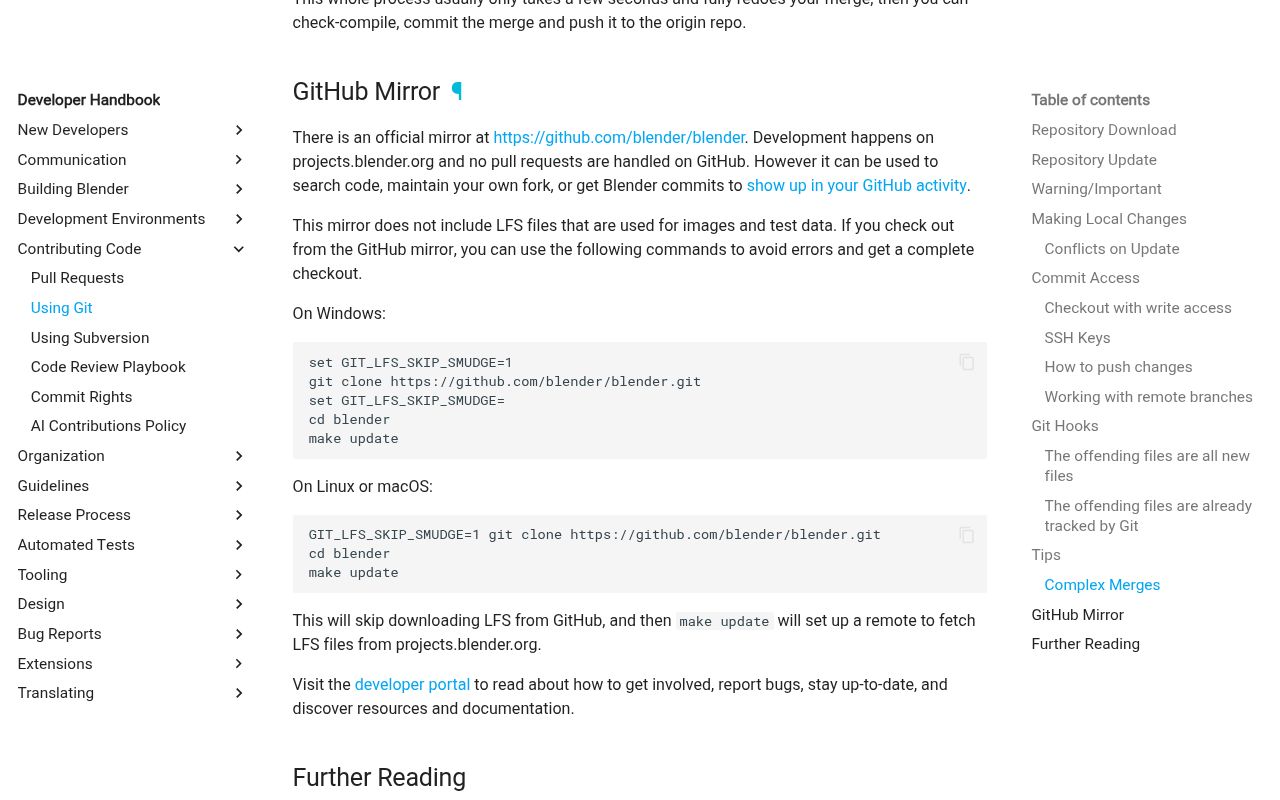
The measured checkout occupied 305 MB before any successful build output. Blender's README warns that cloning this GitHub mirror can cause Git LFS errors and recommends setting GIT_LFS_SKIP_SMUDGE=1 for the initial clone. The Linux build handbook also expects Python 3, Git, Git LFS, CMake, a C and C++ compiler, and libraries. Its preferred route uses make update to obtain precompiled libraries before compiling the application.
This is a normal burden for a cross-platform media application, but it is far beyond pip install. The handbook describes system packages, precompiled libraries, building dependencies from source, and manual CMake configuration as distinct paths. It warns that building all libraries from source is mainly for platform maintainers and may require solving CMake problems. Teams should choose the supported dependency route for their operating system before diagnosing the project itself.
What happened when we ran it
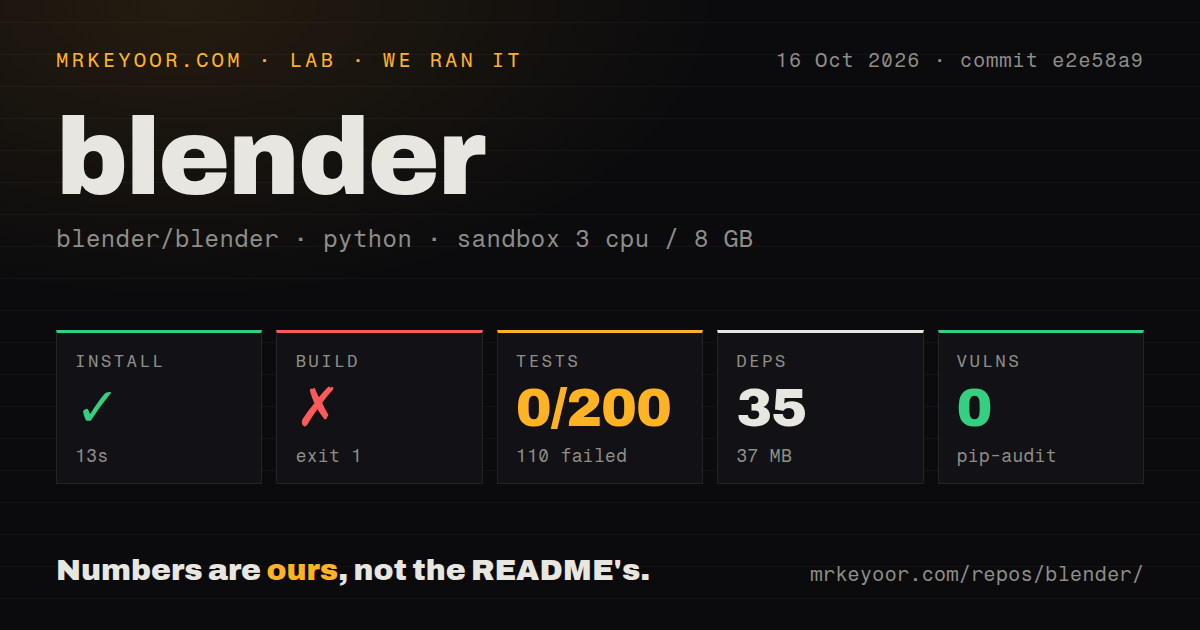
Our sandbox install step finished in 22 seconds, installing 35 Python packages that used 37 MB. The build then failed with exit code 1 after 8 seconds. The supplied measurement does not include the final build-log lines, so there is no evidence for naming a missing system package or another specific build cause. The result is simply that commit 88082a4 did not produce a Blender build in the fresh Python 3.12 Bookworm container.
Pytest exited with code 1 after 12 seconds. It reported 0 passed, 122 failed, 9 skipped, and 78 collection or setup errors of 200. The displayed failures all end with ModuleNotFoundError: No module named 'bpy', including view-layer collection tests. Pip-audit found 0 known vulnerabilities in the 35 installed Python packages. Those audit results cover that installed Python environment, not Blender's entire C and C++ dependency set.
The run used 3 CPUs and 8 GB of RAM in an unprivileged container with no secrets. Our scan found a tests directory, no Dockerfile, and 0 GitHub CI workflow files in the mirror checkout. None of those signals changes the direct outcome: the build failed, and the subsequent Python test command lacked the module its Blender-specific tests import.
Blender tests expect a compiled application and bpy
Blender's handbook says its Python and GTest suites run through CMake, both on developer machines and the project buildbot. The repository's make test target calls make_test.py with the configured build directory, and the Makefile defines the Blender binary inside that directory. Our plain pytest route never reached that state because the 8-second build had already failed and Python could not import bpy.
That context prevents a bad conclusion. The 122 failures do not show 122 broken modeling or rendering behaviors; they show test cases unable to start in the measured environment. They remain a useful setup finding because a generic Python image can appear ready after installing 35 packages, then fail every test that crosses into Blender's embedded API. Contributors should first complete the documented build, then use the project test target against that exact binary.
Development activity lives on Blender's Forgejo tracker
GitHub recorded the mirror's last push on September 10, 2026, with 20,221 stars and 0 open issues or pull requests. The zero is expected because GitHub issues are disabled. Blender's official tracker showed new and updated reports on September 9 and 10 covering Grease Pencil layers, the viewport, Geometry Nodes, the sequencer, Vulkan color management, FBX export, and crashes. Same-day pushes and tracker traffic show active development despite the empty GitHub issue count.
GitHub also returned no latest release for the mirror. That is not evidence of an abandoned product because the README sends users to blender.org and developers to Blender's own infrastructure. Release decisions should come from the official download and release pages, while repository health should be judged through mirror pushes plus Forgejo activity. The distinction matters more here than it does for projects whose entire release and support process lives on GitHub.
GPL v3 and product scope decide the fit
Blender as a whole uses GPL v3, while individual files may use different compatible licenses. Organizations modifying and distributing it need to evaluate those obligations before treating the source as a private proprietary base. Add-on authors and studios can still gain plenty from reading the code and bpy tests, but licensing and integration choices deserve their own review rather than assumptions based on the word open source.
Bforartists is the closest option when the objection is Blender's interface because it is a Blender fork. FreeCAD fits parametric engineering models, Godot fits interactive games, and Natron narrows the job to node-based compositing. None replaces Blender across all 8 pipeline areas named in its README. That breadth is exactly why the finished binary is attractive and why building the source demands a serious CMake and dependency setup.