Python authors the app, while React still runs the page
Reflex lets a developer declare components, state, and event handlers in Python. During development it compiles the interface into a React application and runs the backend with FastAPI. Browser events travel to Python over a WebSocket, state changes are calculated on the server, and updates return to the page. The result feels like one Python project in source control, even though deployment still contains two runtimes.
That architecture sits between dashboard libraries and a hand-built frontend plus API. A data team can create pages, forms, themes, responsive layouts, and event-driven workflows without learning a second application language first. Reflex also allows React components to be wrapped when its component catalog does not cover a need. At that point, the JavaScript boundary becomes visible again, which is fair but worth budgeting for.
Server-held state makes Python easy and scaling concrete
Application state lives in Python classes, and event handlers are the route for changing it. Because handlers run on the server, they can call normal Python packages and private services without moving secrets into browser code. The frontend reflects serialized state instead of running the business logic itself. This model is approachable for backend developers and works well for forms, internal systems, and AI interfaces.
Every interaction that needs a handler also depends on the connection to the backend. Reflex uses a client token for each browser tab and queues events before the server applies them. The architecture guide says the default state manager can be an in-memory dictionary, while production uses Redis. Multiple workers, reconnects, proxy timeouts, and background events therefore deserve the same attention they would receive in any WebSocket application.
Pure Python does not mean every web concern disappears
The generated frontend is a single-page React app, and Reflex components often wrap existing React libraries. CSS remains the styling language, exposed through Python keyword arguments. Teams still need to understand browser layout, responsive behavior, forms, focus, accessibility, and network failures. The framework changes where those concerns are expressed; it does not remove them.
Current issue reports show the edges. Issue 6923 says state variables used for dynamic page titles and descriptions raise VarTypeError, including on version 0.9.8 source. Issue 6882 reports that a clipboard action worked on desktop but failed in Chrome and Firefox on Android 16. These are specific cases, but both affect features that are easy to miss if testing stays on one desktop browser.
What happened when we ran it
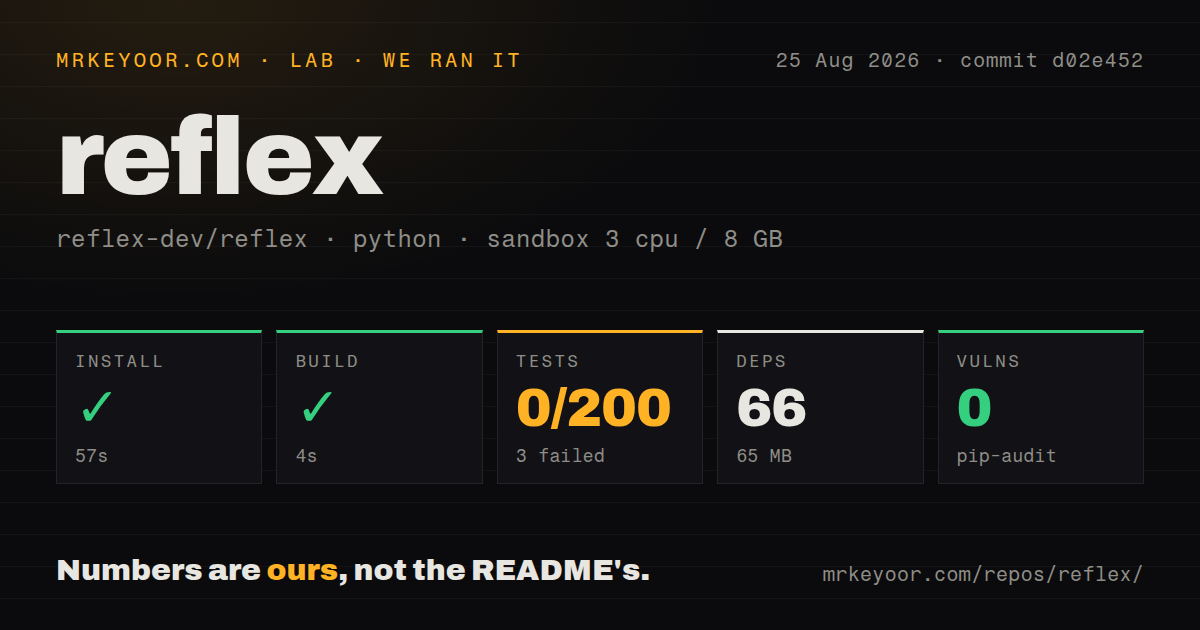
Our sandbox cloned commit d02e452 into an unprivileged Debian container with 3 CPUs, 8 GB of RAM, no secrets, and Python 3.12. The checkout contained 1,704 files, about 227,808 lines of source, and occupied 18.7 MB. It included 19 CI workflow files and a tests directory, with no Dockerfile at the root.
Installation succeeded in 57 seconds. It added 66 packages and used 65 MB on disk. The build finished in 4 seconds, and pip-audit reported 0 known vulnerabilities. Those results make the source package look manageable for its scope and show that compilation itself did not require credentials or an external service in our container.
The test command failed after 5 seconds. Pytest reported 0 passes, 3 failures, and 197 collection or setup errors out of 200 before stopping. The visible failures and errors all said Python could not find reflex_docs, including breadcrumb tests and parameterized documentation generation cases. The log identifies a missing module; it does not show whether application runtime tests would pass once the documentation package is available.
The hosted path is optional, but deployment still has parts
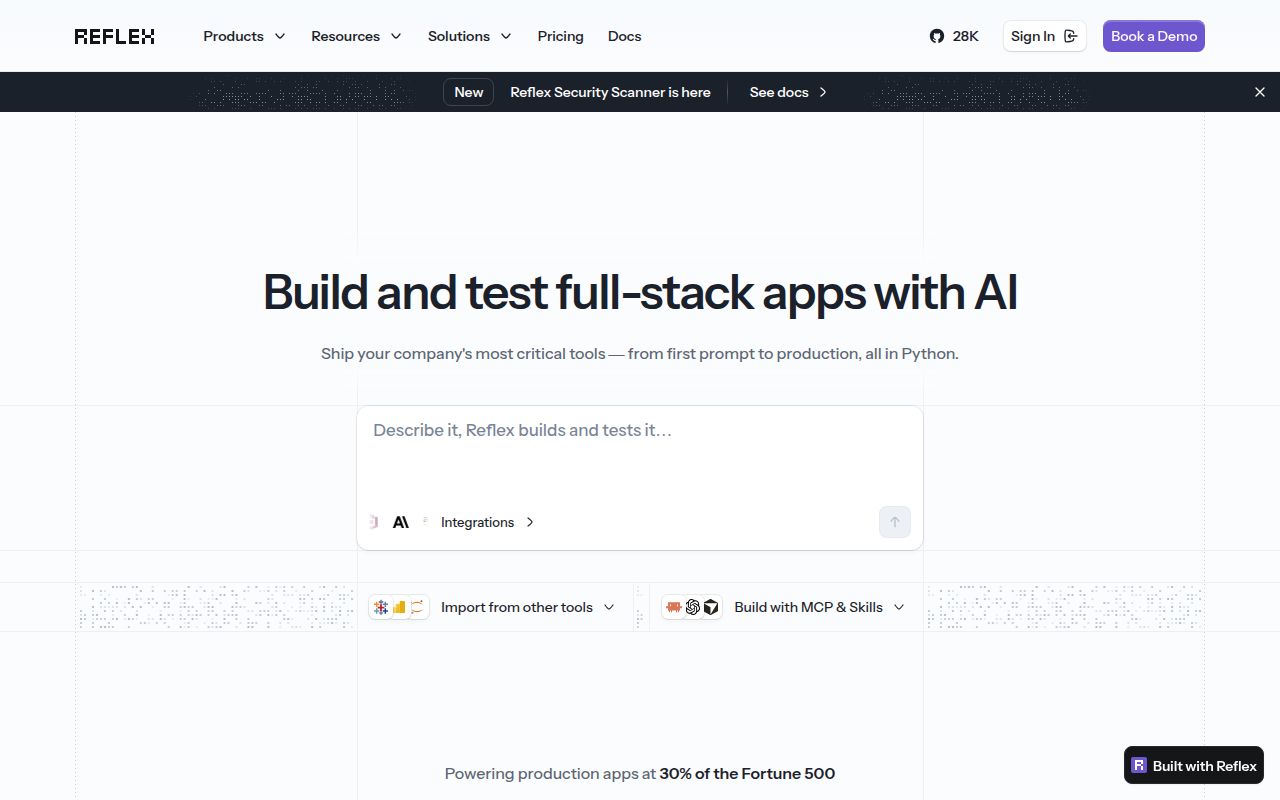
The README's first app uses uv add reflex, reflex init, and reflex run, then serves the page at port 3000. That is a short local path. The example image application adds an OpenAI client and therefore needs provider credentials, but a plain Reflex app does not. Reflex also promotes its own hosting and deployment commands, including Google Cloud controls added in release v0.9.8.post1.
Self-managed production means serving the frontend, running FastAPI, preserving WebSocket connections, and choosing persistent or shared state. Reflex hosting can take on some of that work, while bringing account and platform choices. Teams should decide whether the appeal is the Python programming model or the hosted service, since the open-source framework can be judged independently of the vendor deployment path.
August activity is high, with 338 issues and PRs open
The repository was pushed on August 25, 2026, the same date as our measured commit. GitHub listed 338 open issues and pull requests combined. Release v0.9.8.post1 arrived August 18 with Google Cloud deployment controls, while active pull requests covered state updates, client state, React DevTools labels, and event handling. The project is plainly maintained, and its state machinery is still receiving substantial work.
Reflex is a sound candidate for Python teams that have outgrown a notebook-style interface and want a product-shaped web app. Streamlit or Gradio will usually get a dashboard or model demo online with fewer architectural decisions. A React frontend plus a Python API remains the safer fit when the interface team needs direct browser control and the backend must scale on its own schedule.