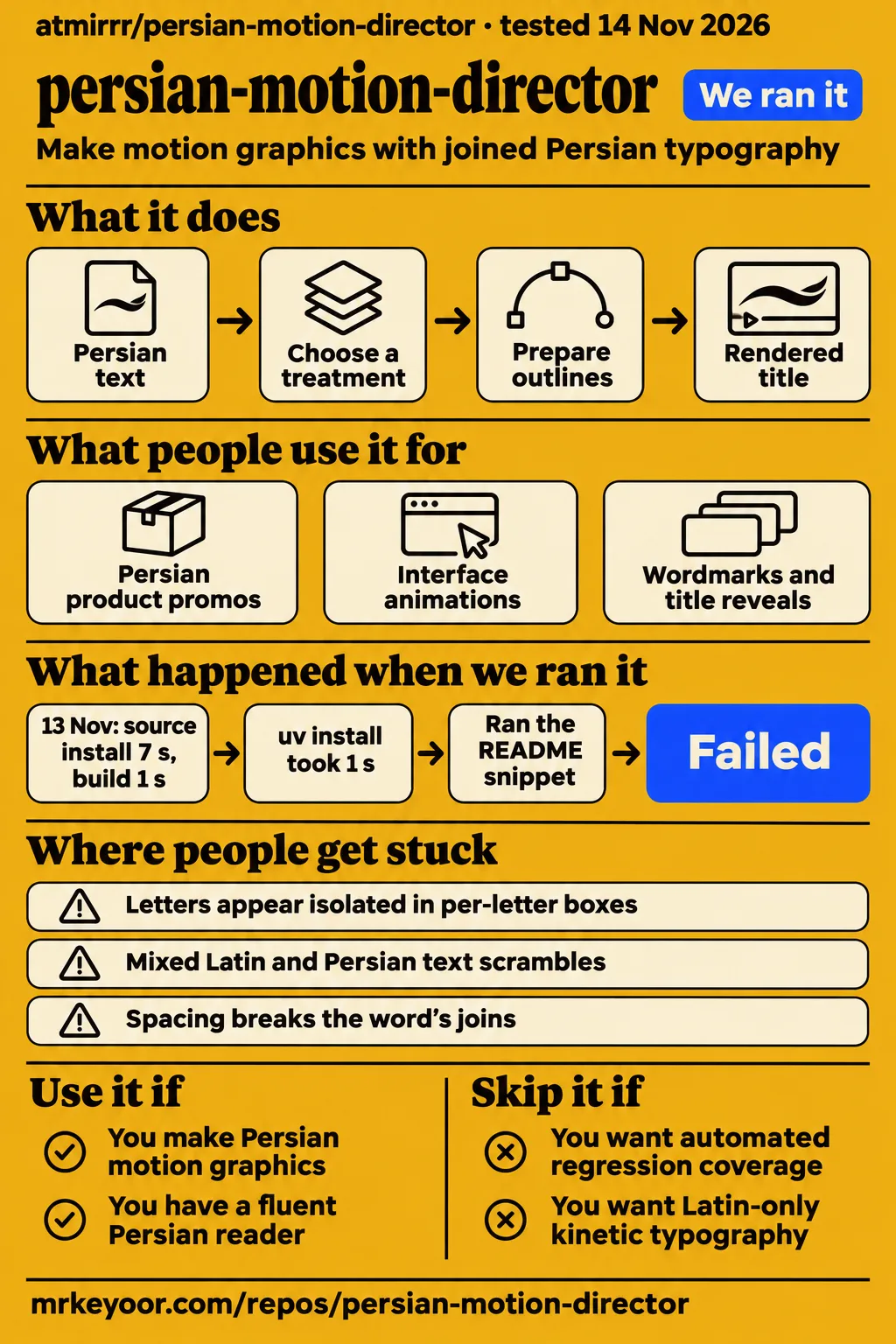
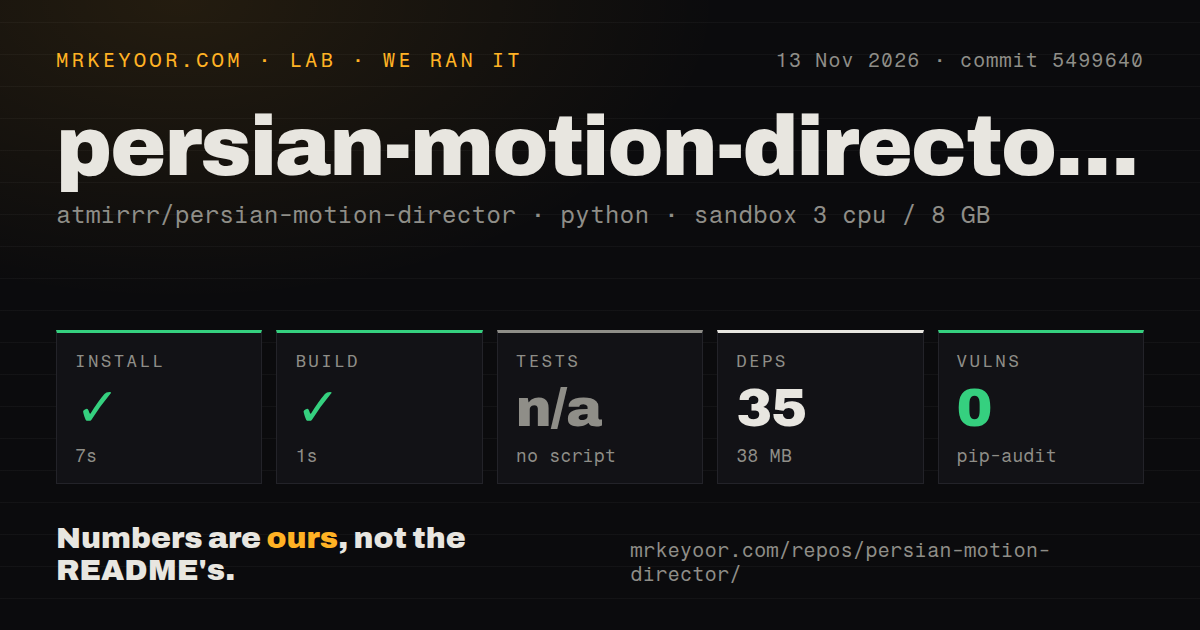
Our sandbox installed persian-motion-director in 7 seconds and completed its harness build step in 1 second. The repository packages a Claude Code motion-design workflow, Persian shaping utilities and examples for a browser or Remotion. Its useful distinction is the choice of representation: animate a whole word, a joined group or shaped outlines according to the effect the brief needs.
Start with that choice before designing the reveal. A product interface, a wordmark whose dots arrive separately and a Nastaliq title ask different things of the typography. The documentation gives developers concrete options to discuss with a designer and a fluent Persian reader. For Claude Code developers making Persian motion graphics, the next useful step is to choose one treatment and review a rendered title in the intended font.
What people use persian-motion-director for
Varg credits project author atmirrr with a seven-second Persian product-promo loop demonstrating the repository's 'One camera, no cuts' technique. The Varg author-demo description describes correctly shaped Farsi text, scenes moving right to left along one strip, whip pans and parallax. In this treatment, a moving camera connects the scenes. It gives a developer and designer a specific visual direction to discuss before building a longer product film.
The README's directed-interface technique presents an RTL interface in 3D with a cursor on arcs and a focus pull. That is a useful starting point for a brief centered on showing an interface. The design decision is which interaction deserves attention and how the camera directs the viewer toward it. The supplied technique describes a treatment a developer can inspect alongside the actual product interface.
For wordmarks and title reveals, the README's dots-last and paper-cutout techniques separate two approaches. 'Dots last' introduces letter bodies before their dots. 'Paper cut-out letters' treats each joined group as a rigid piece. Choose between them according to what needs to move: dots can carry the reveal, while joined groups can move as physical pieces. Both choices begin with the relationships between the Persian letterforms.
What happened when we ran it
Our November 13, 2026 run at commit 5499640 completed installation in 7 seconds and the harness build step in 1 second. We measured these figures in a sandbox configured with 3 CPUs, 8 GB RAM and image label ghcr.io/astral-sh/uv:python3.12-bookworm. The repository scan recorded 60 files, about 2,735 source lines and 9.6 MB checked out. The table keeps each setup result attached to the check that produced it.
| Recorded check | Result | Meaning for the reader |
|---|---|---|
| Install | Succeeded in 7 seconds | Dependency setup completed in the recorded environment |
| Build | Succeeded in 1 second | The harness build step completed |
| Tests | Skipped: no tests script or target | The harness recorded a skipped test step |
| Dependency record | 35 dependencies, 38 MB on disk | Installed footprint for this harness setup |
| pip-audit | 0 known vulnerabilities | Recorded dependency-audit result |
| Repository scan | 60 files, about 2,735 source lines, 9.6 MB checked out | Recorded repository size |
| Automation signals | 0 CI workflow files, no Dockerfile, no tests directory | Files absent from the scan |
The November 14 quickstart run used commit 5499640d2dfe in a fresh, unprivileged container with the same image label, 2 CPUs, 4 GB RAM, no published ports and no secrets. Its recipe was quickstart-lib. The clone step took 2 seconds. The install step ran uv pip install uharfbuzz fonttools in a fresh virtual environment and recorded uharfbuzz 0.57.0 installed in 1 second.
That quickstart recorded 28.0 MB in the virtual environment's site-packages and 1 package besides uharfbuzz installed. The quickstart's snippet step failed because the README had no Python code block to run. The failed snippet step and no-snippet finding record that obstacle; teardown completed successfully. These figures belong to the November 14 virtual environment, separately from the November 13 harness footprint.
The README places its Python invocations in shell-command blocks. It documents linting copy, linting code and shaping a Persian string with the bundled font. The quickstart recipe searched for a Python code block and stopped at that step. For the next task, use the README's component-specific route: skill discovery, browser sketches, shaping tools or Remotion compositions. Each route addresses a different part of preparing the animation.
Where people get stuck: choose the text representation first
The instructions reproduced by SkillsLLM recommend animating whole Persian words or lines, with shaped outlines or joiner splitting for finer movement. This choice affects the reveal before timing or easing enters the discussion. A title that moves as one unit asks for a different representation from a wordmark whose dots arrive separately. The table connects documented symptoms to the corresponding treatment and a concrete design decision.
| Symptom or requirement | Documented response | Editorial advice |
|---|---|---|
| Letters appear isolated after splitting text into boxes | Animate words or lines together | Start with an intact text unit for readable titles |
| Individual letters or dots must move | Use HarfBuzz-shaped outlines, or the joiner splitter where suitable | Choose the representation before designing the reveal |
| Nastaliq loses its cascading arrangement with joiner splitting | Animate by word or line | Approve that treatment at storyboard stage |
| Dots or tall letterforms are clipped | Pad masks and inspect the full-size frame | Review the actual display font |
| Mixed Latin and Persian text scrambles | Set direction and language and isolate Latin runs | Review names and numbers within the complete line |
| Spacing breaks the word's joins | Use kashida where the script permits | Choose an emphasis treatment that preserves joins |
The table follows the project instructions reproduced by SkillsLLM and Varg's typography guidance. The reproduced instructions describe isolated forms arising from per-letter boxes and transforms, then recommend whole words or lines. They also prescribe mask padding, direction attributes and isolation of Latin names and numbers. Those are specific checks to bring into a review of the complete frame.
Varg recommends animating Nastaliq by word or line because the joiner splitter loses its cascade. That changes the storyboard: approve an intact calligraphic word moving into place before specifying individual letters arriving separately. For finer movement in other treatments, the README describes a HarfBuzz tool that exports SVG outlines split into letter bodies, dots and joined groups. The documented workflow shapes the text before using its geometry as animation material.
English instructions cover a Persian typography workflow
The README contains English installation instructions, component commands and a Persian summary, while its linter checks named Persian copy and code patterns. The README's tool inventory lists Arabic character substitutions, digits, half-spaces, punctuation and kashida, alongside code checks for letter boxes, letter-spacing and fades. An English-speaking developer can use these checks to prepare material for a fluent Persian reader's approval.
Give that reader the complete frame, including product names, numbers and line breaks. This is our practical recommendation because the documented problems concern both words and arrangement. Copy can contain the intended characters while a mask clips the dots or a direction choice rearranges a mixed-language line. Reviewing the rendered composition connects the linter's named checks to the actual material the audience will see.
The documented direction rules start reveals and staggers on the right and send camera progress left. They also distinguish Latin runs and numbers within Persian text. An English-led team can discuss those named decisions with a designer rather than apply a blanket instruction to mirror the frame. The reproduced instructions explicitly say that play buttons, clocks and numbers are never mirrored, making the reading order a decision about each element.
Browser sketches and Remotion are separate entry points
The README provides a browser gallery under assets/sketches and a Remotion project under assets/remotion, alongside Claude Code skill installation. For skill discovery, the documented personal-skill installation clones the repository into ~/.claude/skills/persian-motion-director. The README also allows a project's .claude/skills/ folder. Choose this route when the immediate task is giving Claude access to the instructions, then select the component needed for the creative work.
The browser and rendering instructions serve the sketches directory and open gallery.html, then separately describe Remotion studio and clip-rendering scripts. Python's uharfbuzz and fonttools support the shaping utility. Use the gallery to discuss direction, the shaping utility to prepare outlines, or the Remotion project to inspect the supplied compositions. These are distinct entry points within the same repository, so the next command depends on the task.
The README labels the code MIT and the bundled Vazirmatn font SIL Open Font License. Remotion's own README says a company license is required in some cases. Keep those terms attached to their respective components when planning commercial work. Choosing the repository's instructions, a bundled font and a rendering framework involves several source statements, each describing a different part of the finished project's materials.
Security checks recorded a dependency-audit result
Our pip-audit run reported 0 known vulnerabilities across the recorded setup. SkillsLLM separately displays an automated security scan and a third-party software notice. Its notice and scan description identify the site as an informational directory that does not control or maintain the underlying repository. The page also asks readers to review source code, permissions, dependencies and configuration before installing or running a third-party skill.
For an evaluation, inspect the shaping and rendering commands before giving a coding assistant access to a working copy. Keep review of generated code alongside review of rendered typography, since the workflow involves scripts as well as creative instructions. Decide which project files and commands the assistant needs for the selected task. The final section sets out the scope of the audit result and the remaining security and rendering questions.
persian-motion-director vs kinetic-typography, Remotion and ManimGL
Choose persian-motion-director for Persian typography guidance; investigate Varg's kinetic-typography recommendation for Latin-only briefs. Use Remotion directly when you want to implement the video and typography rules yourself, and choose ManimGL when mathematical explanation is the central task. These choices answer different briefs. The comparison below uses the projects' descriptions and Varg's recommendation to help select the next component to inspect.
| Choice | Supported distinction | Pick it when |
|---|---|---|
| persian-motion-director | Persian typography instructions, shaping utilities and browser/Remotion examples | Your motion brief contains joined Persian text |
| kinetic-typography | Varg recommends it for Latin-only kinetic type | Your brief is Latin-only and you want to investigate that recommendation |
| Remotion | Programmatic video creation with web technology | You want to implement the video and typography rules yourself |
| ManimGL | Precise programmatic animation designed for explanatory math videos | Explaining mathematics is the central task |
The kinetic-typography row follows Varg's Latin-only recommendation. The Remotion row follows Remotion's README, which describes owning video as code through web technology. Remotion is also the rendering path used by this skill's examples. Choosing the framework directly means taking on the direction and typography decisions that persian-motion-director packages into instructions and supporting tools.
ManimGL's README identifies explanatory math videos as its intended task and distinguishes 3b1b/manim from Manim Community Edition. That identity matters when following installation instructions. The comparison is most useful at the level of the brief: Persian motion typography, general video implementation or mathematical explanation. Once that decision is clear, inspect the relevant project's installation route and examples rather than combining instructions from different projects.
Repository attention and ratings answer different questions
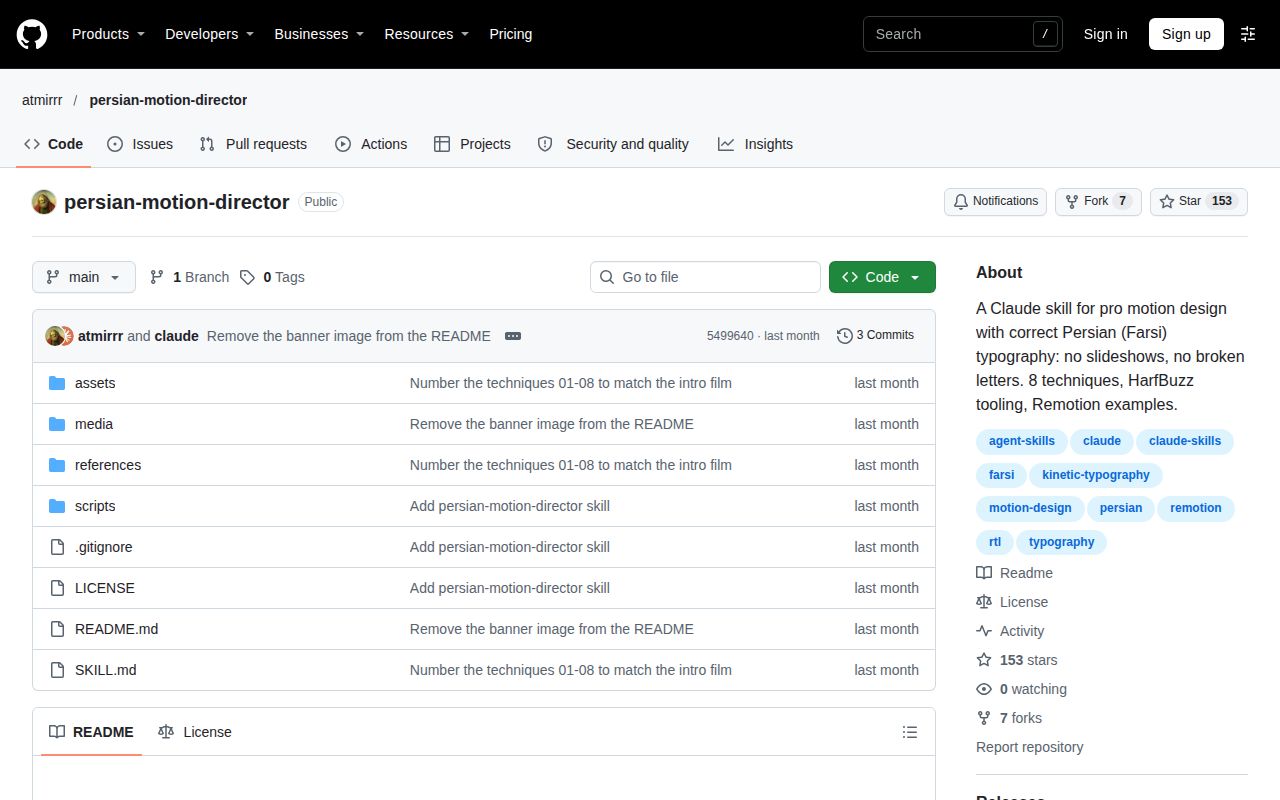
GitHub recorded 153 stars, 0 open issues and PRs, and an October 6, 2026 last push when observed on November 14, 2026. Those figures come from the supplied GitHub repository metadata. They describe repository activity at that observation date. The installation and build results answer a separate question: what happened during our recorded setup at commit 5499640.
Trendshift's activity record reports 49 additional stars, seven additional forks and zero merged pull requests over its 40-day observation window. Varg's dated adoption entry reports five installs and 147 GitHub stars on October 26. Keep each figure attached to its action and observation period. Adding stars, forks and directory installs would mix different events into an unusable total.
The four ratings are unassessed and render as N/A. Installation and the harness build completed, the README names component paths and commands, and the scan found no CI workflows or tests directory. Those concrete observations guide the next evaluation task. The score notes and final section identify the missing evidence for judging setup across a complete creative task, documentation, community support and maturity.
FAQ
persian-motion-director is a Claude skill whose documented personal installation is ~/.claude/skills/persian-motion-director; our dependency audit reported 0 known vulnerabilities, an audit result rather than a safety certification.
What is persian-motion-director?
persian-motion-director is a Claude skill with Persian typography tools, eight technique sketches and browser/Remotion examples. The project README describes a direction-first workflow: show options before building, choose music, cut on the beat and keep a camera moving between scenes. For a developer, its distinctive material is the combination of that process with shaping utilities and copy checks for Persian text.
How do I install persian-motion-director?
The README's personal-skill route clones the repository into ~/.claude/skills/persian-motion-director, and it also permits a project's .claude/skills/ folder. Follow the Claude Code installation instructions for skill discovery. Then choose among the separately documented browser, shaping and Remotion routes according to the task. Opening the gallery helps select a visual direction; running the shaping utility prepares outlines for a different part of the work.
Is persian-motion-director safe to use?
Our recorded pip-audit result was 0 known vulnerabilities. SkillsLLM also reports an automated security scan and supplies a third-party software notice. Read the SkillsLLM scan notice, then review the commands, dependencies and assistant permissions for the component you plan to use. This workflow involves installing tools and running scripts, so the practical decision concerns the particular files and operations needed for your animation task.
What we have not tested yet
Our records cover repository setup and a quickstart recipe; they contain no completed video workload, judged render or independent production case study. We did not render and judge the supplied clips, measure rendering duration or peak memory, or compare output quality and operating costs with another tool. The install and build timings are setup figures. The typography workarounds described above are documented guidance rather than independently reproduced rendering findings.
The quickstart stopped at its missing-snippet step, and the pack supplies no known-answer rendering questions or screenshot records. The image labels and RAM allocations describe configuration; actual runtime and operating-system versions require raw toolchain logs. The dependency audit reports known vulnerabilities found by that check, rather than certifying the skill, its generated code or its behavior. These boundaries also explain why successful setup alone does not supply a numerical rating for a complete creative workflow.
The supplied metadata contains no verified latest-release result. Cross-agent outcomes are also absent: SkillsLLM names Claude Code, Codex CLI and ChatGPT, while Varg explicitly lists Claude Code. The exact repository behind Varg's kinetic-typography recommendation is unspecified in the supplied extract. The comparison uses that named recommendation without assigning a GitHub identity or a measured advantage. Independent customer delivery, maintenance responsiveness and issue-resolution history are also unknown in these records.
Rendered site assets, accessibility, automatic related links, recommendation modules and template content fall outside this text-and-evidence revision. The supplied related-page summaries support a private comparison of editorial intent, rather than an inspection of those rendered pages. The four rating dimensions remain unassessed because the records lack a completed creative task, an end-to-end documentation assessment, support outcomes and production rendering or regression results.
The next useful evaluation is a real title from your brief, including mixed-language names, rendered in the intended font and approved by a fluent Persian reader. Keep the accepted frame beside the final clip so the reviewer has a concrete reference for joins, dots, direction and line breaks. That step addresses the question left open by setup: whether the chosen treatment works for your actual copy.