Provider choice is OpenClaude's clearest technical advantage
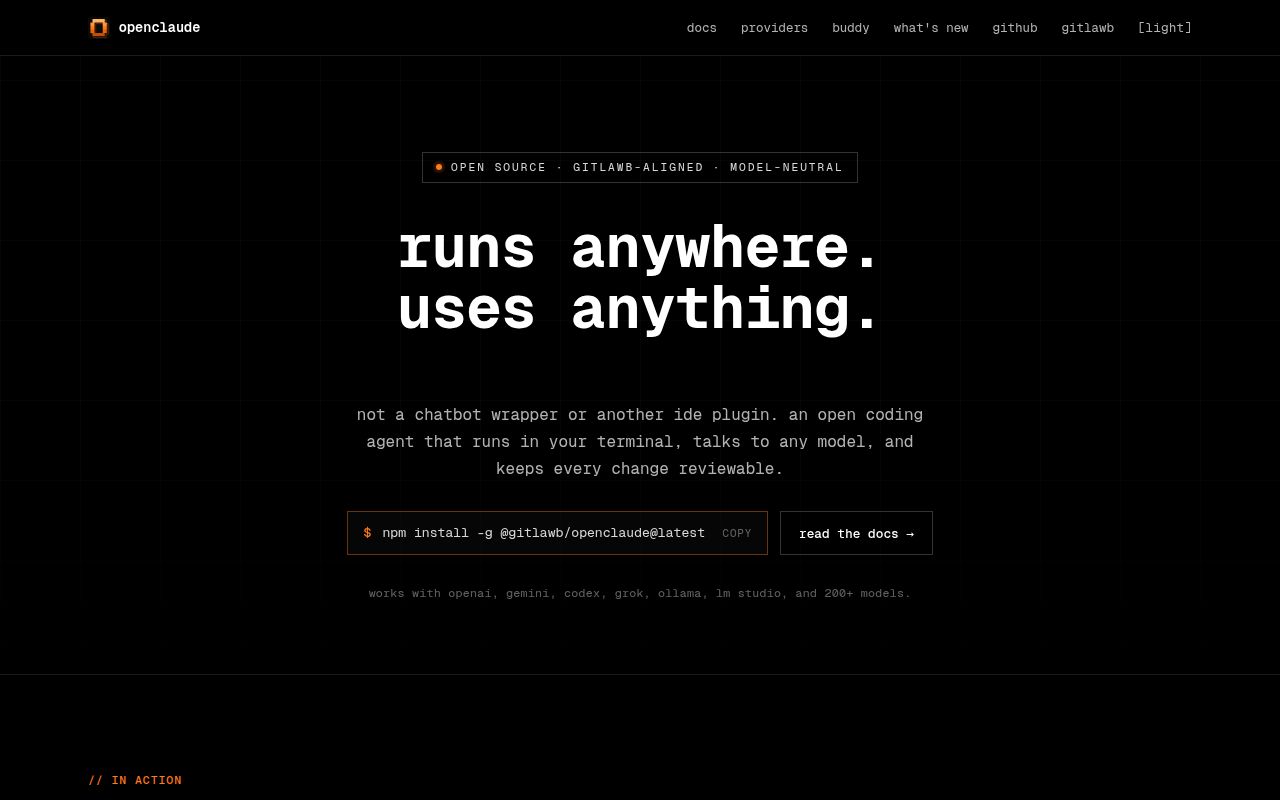
OpenClaude puts OpenAI-compatible endpoints, Gemini, GitHub Models, Codex OAuth, existing Codex credentials, Ollama, cloud platforms, and several commercial gateways behind one terminal agent. The user gets file editing, Bash, search, subagents, tasks, MCP, images, slash commands, and streaming without learning a separate client for each provider. Guided profiles save the endpoint, model, and credential choice for later sessions.
Our checkout at commit 421f459 contained 3,422 files, about 886,334 lines of source, and occupied 33.4 MB. The repository includes the CLI, provider adapters, tools, tests, scripts, documentation, a VS Code extension, gRPC definitions, and 3 CI workflow files. It is a large TypeScript project built with Bun, despite the small 9-second lab build. The size reflects a full agent runtime rather than a thin API switcher.
Provider compatibility stops at a shared interface
The README is direct about behavioral differences. Anthropic-only features may not exist on another backend, tool use depends heavily on the model, and smaller local models may struggle through long multistep jobs. Output caps and context limits also vary. OpenClaude adapts some requests, such as sending a larger context setting to Ollama's native chat API, but it cannot make every model equally good at planning or editing.
Background jobs are local child processes
openclaude --bg starts a detached prompt and records its metadata and logs under the OpenClaude configuration directory. Users can list jobs, follow logs, and kill a named session. A normal zero exit becomes exited, a nonzero exit becomes failed, and an explicit stop becomes killed. When a process vanishes without a recorded outcome after a crash or power loss, the status remains stale.
What happened when we ran it
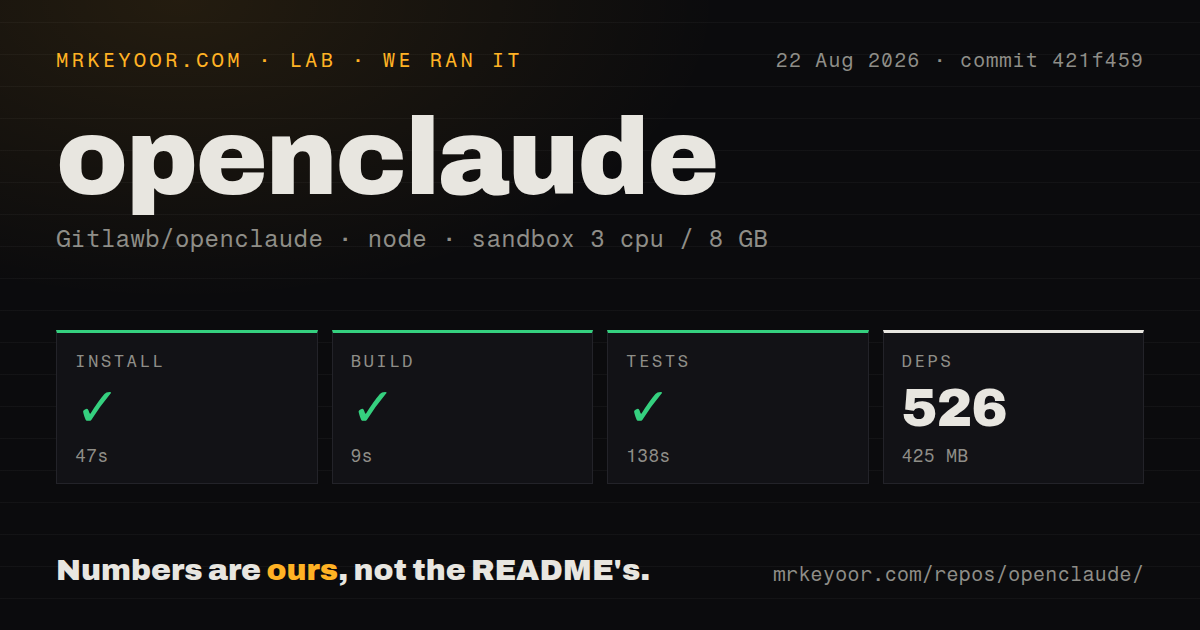
Our fresh Node 22 Debian sandbox installed 526 Bun packages in 47 seconds and used 425 MB on disk. The build completed in 9 seconds. The unprivileged container had 3 CPUs, 8 GB of RAM, no provider secrets, and commit 421f459. OpenClaude also included a Dockerfile and a tests directory in this checkout.
The full test stage succeeded in 138 seconds. The measurement block does not provide a test count, so success should not be turned into an invented number. Among the seven repositories in this assignment, OpenClaude was the only one with successful install, build, and test stages. That is meaningful evidence for source health at the tested commit, though it does not exercise a paid provider, OAuth login, local model, MCP server, or external network workflow.
Configuration can place API keys in plaintext
The /provider flow is the intended setup path and keeps OpenClaude separate from Claude Code directories. The README warns users to migrate only their own settings, commands, agents, skills, and tasks rather than copying Claude Code credentials. Project .env files are not loaded automatically; users can explicitly name a provider environment file or export variables from the shell. This avoids surprising secret discovery.
Per-agent routing is a sharper edge. The routing guide allows endpoint and API-key values in ~/.openclaude/settings.json and states twice that those keys are stored in plaintext. Model-only routes can reuse the active provider without duplicating a key, which is preferable where possible. Restrict file permissions, exclude the configuration directory from backups that lack encryption, and never commit copied settings into a repository.
MCP and gRPC widen the trust boundary
MCP servers can add tools, prompts, and resources to the agent. Issue 2164 documents a current gap: OpenClaude requests concrete resources but not parameterized resource templates. The proposal is detailed and still open, so users of template-only servers should not assume discovery works. As with every agent, each connected tool server can expand what model output is able to touch.
The headless gRPC mode streams text, tool calls, and permission prompts to custom clients on localhost port 50051. Its guide says binding to all interfaces is not recommended without authentication. There is no deployment claim in that document that turns the development command into a secured remote service. Keep it on loopback or put a designed authentication and transport layer in front before using it in CI or another application.
The license notice can override the clean test result
OpenClaude's LICENSE file is a notice rather than a normal repository-wide open-source grant. It says the code derives from Anthropic's proprietary Claude Code CLI, that the original remains subject to Anthropic's copyright and commercial terms, and that OpenClaude does not have authorization to distribute that source. MIT terms apply only to contributor modifications where legally permissible. Users are explicitly told to evaluate their own legal position.
This is not a minor paperwork defect. A company cannot infer rights to the combined work from a badge or from the MIT license on additions. OpenClaude is independent and says it is neither affiliated with nor endorsed by Anthropic. Individuals may make their own risk decision, but a business should obtain legal review or choose Codex CLI, Claude Code, OpenCode, or Aider instead. Technical quality does not cure uncertain distribution rights.
v0.29.1 is active while v0.30.0 is being prepared
The latest published release was v0.29.1 on 2026-08-19, focused on prompt-cache behavior and per-turn context. GitHub recorded a push on 2026-08-25 and showed 62 open issues and pull requests. An open release pull request was preparing v0.30.0, while other current work covered provider validation, background-session cleanup, MCP discovery, and gateway support. The repository is actively maintained.
For an individual who wants to compare many providers in a Claude-like terminal, OpenClaude has real appeal and a clean lab result. The provider guides, background execution, agent routing, repo map, and gRPC surface are more developed than its young age suggests. The recommendation still turns on the license notice: use an authorized project when legal clarity is a requirement, regardless of how well these 138 seconds of tests went.