olmOCR is built for PDFs that lose structure in plain extraction
olmOCR turns PDFs, PNGs, and JPEGs into Markdown through a vision-language model. The practical difference from a basic OCR engine is layout: the project aims to preserve reading order across columns, remove repeated headers and footers, and express equations, tables, and handwriting as usable text. That makes it relevant to archive work, document search, and training-data preparation where a bag of recognized words is not enough.
The repository at commit f7cfe4c had 427 files, about 62,003 lines of source, and a 38.4 MB checkout. Its pipeline is larger than a single-image command. It can process local files, use an S3 workspace as a shared queue, launch Beaker jobs, write Dolma records and Markdown, call a remote OpenAI-compatible inference endpoint, or start a local vLLM server. Training, synthetic-data, filtering, viewer, and benchmark code live beside the converter.
That breadth lets a research team inspect more of the process than a hosted OCR API exposes. It also means adoption needs a clear boundary. A team that only wants to convert occasional invoices may not need model serving, S3 coordination, or training code. A corpus project processing unusual scientific papers can use those pieces and keep the data path under its own control.
Local inference requires GPU hardware and system packages
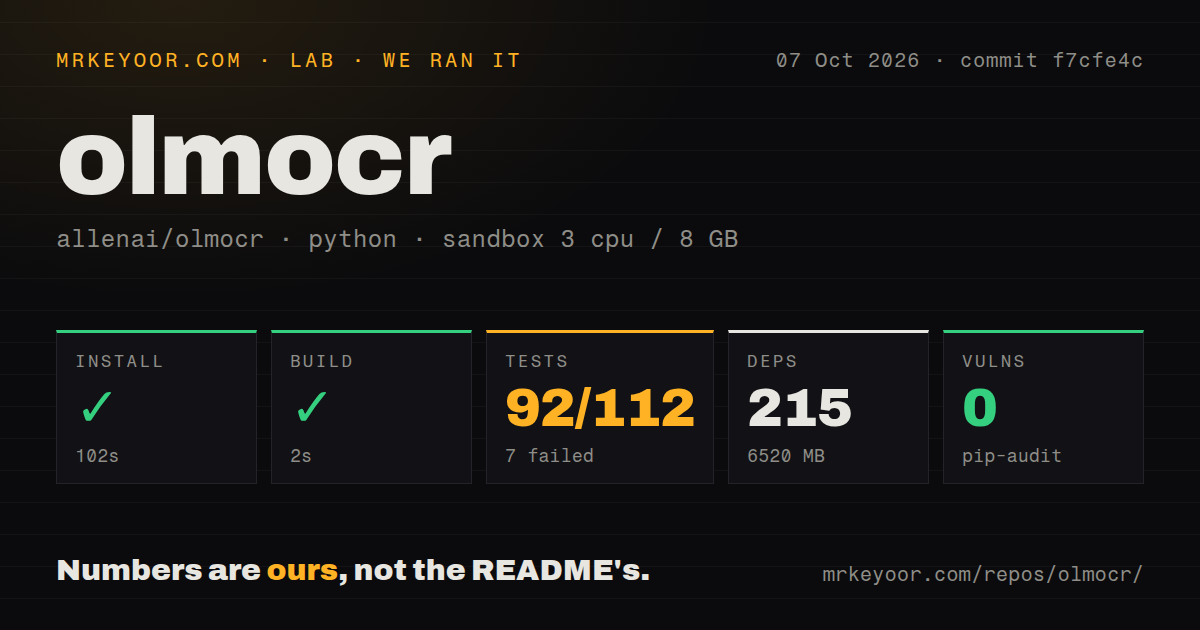
Our installation brought in 215 Python packages in 102 seconds and occupied 6,520 MB before model weights. The README asks local inference users for a recent NVIDIA GPU with at least 12 GB of GPU memory and 30 GB of free disk. Its tested hardware list includes RTX 4090, L40S, A100, and H100 cards. The supplied model is 7 billion parameters, so this is not a lightweight OCR daemon for a small CPU VM.
There is a thinner route. Installing the base package and pointing --server at a remote OpenAI-compatible endpoint avoids the local PyTorch and GPU inference stack. The model name passed to olmOCR must match the one served. A hosted endpoint may also require a key and introduces document-data handling outside your machine. Local GPU use keeps that path closer, but you own CUDA compatibility, vLLM, weights, and capacity.
The non-Python requirements matter just as much. The README tells Debian and Ubuntu users to install Poppler utilities plus several font packages for page rendering. It also recommends a fresh Python environment because the inference requirements are difficult to mix into an existing one. The official Docker image includes the model and is described as roughly 30 GB, while a base image leaves model management to the operator.
What happened when we ran it
Our fresh Debian sandbox installed commit f7cfe4c in 102 seconds using Python 3.12, 3 CPUs, 8 GB of RAM, no secrets, and no elevated privileges. The package build completed in 2 seconds. Pip-audit reported 0 known vulnerabilities. Pytest then ran for 415 seconds and failed, reporting 92 passed, 7 failed, 1 skipped, and 13 collection/setup errors out of 112.
Four named failures were direct system-command errors. Three anchor or rendering tests could not find pdfinfo, and a PDF filter test could not find pdftotext. Both executables come from Poppler, which the README lists as a system dependency. Our base container did not have them. This finding shows that a successful Python install is insufficient for the supplied suite; it does not show a defect in those four tests.
The other 3 named failures were rotation-correction pipeline tests that exceeded pytest's 120-second limit. The log does not show why they timed out. The final summary also records 13 collection/setup errors, but the supplied tail does not include their exceptions. We can say the suite was not green in our environment. We cannot turn the remaining errors into a package, GPU, network, or source-code diagnosis from this output.
Batch jobs need independent progress checks
The pipeline is designed for volume. One worker can populate an S3-backed workspace, and later workers can pull from the same queue. The CLI exposes page retries, acceptable page-error rate, worker count, pages per group, and model-server concurrency. Those controls help operators bound a large run, but they do not remove the need to watch work completion and inspect failed documents.
Our test process itself needed 415 seconds before returning a failure, and two open issues make stalled work worth monitoring. Issue 433 describes long documents waiting on the last page. Issue 480 says the displayed recent throughput can remain nonzero after completions stop, which could make an idle pipeline look active. These are user and contributor reports, separate from our sandbox results. Until resolved, alert on completed items or queue movement rather than trusting one throughput number.
Maintenance is active even though the main push date is older
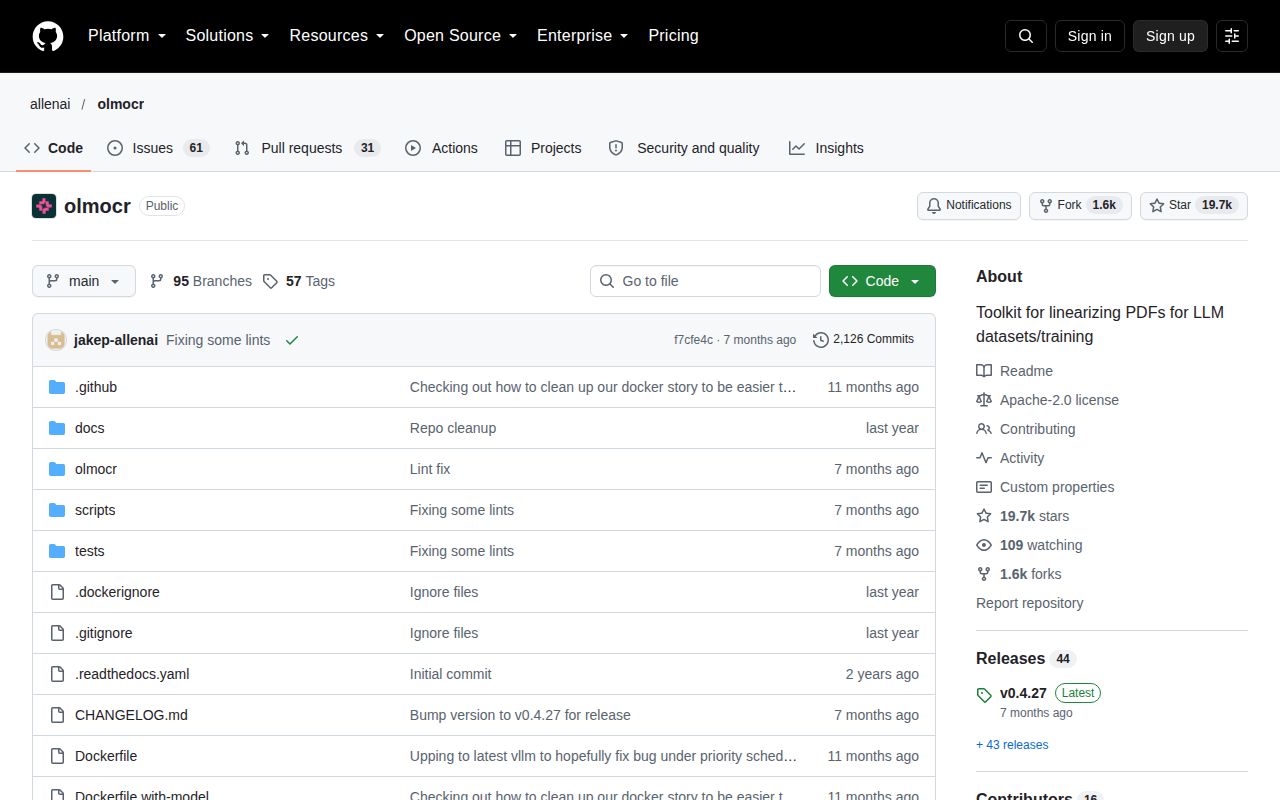
GitHub reported 19,722 stars and 92 combined issues and pull requests on October 7, 2026. The repository facts endpoint listed the last push as March 25, and v0.4.27 was released March 12. Open issue and pull-request activity continued into October, including a proposed fix for the stale recent-throughput reading. The dates together describe an active discussion queue around a base that has not had a newer tagged release.
olmOCR deserves a trial when document structure is the hard part and you can compare its Markdown against representative pages. The Apache-2.0 license, remote-server option, Docker path, and batch workspace cover serious deployment shapes. The gate is operational: install Poppler and fonts, budget for the 6,520 MB Python environment we measured, reproduce the 7 failures and 13 setup errors, and test stalled-page handling before sending it a large unattended corpus.