
PaddleOCR is a document platform, not one recognizer
PaddleOCR v3.7.0 includes much more than a function that turns pixels into text. PP-OCRv6 handles detection and recognition, PP-StructureV3 extracts page structure, and the PaddleOCR-VL line parses complex documents into Markdown or JSON. Other pipelines cover document translation and information extraction. The README starts in English and links 8 translated editions, which fits a project serving many scripts and deployment regions.
The model range is equally wide. PP-OCRv6 ships tiny, small, and medium tiers at 1.5M, 7.7M, and 34.5M parameters. Its unified recognizer covers 50 languages in one model, while the broader catalog advertises support for more than 100. PaddleOCR-VL-1.6 is a 0.9B-parameter document model for text, tables, formulas, charts, seals, and structured page output.
Five optional groups separate OCR from document AI
The default paddleocr install covers general OCR and document-image preprocessing. Five named extras add document parsing, information extraction, translation, office-to-Markdown conversion, or the full set. This division is welcome because a service reading receipt text should not inherit every document-translation dependency. Inference itself still needs a chosen engine such as PaddlePaddle or Transformers, installed and configured separately.
Python support also depends on the path. The base package and office conversion group support Python 3.8+, while the other optional groups require 3.9+ because of upstream packages. Training and export form another layer, with their own repository checkout, requirements, and PaddlePaddle framework install. The official guide recommends a clean environment when another inference engine could create dependency conflicts.
What happened when we ran it
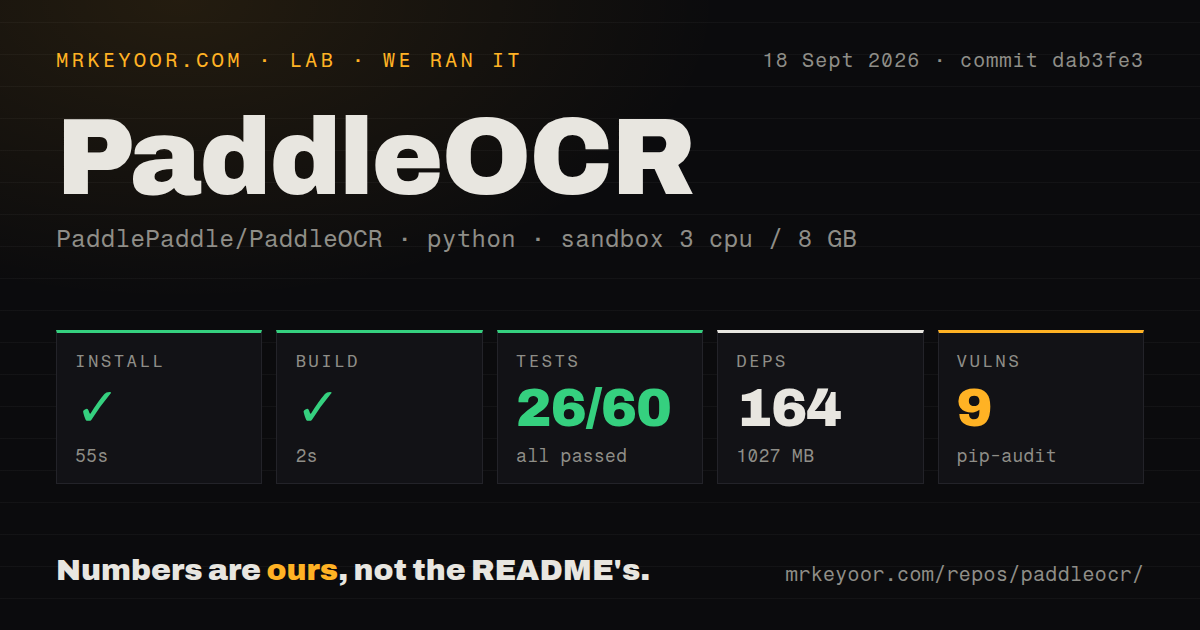
Our sandbox cloned commit dab3fe3 and installed 164 Python packages in 55 seconds. The environment used 1,027 MB, before counting future model downloads. The checkout itself was 135.6 MB with 2,455 files and roughly 178,166 lines of source. Building succeeded in 2 seconds. Pip-audit reported 9 known vulnerabilities in the installed dependencies.
Pytest exited 1 after 9 seconds. It reported 26 passed, 0 failed, and 34 collection or setup errors out of 60 items. Many pipeline errors ended with PDX has already been initialized. Reinitialization is not supported. The tail also listed errors in post-processing, formula, augmentation, and hub-serving modules without enough detail to assign one cause to all 34.
Our scan found 9 CI workflow files and a tests directory, which is stronger visible automation than the other ML projects in this batch. There was no Dockerfile in the measured checkout. The fast 2-second build shows that packaging metadata assembled; it says nothing about OCR quality, model download success, or whether the application can initialize several pipelines in one process.
Framework and backend combinations need their own lockfile
Open issue 18162 reproduces a NotImplementedError with PaddleOCR 3.7.0, PaddlePaddle 3.3.1, Python 3.12, and CPU inference on Linux. The failure occurs during text detection after model files load. One report cannot map the whole compatibility matrix, but it is specific enough to require a smoke test with the exact framework and hardware backend selected for deployment.
Issue 18170 shows a different boundary. With PaddleOCR 3.7.0 and llama-cpp-server, one smart-quote block returned HTTP 500 and caused the full 59-block page prediction to fail. The reporter used vLLM as a workaround. If partial pages are better than no page, wrap each backend call, preserve completed blocks, and test punctuation from real newspapers before accepting this serving path.
Documentation breadth does not guarantee every sample works
The documentation covers local Python, command-line use, C++, C#, Java, serving, ONNX, OpenVINO, TensorRT, and parallel inference. That scope is a major reason to consider PaddleOCR. It also creates more examples to keep current. Issue 18369 reports that the PP-StructureV3 tutorial passes a MarkdownResult object to write(), raising a type error where the sample promises one combined Markdown file.
Language claims deserve a corpus, too. Issue 18349 measured the Arabic PP-OCRv5 mobile recognizer on 20 book pages and found much lower character error after changing crop width. The reporter carefully limits the conclusion to those books and that model. Buyers should do the same: score the exact script, typeface, scan quality, and line geometry they expect, rather than inheriting an aggregate language claim.
September activity is strong, and the backlog is large
GitHub listed 89,776 stars and 249 combined issues and pull requests. The repository was pushed on September 16, 2026, and issue or pull-request activity continued through September 18. Release v3.7.0 arrived June 11 with PP-OCRv6 and three parameter tiers. Nine visible CI workflows and frequent current changes support a high community score, while the open count reflects a very large surface.
PaddleOCR is the right shortlist entry when one product must grow from 50-language text recognition into tables, formulas, layout, and structured document output. Our 26 passing tests show working pieces, while the 34 setup errors and 9 advisories block an easy production endorsement. Pin the whole stack, test one pipeline per process where practical, audit dependencies, and grade output on documents your users actually submit.