Local document reading comes with an 8,306 MB environment
A scanned report needs its words put back in order before a search engine or assistant can use it. MinerU handles that conversion, including tables and formulas, and keeps page and block references for later reading. Our installed environment occupied 8,306 MB. That is the first adoption decision: does your document problem warrant a resident parsing stack, or could an ordinary PDF text reader handle the files you actually receive?
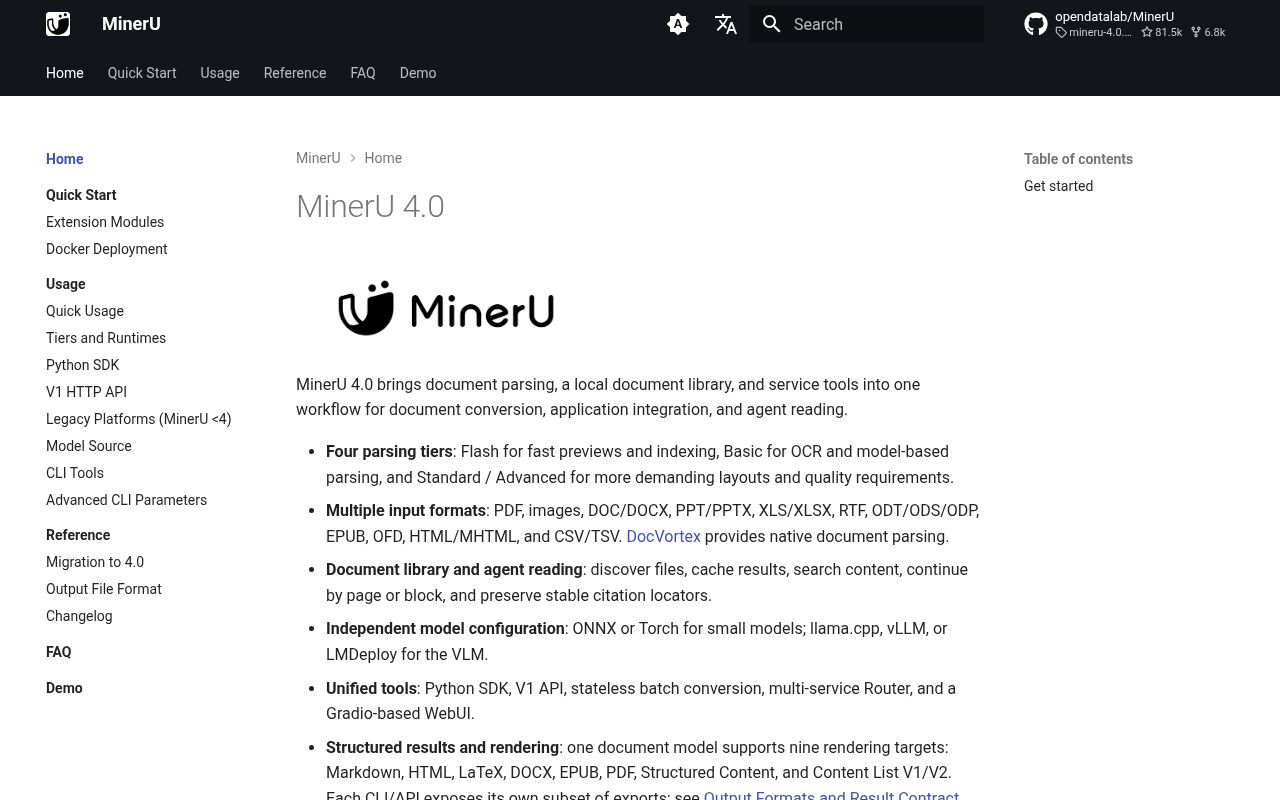
The English README describes local conversion, a document library, and service interfaces. PDFs and images can use different parsing quality tiers, while Office files and HTML take a native parsing path. You can export Markdown or structured content and retrieve cached passages through stable locators. This is useful for building a retrieval pipeline that needs to trace an answer back to a page. You still supply retrieval and answer-generation logic.
What happened when we ran it
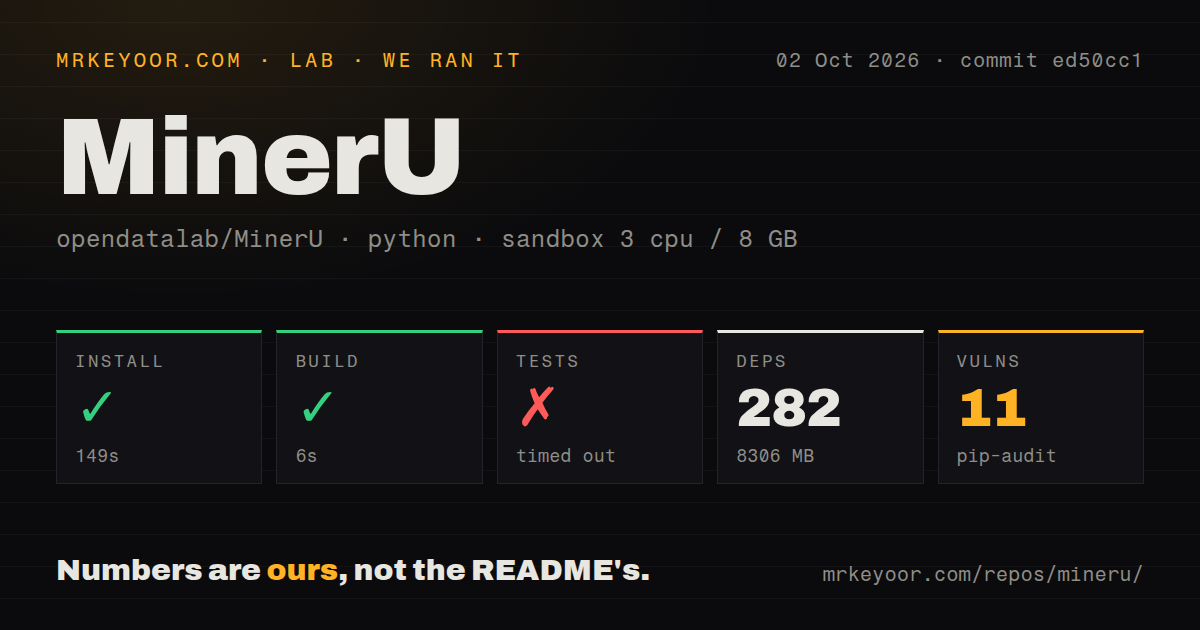
Our run installed MinerU in 149 seconds, pulling 282 packages and occupying 8,306 MB, then built successfully in 6 seconds. We cloned commit ed50cc1 on October 2, 2026, into an unprivileged Debian container using ghcr.io/astral-sh/uv:python3.12-bookworm. The sandbox had 3 CPUs, 8 GB of RAM, and no secrets. Installation and build worked under those conditions. These measurements establish nothing about document accuracy or pages processed per second.
The tests timed out after 900 seconds. The log tail shows a thread in mineru/parser/process_control.py calling listener.accept(), followed by Python's multiprocessing and socket accept calls. A timeout marker and an F appear alongside progress dots. That supports a clear finding: the suite did not finish within the cap, and a thread was waiting to accept a connection. The excerpt cannot identify the failed case or explain the wait.
Pip-audit reported 11 known vulnerabilities in the measured environment. The supplied result does not name affected packages, severity, or reachable code paths, so it cannot establish exploitability. The checkout had 867 files, about 127,007 source lines, and occupied 23.9 MB. Our scan found 6 CI workflow files and a tests directory, but no Dockerfile. Those signals describe the measured checkout rather than every deployment asset available upstream today.
Model setup continues after the package arrives
Local higher-quality parsing requires model downloads and a configured parsing server. The README documents model download and verification commands, then server status checks. Its basic engine uses ONNX, while other choices involve Torch and a vision-language model runtime such as llama.cpp. Remote parsing requires explicit configuration and an API key. The local path avoids a hosted parsing credential, though you must provision the models and keep the service available.
Our 3-CPU, 8 GB sandbox is a useful reference point for repository mechanics, not a certification of the available inference engines. The documented accelerated paths differ by hardware. Windows users need a separate GPU Torch setup, and NVIDIA users have an optional fuller package. The README also says Docker deployment guidance for non-NVIDIA devices awaits an update. Choose the engine for your actual machine before treating the short quick-start command as a deployment recipe.
Cached page references help agents read selectively
The document-library command defaults to a limited PDF page window and returns locators for continuation. The stateless conversion command reads the whole document by default. That distinction matters when an assistant reports findings from a long report: cached page references let it resume reading, but a successful first response does not mean it saw every page. Keep the requested page range and the returned continuation information together in your application.
At 282 installed packages, MinerU deserves a defined role in the stack. Put it where document ingestion happens, cache the structured results, and keep source-page references attached to extracted passages. For plain PDFs with usable embedded text, pypdf is a narrower library worth trying first. Docling is another candidate when you want a document conversion API and structured exports. Marker offers document conversion with optional language-model assistance. Their accuracy needs a separate comparison on your files.
Local parsing still needs an explicit telemetry choice
The README says document contents are processed locally unless remote parsing is explicitly selected. It separately describes anonymous usage and diagnostic telemetry, with commands to inspect, preview, and disable it. The stated exclusions include extracted content and file paths. A privacy-sensitive deployment should configure that choice before routine use. Local document handling and telemetry policy are separate settings, so check both rather than reading the local default as a complete network policy.
The 11 vulnerabilities found by pip-audit also deserve a deployment-specific review before exposing an upload endpoint. Our result gives no basis for ranking them or claiming they affect document parsing. Pin the environment you assess, identify the advisories, and decide which inputs the service will accept. For confidential files, keep the remote option disabled unless uploading is approved. The README's explicit remote switch makes that boundary easier to enforce in a wrapper.
Recent maintenance does not validate extracted reading order
The last push was October 11, 2026, and the latest release was mineru-4.0.12-released that day. GitHub listed 81,460 stars and 11 open issues and PRs. Recent issue activity includes issue 5628, which describes a Basic-tier heading placed after the body text beneath it. The report was closed on October 11. Closure alone does not prove that your files will have correct reading order, but the report provides a concrete case to check.
Use MinerU when cached document reading, OCR, and traceable passages justify the 8,306 MB environment we measured. Teams requiring ordinary Apache-2.0 terms should examine its additional license conditions, including attribution for online services. Before handing parsed output to an assistant, compare the headings and tables against representative source pages. Our suite stopped at 900 seconds, so a successful install is only the beginning of that acceptance decision.