ODS installs an AI appliance rather than one model server
ODS assembles local inference, Open WebUI, LiteLLM, embeddings, Qdrant, SearXNG, Perplexica, Whisper, Kokoro, ComfyUI, n8n, agents, policy tooling, and monitoring under one installer and dashboard. The appeal is operational coherence. One command detects hardware, selects a model, creates credentials, starts services, and exposes chat. Users who tried to combine those projects manually will recognize the hours ODS is attempting to save.
The same breadth is its main cost. Each service has an image, data volume, port, update cycle, and security posture. Local mode avoids mandatory cloud subscriptions, but it does not make the system small. Cloud and hybrid modes add provider keys through LiteLLM. A team that only wants an OpenAI-compatible endpoint should choose LocalAI or llama.cpp; ODS earns its overhead only when several bundled capabilities will be used.
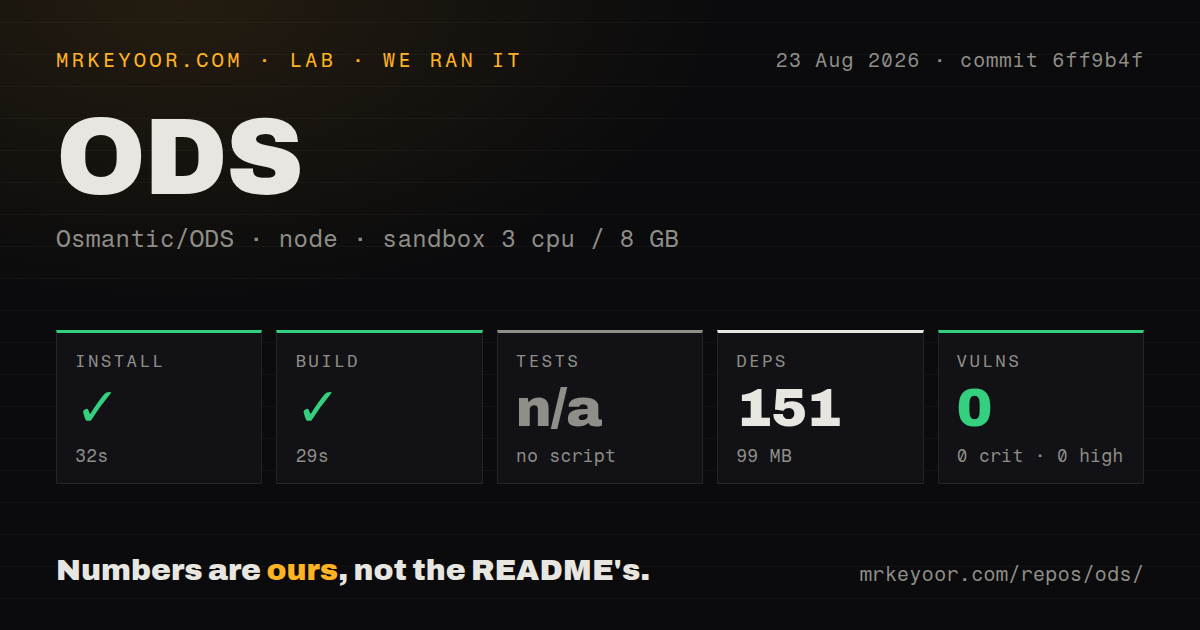
The measured installer used 99 MB before any model download
Our sandbox cloned commit 6ff9b4f and ran the Node project under installer/. Npm installed 151 packages in 32 seconds and used 99 MB. The build completed successfully in 29 seconds. Npm audit reported 0 known vulnerabilities across critical, high, moderate, and low severities. Those results cover the installer project, not the Docker services it later obtains.
The full checkout contained 1,346 files, about 223,827 lines of source, and 14.5 MB before dependencies. Our scan found 19 CI workflow files, no Dockerfile at the scanned level, and no top-level tests directory. ODS stores its product runtime under ods/, including service definitions, installers, tests, dashboard code, and operator documents. Repository size alone therefore understates the downloaded images and model files of a real installation.
What happened when we ran it
Our build had no test script or target, so we skipped tests. A successful 29-second installer build proves that its TypeScript or JavaScript compilation path completed in the supplied Node 22 environment. It does not prove Docker bootstrap, GPU detection, model selection, backup and restore, service health, or inference output. We did not launch ODS because the sandbox was unprivileged and carried no secrets.
This distinction matters because the README describes release validation across hardware and distributions, while the lab block measures only installer/. We cannot convert those project claims into our own test result. A buyer should run the documented User Green procedure on the exact machine, GPU backend, model, and release being adopted, then retain the output with the pinned commit.
v2.6.0 is safer than the hosted mutable installer
The public Linux and macOS one-liner downloads a bootstrap through Osmantic's domain. The installer trust guide says that endpoint proxies the current script from repository main, with a short cache window. Merges can therefore change what the next installation executes. ODS_REF pins the repository payload, but users must still understand which bootstrap they fetched. The guide recommends downloading and comparing the script before execution.
For repeatable use, clone v2.6.0 or an audited commit and run the source installer. The trust guide says ODS does not yet publish a complete checksum, signed-release, or SBOM chain for every installer artifact and core image. Those are listed as future work rather than current guarantees. Strict environments should mirror reviewed sources and images internally, record hashes, and avoid treating HTTPS delivery as full provenance.
Extension compatibility is not enforced at runtime
ODS makes services extensible through a manifest and Compose fragment. Issue 3231 reports that runtime loading checks only a schema version and service ID instead of validating the whole manifest against the repository's JSON schema. A missing gpu_backends field defaults to all backends, which can advertise an incompatible service on Apple Silicon or another host. Issue 3240 separately reports an absent environment value defaulting the dashboard to NVIDIA.
These are current issue reports, not failures reproduced in our installer build. They still point to a sensible control: validate every extension manifest during deployment, fail closed on unknown hardware, and test enable, disable, restart, and uninstall operations. An extension system that generates Compose configuration has infrastructure privileges; a green catalog card should not substitute for reviewing its image, mounts, ports, secrets, and GPU requirements.
CI does not run several data and privacy tests
Issue 3241 identifies 6 backup and restore scripts present in the repository but absent from GitHub workflows. Issue 3237 lists Python suites for agent policy, LiteLLM callbacks, model routing, and Privacy Shield that are also not executed in CI. Issue 3234 says all 4 mypy steps use continue-on-error, so type failures cannot block a merge. These reports qualify what 19 workflow files mean.
A production-like operator should run the local test target, perform a real backup and restore on disposable data, and verify secrets plus agent state survive. Privacy Shield needs test inputs containing the exact identifiers the organization cares about. Restore work deserves special attention because recent August pull requests fix manifest lookup, Compose project naming, and Hermes or persona backup coverage. Data safety should be demonstrated on the chosen tag.
August activity is high and mostly ahead of stable
GitHub showed 4,716 stars, 1,149 combined issues and pull requests, and a last push on August 21, 2026. Issue and pull request activity continued through August 26, with many changes around Windows installation, backups, extensions, model state, GPU detection, dashboard behavior, and tests. The combined count is not a count of confirmed bugs, but it does show a very busy queue.
Release v2.6.0 was published July 28, while the README warns that main moves quickly and stable fixes flow through release/2.6.x. That is good release guidance and should be followed. ODS can save a homelab owner a large integration job, yet its installer controls a large local system. Pin the release, keep services on localhost until deliberately exposed, rehearse restore, and upgrade only with a fresh validation receipt.