Tasks survive conversation changes, but you operate the services
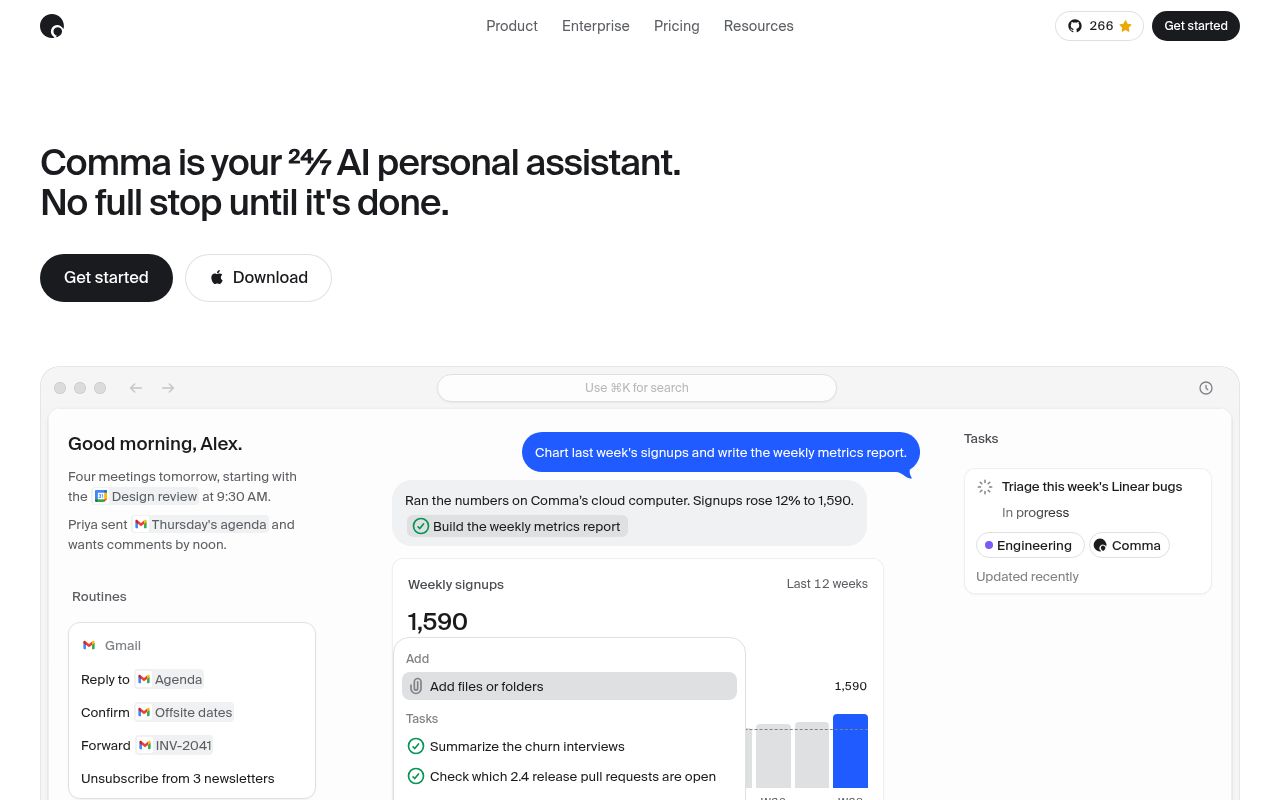
Comma stores ongoing work as Tasks rather than tying it to one conversation. Its board moves work through Backlog, In progress, Needs Review, and Done, while chats act as another way to interact with it. That is a useful model for an assistant you want to revisit from another device. The operating commitment is larger than the chat interface suggests: the documented self-host stack includes databases, object storage, and its own device-connection system.
Our checkout occupied 120.1 MB before installation and contained 8,257 files. The repository spans browser and Electron clients plus an Elixir backend and Lean components. A developer choosing it should want that whole persistent-task arrangement. If all you need is a scheduled request to an existing API, maintaining this much application infrastructure is a substantial price for an interface you may barely use.
What happened when we ran it
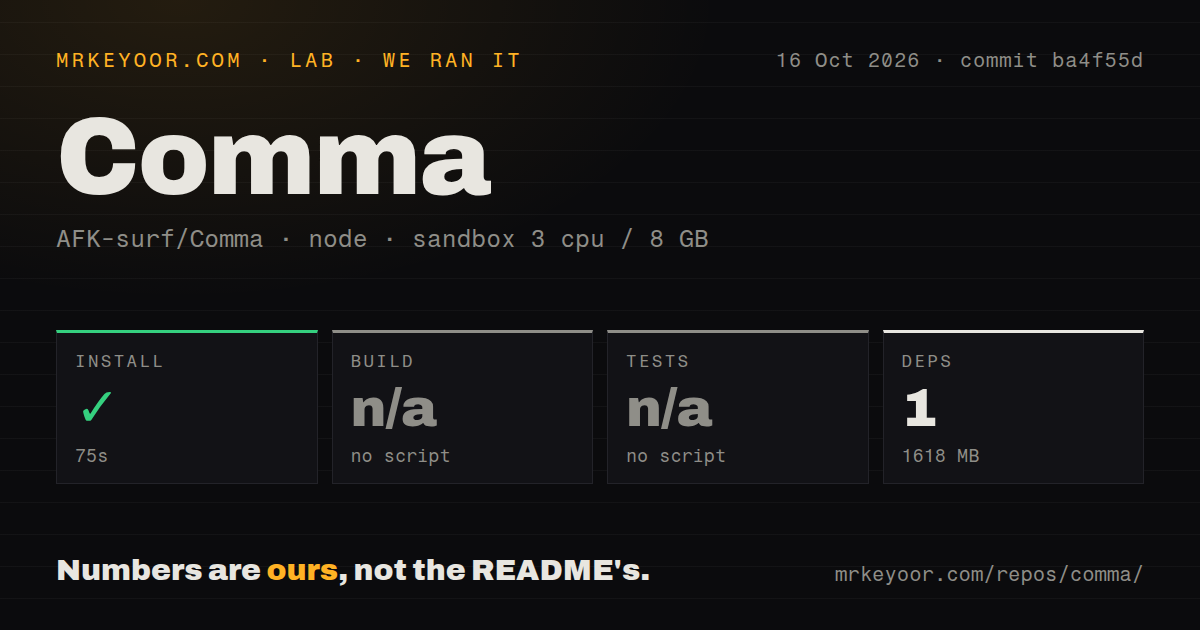
Our run installed commit ba4f55d with pnpm in 75 seconds on October 16, 2026, reporting 1 package installed and 1,618 MB on disk. The fresh Debian container had 3 CPUs and 8 GB of RAM, used lab-node:22, and had no secrets or elevated privileges. Installation succeeded. The reported package count should be read alongside the measured disk footprint, rather than used to call the installed environment small.
Build and tests were skipped because the detected path had no build or test script or target. Our scan reported 0 CI workflow files, no Dockerfile, a Compose file, and no tests directory. The README separately documents named Make targets for clients, systems, and policy checks. We have no results for those targets, and the scan cannot establish that the larger backend has no verification machinery. The defensible result is a successful package install with application operation still unmeasured.
Compose brings storage, email, and several language toolchains
The README requires Docker Compose 2.24 or newer and describes a stack that builds the server and clients from source. PostgreSQL, Redis, MinIO, ClickHouse, and Mailpit run alongside them. First startup downloads public toolchains including Lean, Elixir, Go, and Node. That is a meaningful deployment for a personal assistant, especially if you need to restore it after a host failure rather than merely start a demo.
The 1,618 MB measured in our pnpm run is therefore not a storage budget for the complete deployment. No Compose image footprint or startup time was measured. You also need an owner email and a model provider configuration for real work. The production-oriented stack has no mock model by default, whereas the development instructions describe a deterministic mock. Success with the latter would not establish that provider credentials or real model calls work.
Public access requires separate origins and real email
Web, Admin, and the Product API need different HTTPS origins under one registrable domain for public hosting. The example configuration explicitly says cross-site browser and API origins are unsupported by its session cookie arrangement. This is a concrete routing requirement to check before adopting the stack, particularly if your organization's existing domain setup separates admin tools from application APIs.
The local email inbox is for loopback use because it contains login codes. Public hosting needs a real SMTP server. Backups must retain the named volumes together, including the configuration volume holding encryption and authentication secrets. The README warns against deleting or regenerating those secrets. Someone who can run containers but cannot restore their persistent data has only solved the easiest part of operating this assistant.
Formal proofs have narrower claims than successful tasks
Comma's verification guide discusses durable accepted work, state transitions, and authorization boundaries. It explicitly distinguishes accepting input from completing a Task or delivering a reply. That distinction matters when an assistant appears to acknowledge a request: receipt of the work is only an intermediate state, and the application still owes you the requested outcome.
The 75-second install gives us no evidence about those proofs or runtime behavior. The guide also excludes successful user-task completion and unconditional exactly-once external effects from its claims. That makes the documentation more useful than a broad assertion of verified reliability. Read the boundaries against your intended failure cases, such as an interrupted action against an external service. Correct internal bookkeeping cannot make a mistaken model instruction useful or safe.
Device access and missing runtimes limit the complete package
Salix can read files on a connected computer, while the Allow operations setting enables changes and commands. Comma can also hand work to existing agents, including Claude Code. Decide which machine should receive that access before turning it on. The README says group cloud computers need Cloudflare configuration, and meetings and Agent VMM hosts need runtimes absent from this repository. Those exclusions belong in any feature checklist used to justify self-hosting.
The last push was October 3, 2026. GitHub listed 266 stars and 2 open issues and PRs, with requests for screen streaming and private-network SSH access updated in October. There was no latest published release. That combination shows ongoing requests around device operation without proving support for them. AGPL-3.0-only licensing also comes with a documented source-download requirement for modified hosted versions. Choose Comma only when you can own the persistent services behind that continuing task board.