One server can cover text, speech, images, and agents
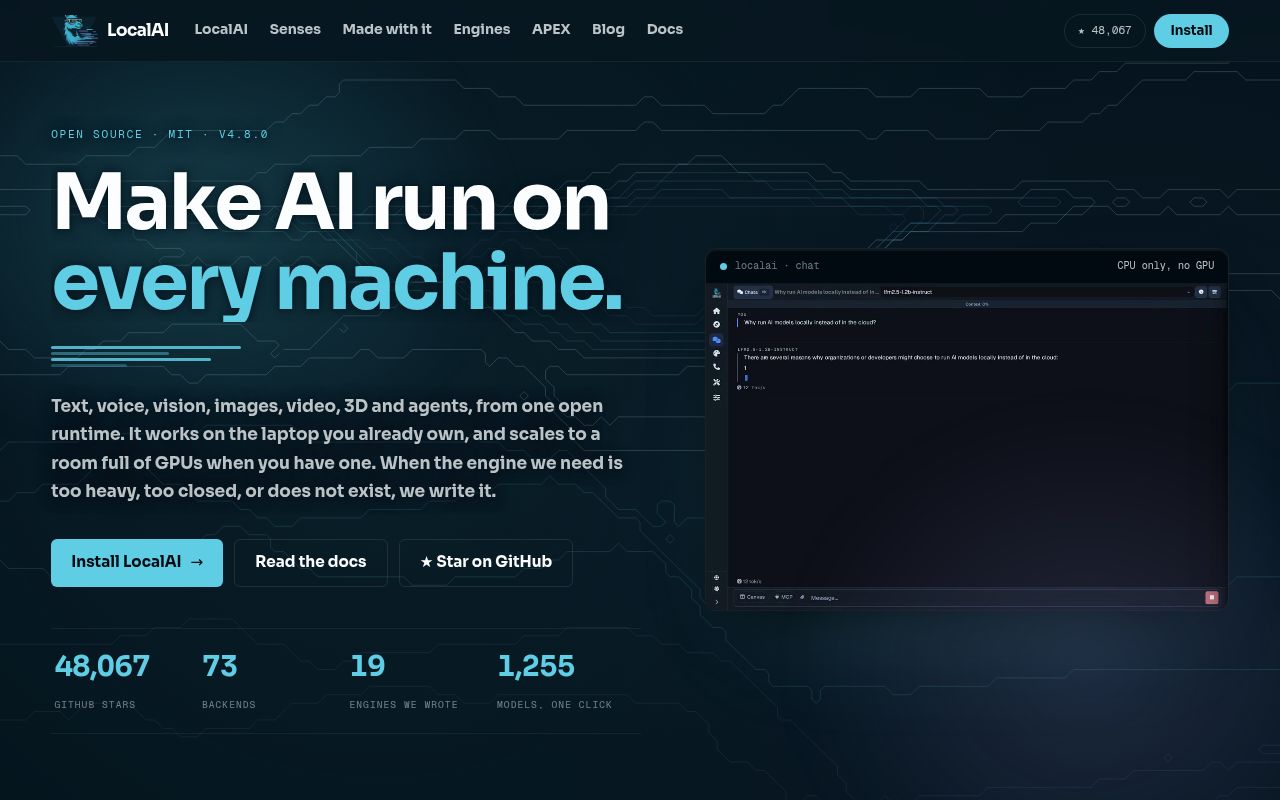
LocalAI is an API layer over many inference engines. It accepts familiar OpenAI, Anthropic, and ElevenLabs request shapes, then routes work to a suitable backend. The published surface includes text generation, embeddings, reranking, transcription, speech, image and video generation, object detection, realtime audio, agents, and MCP. That makes it attractive when a private AI stack has grown beyond one chat model. It also means the product is closer to a platform than a small model runner.
The modular design is the right compromise for that scope. Backends such as llama.cpp, vLLM, whisper.cpp, Stable Diffusion, and MLX live in separate images and arrive when a model needs them. Our checkout still had 5,114 files, about 514,520 source lines, and measured 94.6 MB. LocalAI avoids installing every inference engine up front, but an operator must understand which engine serves each model and which extra image will be fetched.
Familiar APIs reduce client changes, not operating choices
Existing clients can often point at LocalAI instead of a hosted API, and the server adds API keys, quotas, roles, a web interface, and model management. Model inputs can come from its gallery, Hugging Face, an Ollama registry, OCI, or YAML. The built-in terminal agent can read files and run commands with approval for state changes. MCP support extends the same local setup to tool calls and agent workflows.
The phrase "any hardware" needs a careful reading. The README has distinct commands for CPU, CUDA 12, CUDA 13, ROCm, Intel oneAPI, Vulkan, and 2 Jetson families. Automatic detection chooses and downloads a backend, but it cannot make an oversized model fit a small machine. Model quality, memory use, and request speed depend on the weights, quantization, backend, and host. Our sandbox did not benchmark inference, so this review makes no throughput claim.
What happened when we ran it
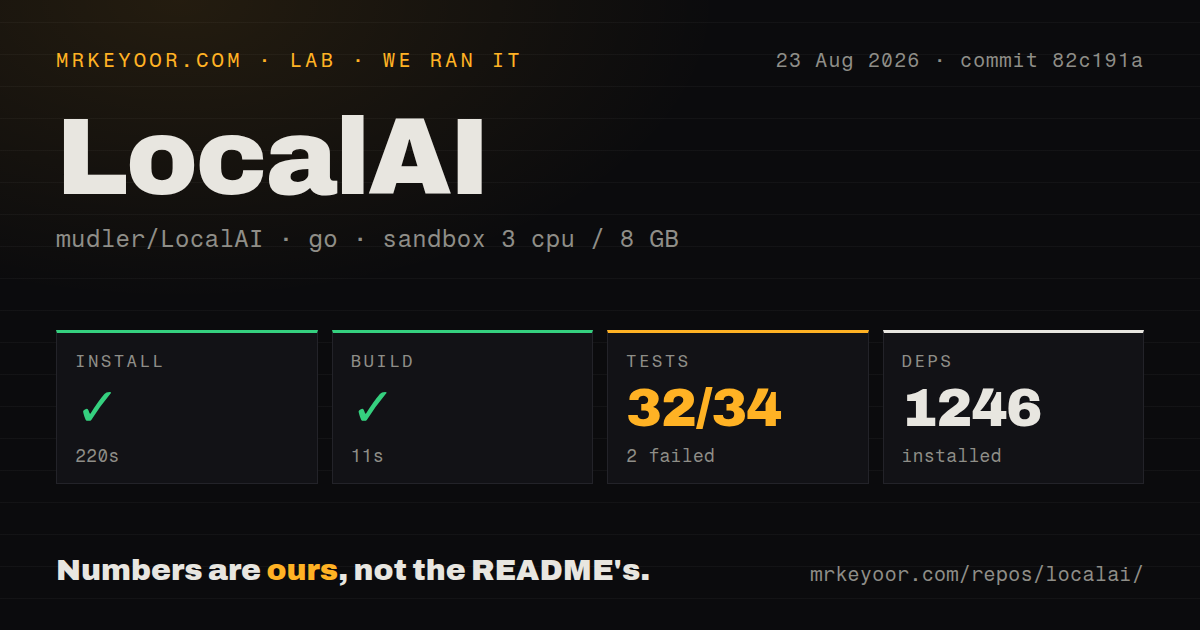
Our sandbox install completed in 220 seconds and brought in 1,246 packages. The build then succeeded in 11 seconds. We used commit 82c191a in an unprivileged Debian container with 3 CPUs and 8 GB of RAM. Those results show that the source can be assembled in a plain environment, though the dependency count and install time are much larger than a narrow Go utility.
The test command exited with code 1 after 192 seconds. Go reported 32 passing packages and 2 failing packages out of 34. In the visible pkg/utils tail, the test runner completed 56 of 59 specs: 55 passed, 1 failed, and 3 were skipped. The log excerpt does not identify the failed assertion or its cause. The defensible finding is that this commit did not pass the complete test step on our box.
Distributed mode adds PostgreSQL and NATS
A single container is enough to explore a CPU model, but production options expand quickly. LocalAI documents multi-user authentication, OIDC, per-user quotas, distributed inference, model routing, and Kubernetes installation. Distributed mode specifically uses PostgreSQL and NATS. Generated media, model files, backend images, credentials, and network access all need their own storage and security decisions. The latest release also changed authentication to deny requests by default unless a route is explicitly public.
That security change in v4.9.0 is reassuring and carries migration work. Generated audio, image, video, and 3D URLs can now require credentials when authentication is configured. The release was published on August 20, 2026, while GitHub showed the last push on August 26 and 217 combined issues and pull requests. Current code and issue activity are obvious, but the combined count should not be read as 217 confirmed bugs.
Broad compatibility makes regression testing your job
A feature matrix this wide creates combinations the maintainers cannot test for your exact host. One recent issue described an agent response disappearing when a user left an in-progress chat; a linked pull request changed the status view so the stream remains mounted. Other active work updates multiple inference backends independently. Pin the LocalAI version, backend image, model artifact, quantization, and configuration together, then test the actual API calls your application sends.
The same discipline applies to model changes. A successful 11-second build says nothing about whether a new weight follows your prompts, emits valid structured output, or fits available memory. Keep a small acceptance set for text, tool calls, media inputs, and authentication boundaries. For agent use, verify every enabled tool and approval rule. LocalAI gives one control surface, but the behavior still comes from several engines and models underneath it.
Choose breadth only when you will use it
LocalAI earns a trial when a team wants private inference across several modalities without building a separate service around every engine. The MIT license, active August 2026 release, familiar endpoints, and hardware-specific instructions make that trial practical. Its breadth is also the reason to avoid it for one straightforward text model. More backends bring more downloads, configuration, and compatibility checks.
Our measured 220-second install and 192-second failed test run set the right expectation. This is active infrastructure with a large surface, not a frictionless binary. Start with one pinned model and backend, require the 34-package test step to pass in your own build environment, and add other modalities only when they replace a service you already operate.