Nasiko puts one server in every A2A 1.0 path
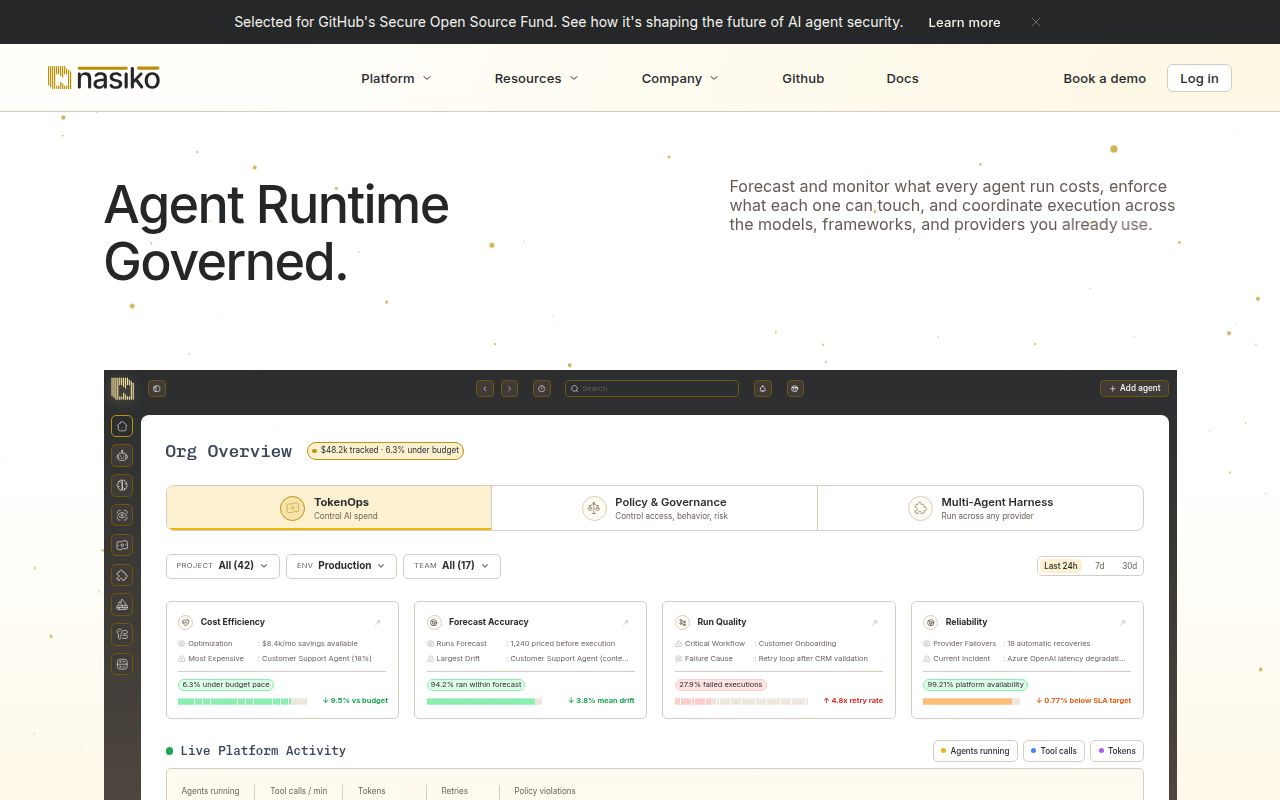
Nasiko's A2A 1.0 design makes its server the only public ingress for a fleet. It authenticates requests, selects an agent, proxies calls, and records each hop. Agents stay behind that boundary instead of exposing their own endpoints. Rate limits and access rules live in one place instead of depending on every agent author to reproduce them.
Agents must speak A2A 1.0. The README says Nasiko sends that version on every request and rejects older 0.2.x and 0.3.0 implementations. An existing fleet of ordinary HTTP services will need adapters. For a new A2A fleet, the constraint buys a consistent request format. For a mixed estate, it is migration work to price before deployment.
The useful parts are credentials, limits, and traces
Nasiko's 3-stage router narrows candidates by embedding similarity, reranks them with conversation context, and uses an LLM for the final choice. Known destinations can be called directly through the proxy. The server also provides an OpenAI-compatible LLM endpoint, an MCP gateway, encrypted agent secrets, an embedded OCI registry, and access rules for users and agents.
Agents receive short-lived identity tokens instead of provider keys. MCP tools can be filtered per agent, while Redis-backed guards cap call depth, fan-out, token use, time, and cycles. Every dispatch and proxy hop emits an OpenTelemetry span, with Tempo and Loki as backends. These controls address leaked billing keys, recursive calls, and traces that stop at the first agent boundary. They also make Nasiko a dependency for every authorized call.
What happened when we ran it
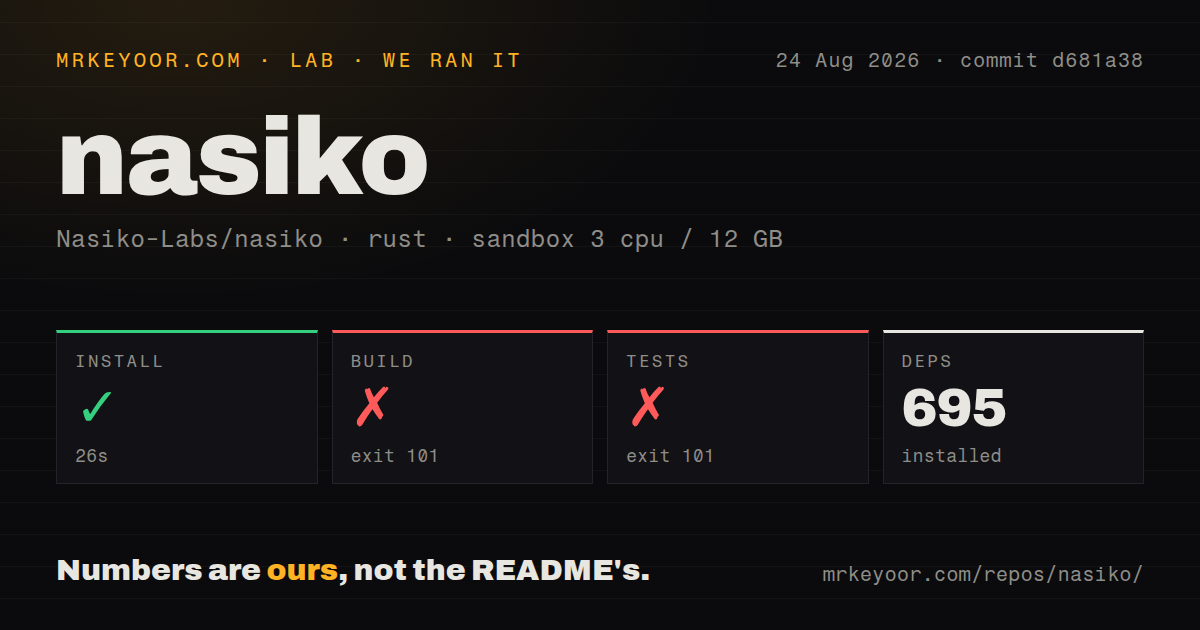
Our sandbox run at commit d681a38 installed 695 packages in 26 seconds, using 3 CPUs and 12 GB of RAM in an unprivileged container with no secrets. The checkout contained 861 files, about 175,696 lines of source, and occupied 10.9 MB. Installation succeeded, so dependency retrieval was not the step that stopped us.
The build ran for 279 seconds and exited with code 101. Its final output shows Rust compiling crates including goose, then reports two errors in the nasiko-server library and refers to rustc --explain E0560. The test command reached the same library failure after 111 seconds and also exited 101. Its tail shows Criterion-related crates compiling before the same summary. The lines do not show enough context to name a cause.
The repository had 2 CI workflow files, a Compose file, no Dockerfile, and no top-level tests directory in our measured checkout. Rust tests may live beside source, and the test command compiled Criterion, so that signal does not prove tests are absent. Our run produced no passing test result. We evaluated the dependency path but never reached a running control plane.
One Compose command starts a seven-container platform
The README's trial path starts 7 named containers with docker compose up -d. Compose builds the Rust server and starts Postgres, Redis, RustFS, the OpenTelemetry collector, Tempo, and Loki alongside it. That is 7 named containers including the server. The command saves assembly work, but the result is a small platform rather than a utility.
SECRETS_ENCRYPTION_KEY must be a base64 32-byte key, JWT_SECRET signs sessions, and the bootstrap admin defaults should be replaced. An OpenAI key is optional in the variable table, though model-backed routing needs a provider. The embedded registry uses S3-compatible storage. A lasting deployment needs volume backups, TLS, credential rotation, and monitoring for the central path.
Native development needs Rust 1.85 or newer because the workspace uses the 2024 edition. It also needs just and Docker; cargo-watch is optional. Native Docker on Linux does not create host.docker.internal by default. The README gives a host-gateway mapping or an alternate MCP gateway URL, plus specific fixes for linkers, Docker sockets, stale login data, and port conflicts.
The August main branch lacks a matching release
GitHub recorded a push on August 25, 2026, one day after commit d681a38. The repository showed 17 open issues and pull requests combined. Open issue #121 reports that one upload path writes AgentCard.json while parts of local orchestration look for Agentcard.json, which can trigger fallback registry data. Teams using local deployment should test that path.
The latest GitHub release is v1.0.0 from February 12, 2026, titled as a macOS desktop application. The current README describes a Rust control plane with A2A, MCP, LLM routing, and stateful services. The August push shows work continues, so the old tag is not evidence of abandonment. It does leave operators without a recent tagged milestone matching the product on the main branch.
Use it for an A2A 1.0 lab, not production yet
Nasiko puts identity, routing, tool permissions, secrets, loop limits, and traces on every call path. A team committed to A2A 1.0 could learn from a private trial. A team with one agent, custom HTTP services, or an existing gateway will take on more infrastructure than the control plane removes.
commit d681a38 is not a production candidate based on our results. Both build and test compilation stopped in nasiko-server, and v1.0.0 describes a different application. Pin a later revision, repeat the build in a clean environment, and exercise deployment plus AgentCard.json handling before trusting it with provider keys or traffic.