One front door for model APIs
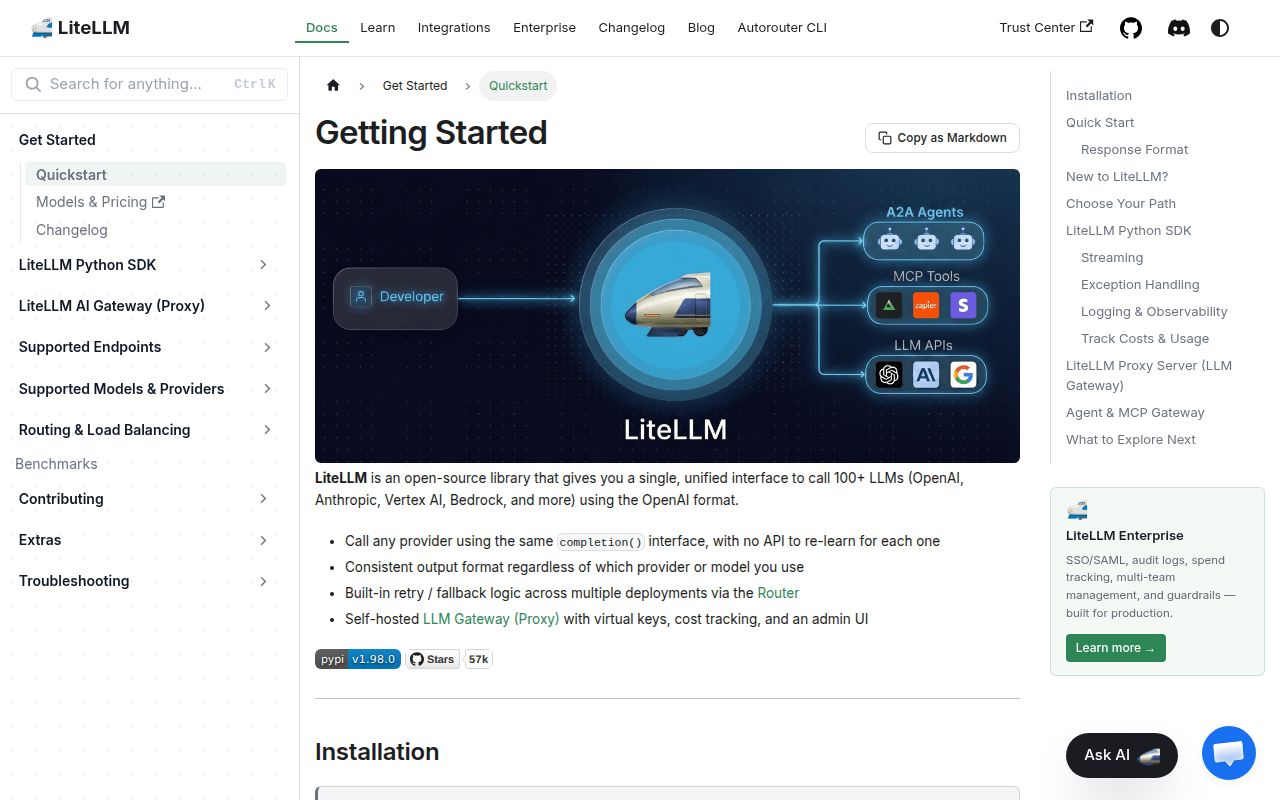
LiteLLM addresses a problem that appears as soon as an application uses a second model provider. OpenAI, Anthropic, Bedrock, Vertex AI, Azure, and smaller vendors differ in authentication, model names, request fields, streaming events, errors, and usage accounting. LiteLLM translates a common call into provider-specific requests and normalizes the response. Developers can use it as a Python library or run the proxy as a shared service.
The library path is appropriate when one application wants provider choice without another deployed component. The gateway path is more consequential. It centralizes provider keys and presents virtual keys to clients, then applies budgets, routing, fallbacks, rate limits, guardrails, and logging. That gives a platform team one policy point, while applications keep an OpenAI-style client and base URL.
Coverage is unusually wide. The README lists chat completions, Responses, embeddings, images, audio, batches, reranking, Anthropic messages, agent-to-agent calls, and MCP tools. The matrix is also a warning against assuming interchangeability. Many provider rows have empty cells. A common request shape reduces integration work, but a model cannot gain an endpoint its vendor does not implement.
The gateway becomes sensitive infrastructure
A proxy that holds every model credential is more than a convenience service. If it is exposed or misconfigured, an attacker can spend across providers and reach models that individual applications could not. Production installations should isolate the admin surface, rotate the master and provider keys, restrict outbound destinations, protect configuration, and send audit records somewhere operators will inspect.
Virtual keys are useful because teams and projects do not need raw vendor secrets. Budgets and spend attribution can make a shared model program manageable. Yet those controls depend on correct model pricing, token accounting, and request ownership. The v1.98.0 release includes fixes for streamed costs, batch attribution, prompt-caching savings, pricing data, budgets, roles, and caller-scoped file listings. That activity shows how much policy logic lives inside the gateway.
Routing adds another set of decisions. LiteLLM can balance deployments, cool down failed targets, retry, and fall back to other models. A fallback may return a response while changing price, latency, context limits, safety behavior, or output quality. Teams should define which substitutions are acceptable per workload and log the deployment that served each request. Availability is useful only if the replacement still meets the product's contract.
What happened when we ran it
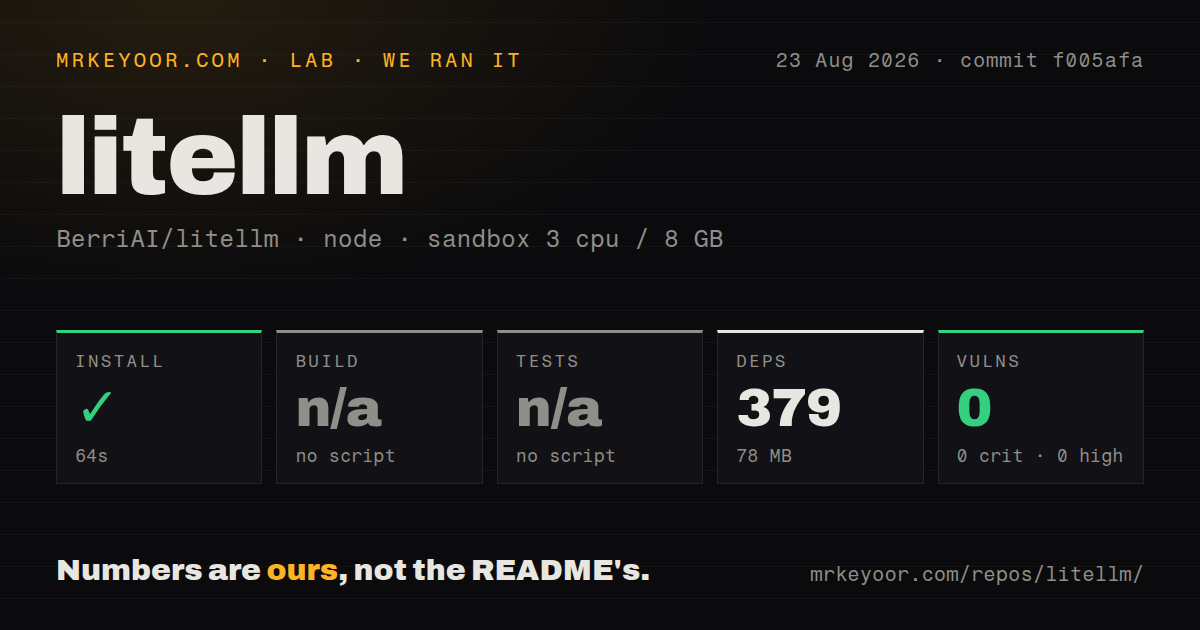
We cloned commit f005afa into an unprivileged Node 22 Debian container with 3 CPUs, 8 GB of RAM, and no secrets. The checkout was 150.4 MB, containing 9,508 files and about 2,422,783 lines of source. It includes a Dockerfile, a Compose file, a tests directory, and 45 CI workflow files.
The npm install completed in 64 seconds. It added 379 packages and occupied 78 MB on disk. npm audit reported 0 known vulnerabilities: 0 critical, 0 high, 0 moderate, and 0 low. These figures describe the npm dependency set exercised by our harness at that commit.
There was no npm build script or target, so the build step was skipped. There was also no npm test script or target, so we did not run tests and have no pass count. The repository's tests directory and CI configuration show that tests exist elsewhere, but substituting a different command would violate the measured run. The result is narrower than a full validation of the Python SDK or proxy.
MCP and agent traffic fit the same policy point
LiteLLM can load MCP tools into a model call and can expose configured MCP servers through the gateway. That is a logical extension of its role: model requests and tool access can share authentication and policy. Cursor and other clients can point at the gateway rather than receiving credentials for each tool server.
Tool calls carry higher stakes than text generation because they may read repositories, query business data, or change external systems. The README example includes a require_approval setting, and operators should make that choice per server and tool rather than copy a permissive example. Timeout, identity forwarding, result logging, and least-privilege credentials matter as much as model routing. A gateway can centralize those controls, but centralization does not create a safe policy automatically.
A2A support likewise lets the proxy invoke configured agents. This is useful for organizations standardizing one access layer across models, tools, and agents. It also expands the blast radius of a configuration mistake. Start with a small provider and endpoint set, then add routes after ownership, budgets, and audit visibility are clear.
Release pace and documentation
The repository was pushed on August 25, 2026, and v1.98.0 was released on August 23. GitHub reported 4,902 open issues and pull requests combined. That number is not a bug count, but it does reflect a huge support and development surface. The current release notes contain many provider-specific fixes alongside proxy authorization, cost, routing, UI, and test changes. Pinning versions and reading release notes should be part of deployment.
Documentation covers providers individually as well as the proxy, Docker quick start, configuration, virtual keys, routing, observability, MCP, and A2A. The amount of material is necessary but can be hard to navigate because LiteLLM spans an SDK, gateway, admin UI, and enterprise features. Buyers should verify that the exact feature they need is in the open-source edition and supported by their selected deployment mode.
LiteLLM pays off when several applications and providers already create duplicated integration and governance work. Put it behind a stable internal endpoint, test provider translations with real application fixtures, and treat upgrades like changes to an API gateway. A single-provider prototype should keep the vendor SDK. A shared AI platform will usually be better with LiteLLM than with a homegrown collection of adapters.