The account profile carries useful work between posts
The most useful artifact in Wenzi's workflow is the account profile. It records who the creator serves, what they can credibly claim, how they write, and which topics or visual choices they should avoid. That gives later drafting sessions something concrete to consult. A creator who repeatedly tells an agent that a draft sounds unlike them may get more value from this shared brief than from another collection of headline prompts.
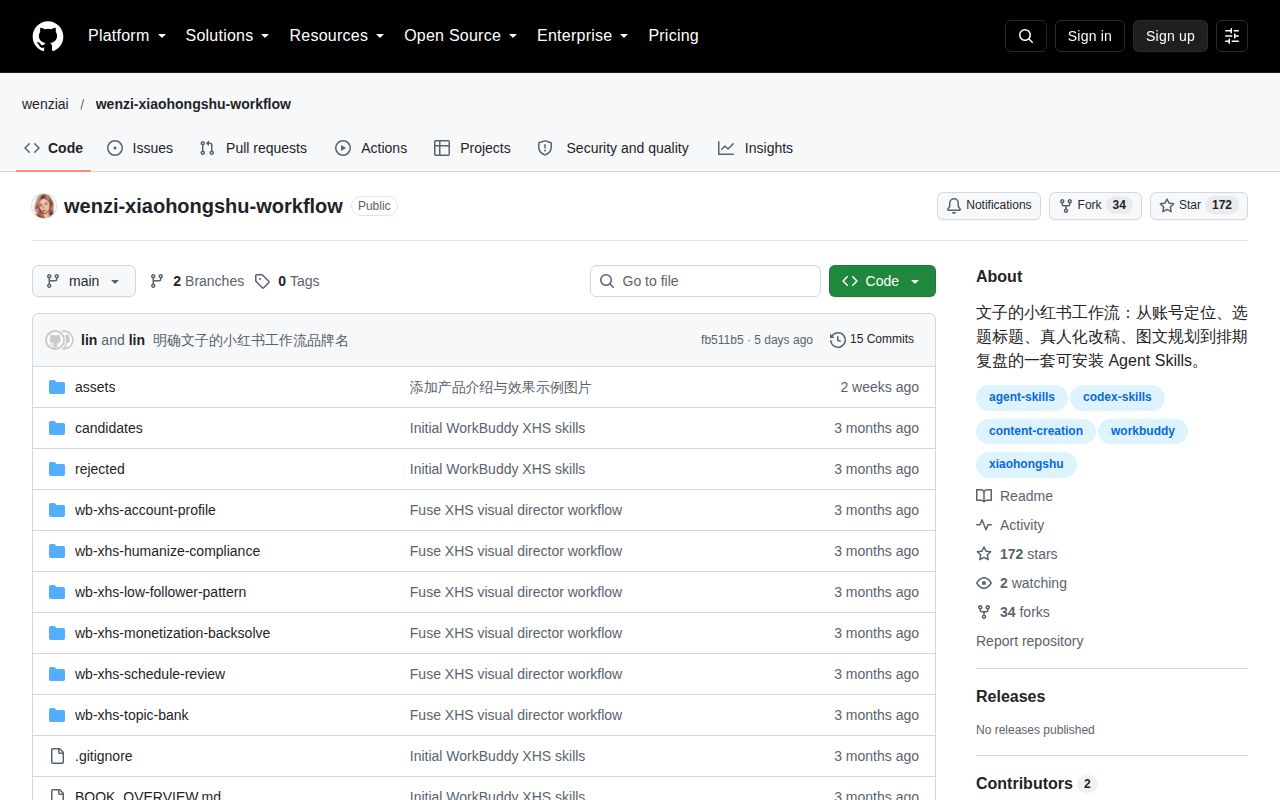
The former wenziai/wenzi-xhs-agent-skills address redirects to wenziai/wenzi-xiaohongshu-workflow. Our lab record refers to commit fb511b5 on October 16, 2026, under the earlier name. The current README and the skill bodies we read are Chinese, and the root listing contains no English README. This is a practical language requirement, because the useful details are inside instructions and failure-mode notes, not just in the folder names.
What happened when we ran it
Our lab did not run this skills pack: its language field was null, no supported ecosystem was detected, and no Dockerfile was present. The intended sandbox had 3 CPUs and 8 GB of RAM, with no secrets or elevated privileges, but no image was assigned. There are no measured installation, build, test, audit, or agent-behavior results. Copying instructions into an agent and observing whether they work would require a different evaluation.
The README says each skill directory contains instructions and prepared trigger examples. That is useful material for checking intended behavior, but it does not supply a passing result from our sandbox. The project also lists an automatically executable trigger and behavior-regression system as future work. Treat those items as unfinished. They are relevant if you want to distribute the same workflow across several agents and expect consistent selection and output.
Copying the skills still leaves the host to configure
The documented setup copies the wb-xhs-* directories into a compatible agent's skills folder, then restarts the application. There is no Xiaohongshu login or posting credential in that copy step. The host supplies the model, filesystem access, and whatever memory or visual-generation capabilities the workflow needs. Someone already using a compatible agent may find this easy to inspect, because the main product is readable instructions rather than another running service.
Our unused 8 GB environment says nothing about how much context your chosen model will need. More directly, the account-profile skill warns that WorkBuddy's memory mechanism can change. It asks for a readable profile file and periodic updates. Before relying on persistence, begin another session and confirm that the agent retrieves the actual profile. A claim that the assistant remembers you is weaker than seeing it use the saved boundaries correctly.
Real source material determines whether rewriting helps
The editing skill asks for actual experiences, situations, and evidence, then checks whether the rewrite matches the account's voice. That is a sound request for inputs. A creator who supplies only a topic and an abstract personality description leaves the agent little factual material to work with. Personal language samples and an explicit list of supportable claims give an editor something to accept, reject, or correct in the resulting draft.
The lab's October 16 record contains no audience experiment, so the README's screenshots cannot become our evidence of growth. The project itself disclaims guaranteed followers, traffic, or monetization. Its rewriting guidance also warns against relying on automatic checks alone. Use your own records to distinguish a true personal detail from an attractive sentence the agent supplied, and inspect the actual images before treating a page plan as finished visual content.
A publishing calendar is an editorial output
The scheduling skill produces a calendar, production tasks, and a review board. It asks the user to track exposure and engagement, then feed findings into the account profile. That is a repeatable working routine for a solo creator who otherwise loses useful observations in chat history. It also gives the person a way to reserve time for image planning and review before a scheduled post date arrives.
The inspected instructions do not document an authenticated publishing connector or automatic account-metric collection. If you need unattended posting, the calendar alone will not meet that requirement. The review skill also warns that small samples can mislead, which matters when one unusually successful post tempts you to change direction. Judge whether the routine improves your editorial decisions before attributing an account's performance to the skill pack.
The current repository has little public feedback
GitHub showed 172 stars, an October 12, 2026 push, and no open issues or PRs. The issue endpoint returned an empty list, and the latest-release endpoint returned no release. There is current repository activity, but little public discussion to assess how other users handle persistence or workflow selection. GitHub detected no license, and a root LICENSE request returned no file. Resolve reuse terms with the owner if redistribution matters to your adoption.
For a Chinese-speaking creator who already maintains evidence and account records, this is a reasonable routine to inspect and adapt. dbskill is broader if business and content diagnosis are the job, while XHS Visual Director concentrates on image production. Start Wenzi's pack with an existing draft and known profile, then inspect whether the output respects both. Keep it only if it reduces repeated explanation without making you invent the experiences that the writing needs.