
Activepieces joins visual workflows and TypeScript integrations
Activepieces is a self-hosted automation builder in the same broad category as Zapier and n8n. A user connects services, lays out triggers and actions, adds branches or loops, and publishes the flow. Developers can create new "pieces" in TypeScript when the catalog does not cover a service. Those packages remain inspectable and versioned, which is a better fit for engineering ownership than a closed connector.
The same piece system now reaches agent clients through MCP. The README says contributed pieces become available as MCP servers for Claude Desktop, Cursor, or Windsurf. This can spare a team from maintaining separate tool adapters for agents and visual workflows. It also means permissions deserve close review: a convenient connector can carry write access to email, files, tickets, or databases.
The Community Edition is MIT, while enterprise code is commercial
Licensing needs a careful read before standardization. The README identifies the Community Edition as MIT and says enterprise features have a commercial license. GitHub's repository API returned no single SPDX license identifier, which fits a source tree containing more than one license. A procurement review should map required features to the relevant edition instead of treating the whole checkout as uniformly MIT.
The product scope is large. Flows support retries, versioning, HTTP calls, npm code, forms, chat interfaces, and approval steps. The repository also contains a community integration catalog and enterprise packages. That breadth is useful for a platform team. It creates more upgrade and security surface than a narrow job runner, especially when many service credentials are stored in one automation system.
What happened when we ran it
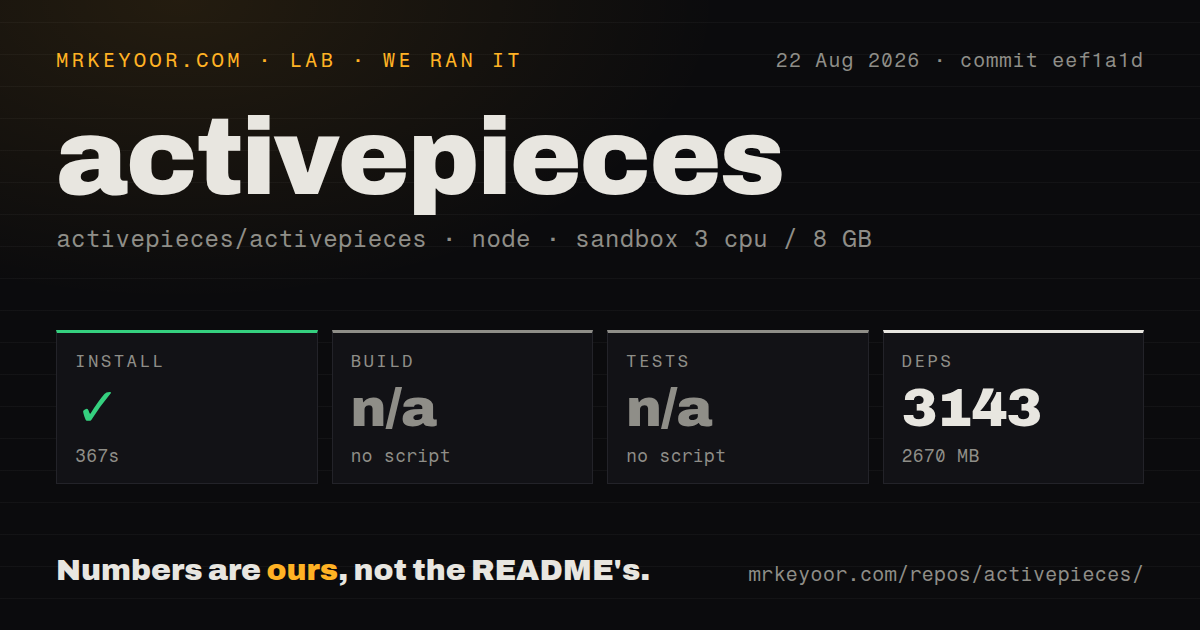
Our sandbox installed commit eef1a1d in 367 seconds. Bun pulled 3,143 packages, and the resulting dependencies occupied 2,670 MB. The checkout itself contained 25,125 files, roughly 1,343,137 lines of source, and 167 MB of repository data. Those numbers make a clean source setup expensive enough to budget in CI caches and developer machines.
The harness found no build script or target, so it skipped the build. It also found no test script or target and skipped tests. A skipped step is not a success: our run provides evidence that dependency installation worked, but it gives no local compiler or test-suite result for commit eef1a1d. The repository did contain 37 CI workflow files, a Dockerfile, a Compose file, and workspace configuration.
No failure log exists for the skipped steps because no runnable root target was detected. Teams evaluating the source should identify the exact package and command their deployment depends on, then put that command in their own release check. The monorepo's absence of a generic root target makes the quick clone-and-verify experience weaker than the product's polished visual interface suggests.
Jira polling and builder accessibility need acceptance tests
Open issue 15069 describes a concrete Jira Cloud risk. It says five JQL polling triggers can miss an event when an eventually consistent search result advances a single timestamp watermark past that event. The report names new issues, status updates, comments, assignments, and attachments. If a missed ticket can breach an operational promise, reproduce those trigger cases before moving the workflow out of shadow mode.
Two August 25 accessibility reports concern the flow editor itself. Issue 15055 says rich-text step inputs can lack an accessible name because a label points to an ID that never reaches the editable element. Issue 15054 says trigger and read-only canvas nodes may be exposed as disabled buttons even though clicking opens the step. Screen-reader users and label-driven browser tests can fail on those controls.
These are open reports, not proof that every deployment hits every defect. They are specific enough to shape an acceptance suite. Test the integrations your organization actually uses, verify event delivery under delays, and include keyboard and screen-reader checks for authoring flows. A connector count does not compensate for one silently missed business event.
Daily activity supports the project, but upgrades still need care
GitHub recorded 24,040 stars, 493 combined issues and pull requests, and a last push on August 26, 2026. Release 0.88.4-hotfix.1 arrived on August 25. Its only listed fix addresses worker memory use related to prewarming the flow cache, and its upgrade note directs self-hosters to review breaking changes before updating. That is active maintenance with real operational churn.
Activepieces is most convincing when one team owns automation as a shared platform. The 37 workflow files, frequent releases, custom piece model, and worker architecture give that team room to operate. A small group seeking five dependable automations may prefer a hosted service or narrower runner, since the 2,670 MB install and mixed product surface create ongoing work beyond drawing the first flow.