Argusic reports installing mcode-stack in 2 minutes with no errors on a clean machine without a GPU. Its record identifies commit 49a3ff4dfd1a and says ronny and jiachen loaded as Codex plugins, with all skills present, and passed structural and plugin validation. For an existing coding-assistant user, that is a concrete installation result attached to a specific snapshot. Argusic's installation record
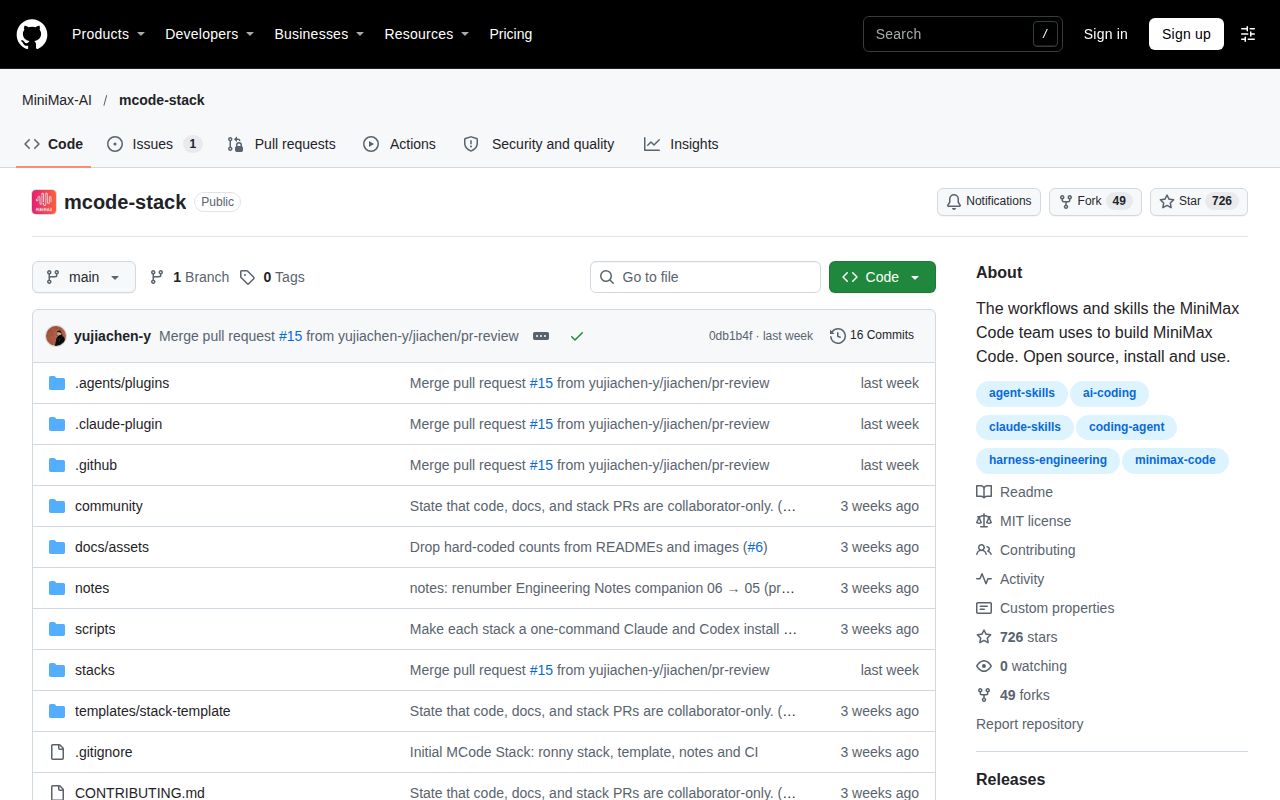
Mcode-stack contains workflows and skills; the MiniMax Code application lives in a separate repository. The decision here is which engineering task you want help organizing: reviewing a diff, carrying work into a new session or examining context costs. A single skill is a practical starting point because its stated inputs and output give you something specific to assess against the work already on your desk.
What people use mcode-stack for
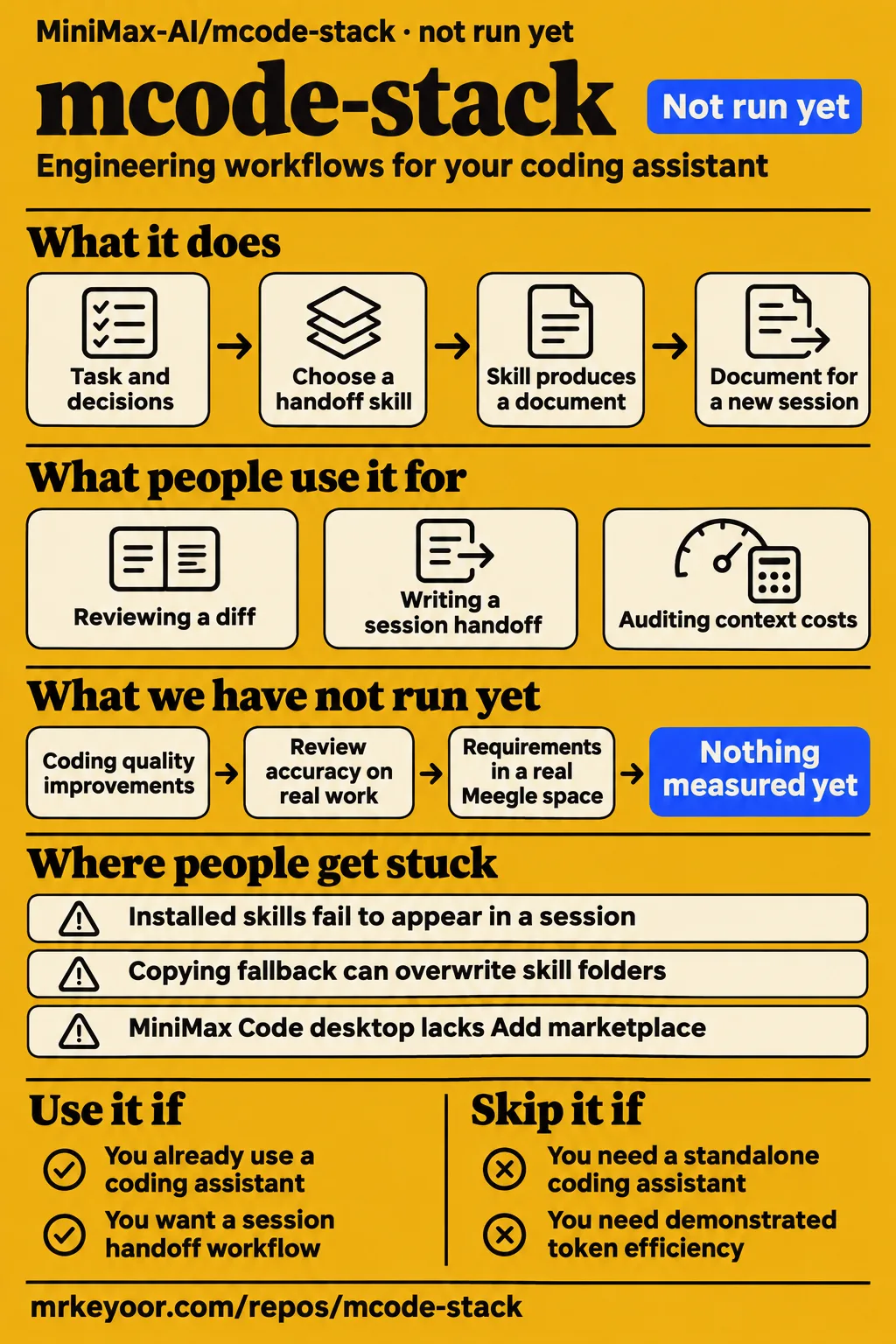
Mcode-stack documents skills for reviewing a diff, writing a session handoff and auditing context costs. Independent-review takes a diff, requirement and test results into a clean context; handoff-doc produces a document for a new session. Tool-budget-audit examines tool context costs, while context-tax-audit examines material injected into requests. These are distinct tasks, so choose by the problem you need to address. README skill catalog
| Who used it | What they did | Recorded outcome |
|---|---|---|
| MiniMax Code team, according to the project's announcement | Used workflows and skills while building MiniMax Code | The author reports daily internal use. Author's announcement |
| Argusic Runner | Installed ronny and jiachen as Codex plugins and checked their structure | Both stacks installed with all skills present and passed structural and plugin validation. Argusic's installation record |
| 0exp's tester | Installed ronny through Claude Code in a clean container and inspected plugin files | The account records installation and file inspection. 0exp's installation account |
The README also assigns subagent-split-check to deciding whether work belongs in a subagent or the main loop, and long-command-check to a ten-point audit of long shell commands and background tasks. Those choices concern how an assistant carries out work. A handoff document instead concerns what the next session needs to know. Matching the skill to that immediate need makes the catalog easier to navigate than installing every stack at once. README planning and session catalog
What happened when we ran it
Our November 18, 2026 run at commit 0db1b4f stopped before workload execution: the harness found no supported ecosystem for its JavaScript classification and no Dockerfile. Our run recorded a configured allocation of 3 CPUs and 8 GB RAM. Installation, build and test durations are null in the harness record; its totalS field is 3 seconds for the stopped harness attempt.
| Our recorded check | Result | What it tells you |
|---|---|---|
| Checkout | commit 0db1b4f, November 18, 2026 | Identifies our source snapshot |
| Build/test harness | NOT RUN: no supported ecosystem, language classified as JavaScript, no Dockerfile | The harness skipped execution |
| Container safety step | FAILED: none of compose.yaml, compose.yml, docker-compose.yaml, docker-compose.yml exists | The runner's required Compose file was absent |
| Teardown | ok | Cleanup completed |
The safety-step record calls the repository unsafe under its rule requiring a Compose file. That is the runner's stated reason for stopping. The teardown record says cleanup completed. A separate generated run summary claims deployment through the project's own Docker Compose on November 18, 2026, with every port bound to 127.0.0.1. The explicit failed safety step contradicts that deployment statement and determines the outcome reported here.
Argusic's successful route was plugin installation: ronny and jiachen became available in Codex at commit 49a3ff4dfd1a. Our stopped route used commit 0db1b4f and a runner requiring Compose. Keeping the revisions and installation methods alongside their outcomes explains why the records differ without turning a runner requirement into an installation requirement for Markdown skills. Argusic's result and snapshot
Where people get stuck: installation routes and durable requirements
0exp reports skills missing from a current session, an older Claude Code installation route and deletion of same-named folders in the copying fallback. The README also describes gradual rollout of MiniMax Code desktop marketplace addition. A plugin installation, an individual skill copy and a local MiniMax Code plugin use different routes, so the command you choose should match the assistant and installation type. 0exp's troubleshooting, README installation routes
| Reported problem | Suggested response | Evidence status |
|---|---|---|
| Installed skills fail to appear in the current session | Start a new session | 0exp documents this workaround |
| Older Claude Code lacks the one-command marketplace option | Add the marketplace, then install ronny@mcode-stack | README and 0exp describe the older route |
| Neither claude nor codex is on PATH | Preserve customized same-named folders before using the copying fallback | 0exp reports deletion before copying |
| MiniMax Code desktop lacks Add marketplace | Use the documented single-skill copy or local-plugin route | README describes gradual marketplace rollout |
| Agent repeatedly needs complex requirements explained | Keep confirmed rules, evidence, open decisions and acceptance examples in a reusable table | ChongjinHuang proposes this in issue #4 |
Issue #4 describes repeated clarification while developing an AI-assisted medical diagnosis product. The issue author reports difficulty getting AI to understand functional requirements and implementation details. ChongjinHuang proposes making clarification a reusable artifact, with columns for the actor and goal, confirmed rule, evidence, open decision and acceptance example. Recommendations and assumptions belong in separate columns. Requirements discussion
The example in that discussion makes the intended distinction concrete: a reviewer must confirm before final submission, and a draft cannot be submitted until that confirmation occurs. The rule states the required behavior; the acceptance example makes it checkable. For a team facing repeated clarification, the proposed next step is to preserve one agreed requirement in that form and carry it into the implementation discussion.
Which stack fits your task?
Ronny covers review, context and session work; jiachen adds review and content workflows; req-tpm handles requirements involving Feishu and Meegle; youfang produces architecture presentations. The supplied HEAD catalog therefore extends beyond the original ronny and jiachen pairing. Stack selection matters because a session handoff, a requirement lifecycle and an offline slide deck have different outputs and dependencies. HEAD README catalog
| Stack | Documented purpose | Decision it raises |
|---|---|---|
| ronny | Context audits, session handoffs, review and owning agent work | Which recurring engineering task needs attention? |
| jiachen | MCode Review in an agent and CI, review tuning, lifting-loops and content work | Which review or content artifact do you need? |
| req-tpm | Requirement lifecycle with Feishu documents and Meegle status | Are those services part of your team's work? |
| youfang | Architecture walkthroughs as a single offline HTML slide deck | Is an architecture presentation the required output? |
Req-tpm requires logged-in meegle CLI access and lark-cli access for Feishu documents. Its instructions require replacing assumed mappings with the actual space configuration before the first real write. Anything visible to others, including comments, mentions and status transitions, must be shown to the requester and confirmed first. Service access and approval are therefore explicit parts of that workflow. Req-tpm dependencies and action rules
0exp describes jiachen's content pipeline as intended for Chinese drafts and Xiaohongshu posts. For an English-speaking reader, that output is a more useful selection criterion than the fact that the workflow shares a repository with code-review skills. The same principle applies to youfang: choose it when the required artifact is the architecture presentation named in the catalog. 0exp's stack description, README catalog
Context and review capacity matter as usage grows
The README's review-capacity-check asks teams to limit agent work to what they can stand behind, and taste-to-checks turns repeated corrections into tests, lint, hooks or CI steps. These skills connect an immediate review problem with a durable response. If the same correction keeps appearing, the catalog points toward recording it as a check rather than relying on another reminder in a future conversation. Owning-agent-work catalog
QAI estimates making-content's body at about 5,643 tokens against a suggested limit under 5,000. It says Claude Code retains only the first 5,000 skill tokens after compaction and recommends moving detail into reference files loaded when needed. QAI also reports reference files that pr-review's SKILL.md does not link, recommending direct links and instructions for when to read them. Making-content assessment, Pr-review assessment
A useful local assessment would keep the representative diff, requirement and actual check output together, then record which review comments prompted changes and which were rejected, with reasons. That proposed method gives the team a record of the workflow's contribution to a particular change. It also follows the catalog's emphasis on evidence and turning repeated corrections into checks, without treating the number of installed instructions as a result.
Security checks and licensing affect what you enable
QAI describes checking every text file in pr-review against 45 published patterns at commit 0db1b4f on November 11, 2026. Those patterns include download-and-run commands, hidden text and credential access. Separately, 0exp's ronny inspection says commands requested by its skills go through the assistant's normal permission prompts. These accounts describe different checks, so keep each source attached to the behavior it actually reports. QAI pattern-check description, 0exp's ronny inspection
0exp reports an MIT repository license with an exception for six engineering skills adapted from Google Engineering Practices, whose material stays under CC-BY 3.0. That makes the applicable notice relevant when copying or redistributing those instructions. When assembling an internal skills pack, read the notices for the files you take; the repository-level license label alone omits the exception described in the supplied account. 0exp's license account
Mcode-stack vs Superpowers, Anthropic skills and review alternatives
Superpowers describes a software development methodology, while Anthropic's repository supplies skills for creative, technical, enterprise and document tasks. Scope is the useful comparison here: a process spanning a software change, a specialized task skill or one of mcode-stack's engineering workflows. The narrower review alternatives below come from the attributed accounts, with their stated approach kept separate from the primary repository descriptions. Superpowers README, Anthropic skills README
| Alternative | What the evidence describes | When to compare it first |
|---|---|---|
| obra/superpowers | Design clarification, implementation planning, test-driven development and review | You want a development process from design through implementation |
| anthropics/skills | Creative, technical, enterprise and document tasks | You need document creation or another specialized task |
| tstack | Explainx describes three-model review | You want to assess model diversity against input isolation |
| Anthropic PR Review Toolkit | 0exp lists specialized pull-request review agents | Pull-request review is the job you are choosing for |
Superpowers emphasizes true red/green TDD, YAGNI and DRY. Anthropic's repository includes document creation and editing skills for docx, pdf, pptx and xlsx. For review architecture, Explainx contrasts tstack's three reviewers with mcode-stack's one clean-context reviewer. These descriptions help narrow the shortlist by process and output before comparing installation routes. Superpowers methodology, Anthropic document skills, Explainx's tstack comparison
Outdated claims, corrected
MarkTechPost's launch coverage describes two stacks and 17 skills, while the supplied HEAD README names ronny, jiachen, req-tpm and youfang. The useful correction is to the current catalog description: the launch count belongs to its earlier snapshot. The supplied records also update the status of a companion note and the existence of outside installation accounts. MarkTechPost launch article, HEAD README
| Older description | Supported correction |
|---|---|
| MarkTechPost, its republications and ClaudeMap describe only ronny and jiachen | The supplied HEAD README also names req-tpm and youfang and adds owning-agent-work skills |
| The launch article says the per-turn context-tax companion note is upcoming | The supplied README lists note 05, One small field can break the whole prefix cache, with context-tax-audit |
| Explainx says the project has had no outside testing | Argusic and 0exp subsequently published installation reports |
Argusic's installation record and 0exp's account replace a blanket current statement of no outside testing with named activities: Codex plugin installation and validation in one case, Claude Code installation and file inspection in the other. The supplied Reddit record is an announcement inviting its first comment. The video material introduces a sample project called PulsePay. These records contribute different kinds of information and should be read for those specific purposes. Argusic installation, 0exp inspection, Reddit announcement, PulsePay introduction
FAQ
Issue #4's proposed response to repeated requirement clarification is a reusable table of confirmed rules, evidence, open decisions and acceptance examples. Installation questions instead turn on the assistant and selected stack: the README documents Claude Code, Codex and MiniMax Code routes. The questions below come from the supplied question inventory and keep each answer attached to its relevant instructions or reported activity. Requirements discussion, README installation instructions
How can mcode-stack help AI understand complex product requirements without repeated clarification?
ChongjinHuang proposes storing confirmed requirements in a reusable table, with assumptions and recommendations kept separately. The example pairs a reviewer-confirmation rule with an acceptance example that blocks submission until confirmation. This gives the agent a specific rule to follow and the reviewer a behavior to check, rather than leaving the decision buried in a conversation. Issue #4's proposed requirements artifact
Does mcode-stack work with Claude Code and Codex?
The README documents plugin installation routes for Claude Code and Codex. The independent accounts describe different installations: 0exp installed ronny through Claude Code, while Argusic installed ronny and jiachen through Codex. For setup, use the route for your assistant and stack; the troubleshooting table above covers the older Claude Code route and session discovery behavior. README routes, 0exp installation, Argusic installation
Do I need MiniMax Code to use mcode-stack?
No. The README gives Claude Code and Codex routes alongside MiniMax Code options, including plugin installation and individual skill copies. Mcode-stack contains the workflows and checklists; MiniMax Code's application source lives separately. An existing assistant user can therefore choose the documented route for that assistant rather than installing another coding application to obtain the skills. README project relationship and installation options
Does mcode-stack need an account or API key?
0exp says the Markdown skills themselves need no account or API key. Req-tpm has additional dependencies: logged-in meegle and lark-cli access for its requirement and document work. The selected assistant also has its own access requirements. Reading an instruction pack and authorizing a workflow to use external services are separate setup steps. 0exp FAQ, Req-tpm dependencies
Is mcode-stack suitable for beginners?
0exp recommends brief, handoff and evidence skills for beginners, while placing harness and tool-budget work with people tuning their agent setup. A handoff document is a concrete starting point because a newcomer can read whether it carries the task, decisions and next work into another session. Choose that task because you need the output, rather than enabling the whole catalog. 0exp beginner guidance
What alternatives should I compare with mcode-stack?
Superpowers documents a development methodology, and Anthropic skills supplies specialized task examples, including document work. The supplied accounts also discuss tstack's three-model review and list Anthropic PR Review Toolkit for specialized pull-request review. Choose a comparison according to the work you need organized; the table above separates development process, document output and review architecture. Superpowers README, Anthropic skills README, Explainx comparison, 0exp alternatives
Should I delegate a task to a subagent or keep it in the main session?
The README assigns that decision to subagent-split-check, described as deciding whether work goes to a subagent or stays in the main loop. It is one of ronny's planning skills, alongside small-PR and change-description guidance. Use it for a task whose delegation is actually in question, with the required work and dependencies available to the assistant. README planning catalog
What evidence should I request when an agent says its work is done?
The README's independent-review takes the diff, requirement and test results, while evidence-first-review focuses on evidence, gaps in checks and silent decisions. Those inputs suggest a practical request: the changed code, actual check output and the acceptance criteria the checks address. Together they give the reviewer material for assessing the agent's completion claim against the requested behavior. README review catalog
How long does mcode-stack take to install?
Argusic reports 2 minutes for its installation at commit 49a3ff4dfd1a, with no errors on a clean machine without a GPU. Its account describes ronny and jiachen as Codex plugins and reports structural and plugin validation. That duration belongs to the recorded installation and setup identified by Argusic, so keep the activity and snapshot alongside the figure. Argusic installation result
Does mcode-stack need a GPU?
Argusic reports successful plugin installation on a machine without a GPU. The recorded activity was loading ronny and jiachen into Codex and checking their structure and plugin format. For that installation, the hardware description is explicit: a clean machine without a GPU, at commit 49a3ff4dfd1a. The record ties that hardware fact to a specific activity. Argusic hardware and installation account
What can go wrong when installing mcode-stack?
0exp identifies missing skills until a new session starts, older Claude Code commands and deletion of same-named directories in the copying fallback. Start a new session for discovery problems, use the documented two-step route for older Claude Code, and preserve customized folders before using the fallback. The installation table above keeps those responses beside their reported triggers. 0exp installation troubleshooting
How was mcode-stack tested, and where is the evidence?
Argusic records Codex plugin installation and structural validation; 0exp records Claude Code installation and file inspection. QAI describes pattern and format checks. Our run section records the stopped harness at commit 0db1b4f, the failed Compose safety step, successful teardown and contradictory deployment summary. Each linked account identifies the activity behind its result. Argusic, 0exp, QAI method
What we have not tested yet
Our sandbox executed no mcode-stack workload, and the supplied records provide no demonstrated improvement in coding quality, review accuracy, token efficiency or sustained reliability. The 3 CPUs and 8 GB RAM were sandbox allocations, not product requirements. The installation accounts concern their stated activities and snapshots; 0exp explicitly says it had not used the skills in a real AI session or on real work. The comparisons contain no controlled head-to-head coding result.
Req-tpm's README says the stack has not yet run against a real Meegle space, and project-specific fields, roles and states remain assumptions until looked up. Our records contain no executed service writes, MCode Review CI task, review-tuning task, content-generation task or youfang deck result. Issue #4 is an open discussion with a proposed workflow and no recorded resolution. The supplied material gives no completed PulsePay review result or identified video channel. Req-tpm boundary, Requirements issue, Video material
QAI says it does not execute skills in agents or read linked web pages. Its format results therefore do not demonstrate runtime compatibility, and its pattern results are not a security audit. The supplied records do not show whether its making-content and pr-review recommendations were implemented. 0exp's permission description concerns its inspected ronny files; it supplies no matching revision extract for an exact commit claim in this review. QAI method, Making-content findings, Ronny inspection
The sample does not establish broad adoption or a maintenance response pattern. Empty autocomplete results, incomplete video material and Bilibili results mixed with unrelated MCODE biology tutorials limit search conclusions; search demand and ranking are unknown. The GitHub metadata records a November 11, 2026 push, while the issue sample contains one requirements thread. No numerical product ratings are assigned. A representative change reviewed against its requirement and actual check output would provide more useful adoption evidence than another installation count.