The installed skill is a loader for a changing knowledge pack
The local /kun skill does very little by itself. It tells the agent to fetch four files from the current main branch, read them in full, and follow ENTRY.md. Those files describe Kun Chen's tools, inferred public opinions, and writing voice. If raw GitHub fails, the loader tries jsDelivr. If both fail, it must stop instead of guessing what the files say.
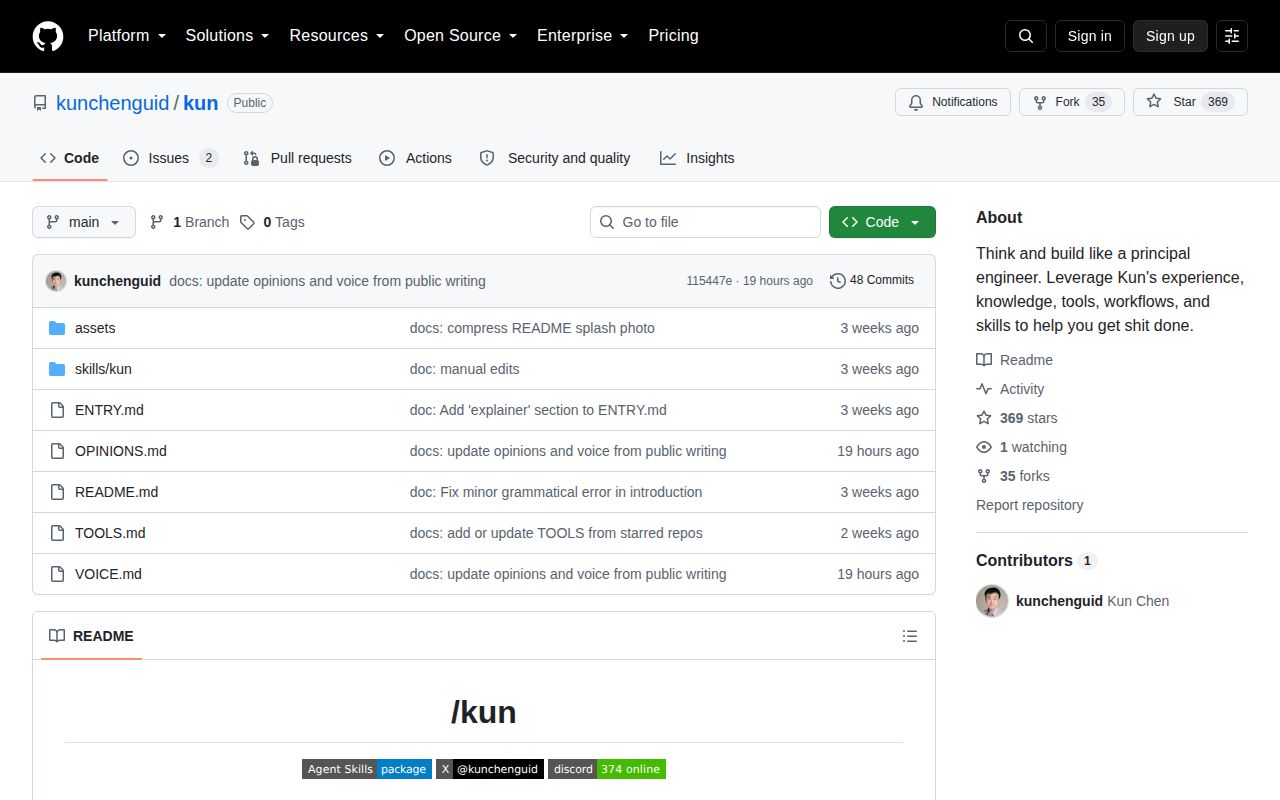
This design keeps the package current without reinstalling it. It also moves the important instructions outside the installed artifact. The GitHub tree listed 89,555 bytes for OPINIONS.md, 20,500 for VOICE.md, 14,938 for TOOLS.md, and 6,316 for ENTRY.md, or 131,309 bytes before the task and project context enter the model. Session caching prevents repeated downloads during one conversation.
What happened when we ran it
We did not run commit 63592c5. GitHub reports no primary programming language, and our harness found no supported ecosystem or Dockerfile. It therefore performed no installation, build, or test step. We inspected the Markdown, repository tree, issue activity, and loading instructions, but we did not invoke /kun inside every supported agent or measure answer quality.
The documented user path is one global command, npx skills add kunchenguid/kun -g. Runtime needs outbound HTTPS access to raw GitHub or the CDN fallback. No GitHub CLI or authentication is required. The README says Grok Bot automation refreshes the living documents daily in the America/Los_Angeles timezone, drawing from public X, Substack, YouTube, and Kun-owned repositories.
The workflow advice is specific enough to change agent behavior
ENTRY.md routes feature work through research, planning, implementation, and validation. Bug fixes start with reproduction, preferably an automated failing test. Refactors begin with guardrail coverage. Explanations and plans are directed toward interactive artifacts with diagrams rather than long prose. Validation uses either Kun's no-mistakes gate or an adversarial subagent review, depending on repository setup.
That is more actionable than a loose collection of quotes. An agent following the file will inspect adjacent code, reproduce defects, set up test coverage before refactoring, and seek independent review. The pack also says to admit when Kun's material does not cover a question and then fall back to the agent's own knowledge. These choices create a recognizable operating method, even when the answer never imitates the voice perfectly.
Daily updates trade reproducibility for freshness
The loader uses unpinned main URLs. A question asked on Monday and the same question asked after Tuesday's automation can run under different opinions, tool descriptions, or voice rules even though the installed skill did not change. The repository offers no tagged release to pin through its normal installation path. Teams cannot reconstruct an earlier answer unless they recorded the commit and fetched file contents themselves.
That moving boundary deserves the same review as a dependency update. A mistaken automation merge could alter planning rules, recommend a new tool, or change which validation path the agent follows. Public HTTPS prevents a private server requirement, but it does not make the content immutable. A serious setup should pin raw URLs to a reviewed commit, keep a local mirror, or record the resolved commit at the start of each session.
The persona layer is a product choice, not neutral documentation
VOICE.md tells the agent how to sound like Kun, and ENTRY.md requires that voice for the response addressing a /kun request. OPINIONS.md describes viewpoints inferred from public posts and transcripts. This is transparent in the repository, but teams should still decide whether imitating a living person's voice belongs in internal engineering advice. The useful process guidance can be separated from the persona if needed.
Licensing is the harder stop. GitHub reported no license, and issue 2 asks the author to add one so the repository can be pinned and mirrored. Public readability does not grant redistribution rights. An individual can inspect the files and use the hosted skill, while a company planning to vendor, modify, or redistribute the pack should wait for explicit terms or ask the author.
Active updates do not yet amount to a stable release record
GitHub showed 369 stars, 2 open issues, and a last push on September 29, 2026. The repository was created on September 6 and has no latest release. Pull requests are deliberately closed because this is the author's own knowledge base, while bug reports and suggestions remain welcome as issues. That governance model fits a personal skill but limits community correction through code review.
Kun works best as a perspective you choose, not as an invisible default over every task. Read ENTRY.md and the opinion headings, note the 131,309-byte context cost, and decide which workflows you actually want. For repeatable organizational use, extract those workflows into a licensed, pinned local skill. The live version is better suited to exploratory sessions where freshness matters more than reproducing the exact instruction set later.