Komodo targets the gap between Compose and Kubernetes
Komodo gives Docker-centric teams a central place to manage servers, containers, Compose stacks, Swarm services, image builds, logs, alerts, terminals, and automated procedures. It suits the point where SSH plus hand-edited YAML has become hard to govern, while Kubernetes would introduce more machinery than the fleet needs. The browser and API expose the same operational model rather than hiding a second control plane.
Core hosts the interface and API. A stateless Periphery agent runs on every managed server, reports status, retrieves logs, and performs requested actions. That layout is understandable, but it makes Core, its database, and every agent connection part of production infrastructure. Losing the dashboard should not be the first time a team discovers it never documented direct host recovery.
Git-backed resources coexist with interface edits
Komodo can define resources in its interface, read existing host files, or pull configuration from Git. Resource Sync stores servers, builds, deployments, stacks, procedures, and user groups in TOML. Operators can compare declared and live state, inspect a diff, and apply it manually or through a webhook. Managed mode can write interface changes back to Git.
This two-way model is useful for teams whose operators and developers prefer different tools. It also needs one clear authority. Decide whether Git or the interface wins, protect webhook credentials, and restrict who can approve deletions. A synchronized mistake is still a mistake. Procedures and schedules can repeat that mistake across several hosts faster than an SSH session would.
What happened when we ran it
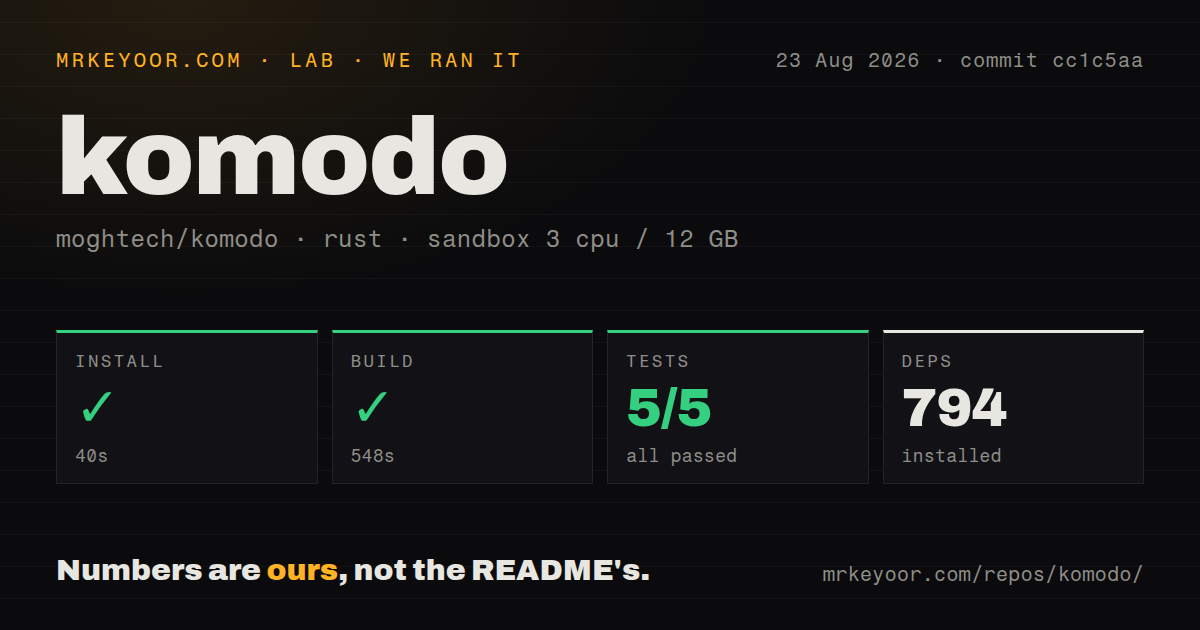
Our sandbox installed commit cc1c5aa in 40 seconds, resolving 794 Rust packages. The build succeeded in 548 seconds. Cargo tests then completed in 134 seconds with 5 passed and 0 failed. The checkout was 14 MB before installation, contained 902 files, and held about 185,300 lines of source.
The clean result matters, but the number of tests matters too. Five successful cases cannot exercise a web control plane, database behavior, agent enrollment, Docker commands, terminal sessions, permissions, failure recovery, and multi-server automation. Our scan found 1 CI workflow, no Dockerfile, and no tests directory. Treat the run as proof that the measured source builds and its available tests pass, not as proof of production safety.
The 548-second build is also a practical cost. A maintainer changing Rust code on a small runner may wait more than 9 minutes before tests start. Cache strategy and targeted checks will affect feedback time. Our timings come from an unprivileged Debian container with 3 CPUs and 12 GB of RAM, not from a deployed Komodo fleet.
Every managed host extends the security perimeter
Core needs MongoDB or FerretDB, and each server needs Periphery. The agent's operating user requires Docker access without sudo. Since Docker control can amount to host control, the enrollment key, agent private key, Core route, and permission model deserve the same care as SSH access. Installing agents with systemd is the documented recommendation; larger fleets can use Ansible.
Permissions distinguish read, execute, and write access, while separate controls cover logs, inspection, terminals, attachment, and process lists. Browser terminals can open host shells and container sessions. Those features are useful during incidents, but many organizations should disable them for ordinary users. Start with no rights and add narrow groups instead of creating a broad operator role because the interface is convenient.
Auto-update has two current v2.3.2 failure reports
Issue 1604 describes a stack whose image uses Compose substitution such as ${COMPOSE_KOMODO_IMAGE_TAG:-2}. Deployment resolves the reference, while Komodo's update check reportedly reads the literal string and sends it to Docker. The reporter saw every scheduled GlobalAutoUpdate attempt fail with invalid reference format. Teams using variable-based image tags should reproduce the check before enabling automatic updates.
Issue 1603 is more serious because its reported blast radius crosses stacks. A 10-second update-check timeout killed one subprocess, after which Periphery repeatedly disconnected and reconnected. Unrelated stacks then failed to detect newer images. The report is specific to Core in Docker and Periphery under systemd on v2.3.2; it is still a reason to test timeout isolation and monitor agent reconnects.
Secret redaction is being tightened after v2.3.2
Pull request 1601 proposes redacting conventionally named secrets from persisted operation records, update logs, TOML snapshots, and tracing spans. Its scope note matters: the change would prevent newly identified values from being stored, but would not clean historical data or rotate exposed credentials. Unusually named secrets and literals inside Compose files also fall outside its detection seam.
Until a release containing that work is verified, audit who can read operation records and what values deployments place in them. Keep secrets in a dedicated mechanism where possible, use recognizable sensitive key names, and assume a cleanup requires both record removal and credential rotation. The root README's GPL warranty disclaimer is not a substitute for this operational review.
Active maintenance comes with a large combined queue
GitHub showed 12,080 stars and 612 open issues and pull requests when fetched. The repository was pushed August 26, 2026, while v2.3.2 was published August 11. Current activity included a 2.3.3 pull request, procedure fixes, secret redaction work, and detailed user reports. The combined 612 figure should not be described as 612 bugs.
Komodo is credible because it addresses the real daily work of a Docker fleet and exposes enough policy to govern that work. Its measured build and 5 tests passed, yet those checks cover little of the operational surface. Adopt it with a staging host, backup and restore drills, narrow permissions, and an explicit route back to direct server access.