Dokploy replaces several small-team deployment chores
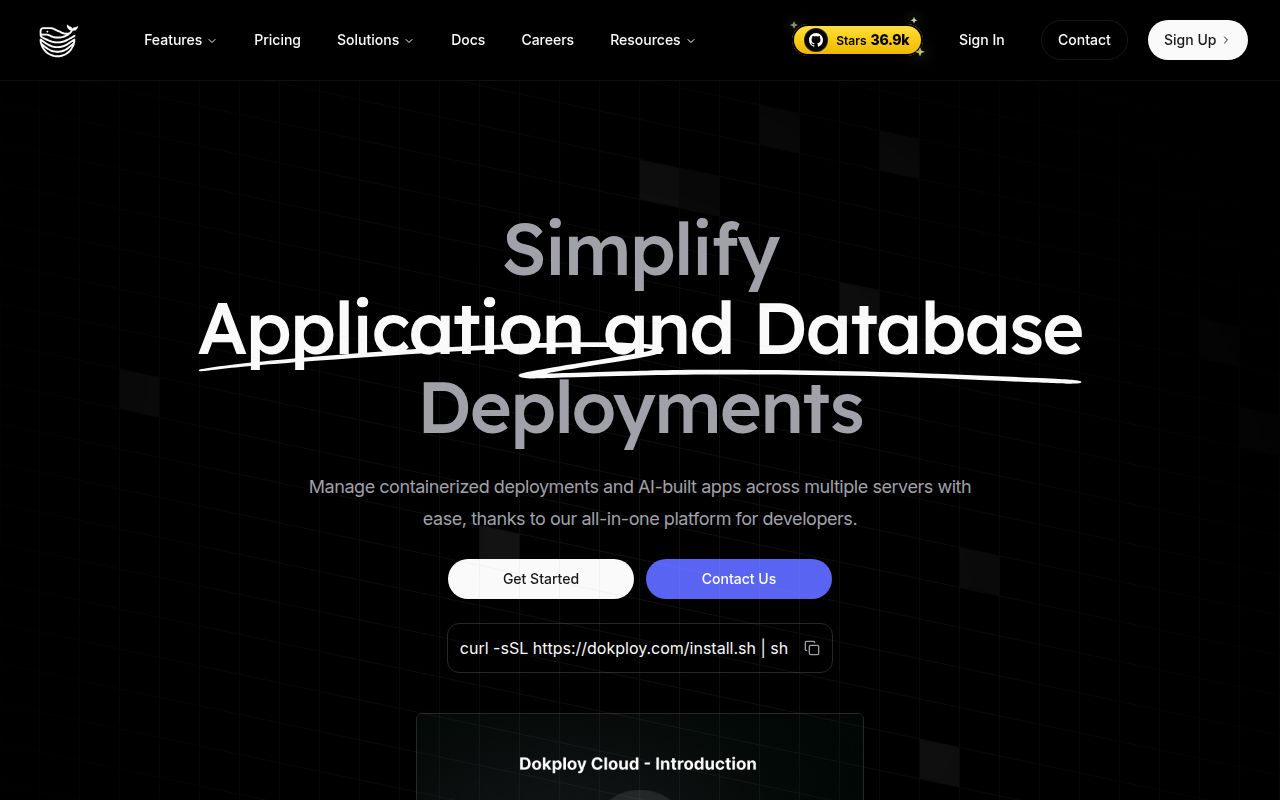
Dokploy combines application builds, Docker Compose, databases, routing, certificates, monitoring, backups, notifications, and remote servers in one panel. The target is a team that likes the workflow of Heroku or Netlify but wants its workloads on owned VPS instances. Applications can come from common languages or containers, while databases include PostgreSQL, MySQL, MariaDB, MongoDB, Redis, and libSQL.
The checkout we tested was no toy dashboard. commit 772b768 contained 1,488 files, about 205,816 lines of source, and occupied 37.4 MB before dependencies. It is a pnpm monorepo with a Dockerfile and 10 CI workflow files. The interface sits on top of host-level systems that remain visible when something breaks: Docker, Swarm, Traefik, storage, DNS, and the network between servers.
The one-line installer assumes control of a VPS
The README starts with a curl-to-shell command. That is convenient on a new machine, but the documentation makes the contract clearer. Dokploy expects a supported Ubuntu or Debian server, Docker, free ports, and working Swarm networking. After installation, the panel first appears on port 3000 so the operator can create an administrator. The docs then advise configuring a domain with HTTPS and disabling direct IP-and-port access.
A production setup needs more than the first login. Repository deployments require Git access, registries need credentials, database backups need an external destination, and notifications need their service tokens. Remote servers add SSH and network trust. Dokploy can automate much of this work after configuration, but it cannot decide firewall policy, recovery objectives, or where privileged credentials should live.
Docker Swarm is part of the operating model
Multi-node placement uses Docker Swarm rather than treating each server as an unrelated Docker host. That gives Dokploy a way to spread services and manage a cluster, though it also imports Swarm's networking behavior. The installation documentation specifically warns that service discovery requires IPVS kernel support. Minimal or appliance-style kernels can therefore pass a basic Docker check and still fail once services need to find each other.
An open backup report shows why placement must be tested. In issue 3516, a PostgreSQL container scheduled on a worker node could not be found when the backup command ran on the manager. A related fix was still an open pull request on 2026-08-25. If databases are part of the migration, run a restore drill from every placement class before calling the platform ready.
What happened when we ran it
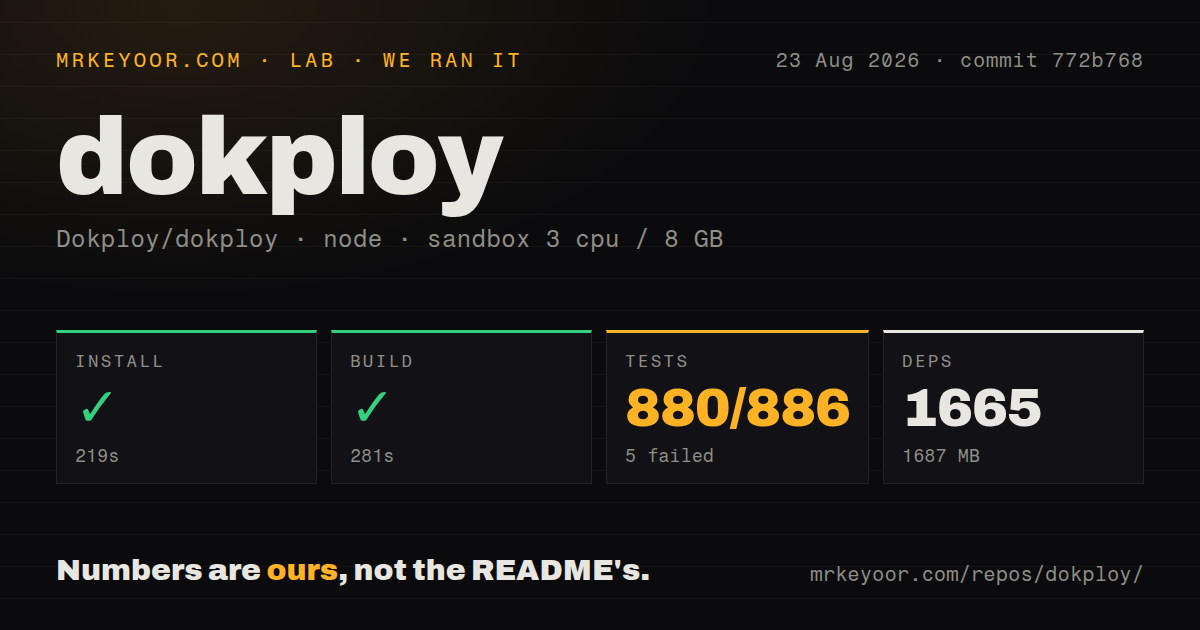
Our unprivileged Node 22 sandbox installed 1,665 packages in 219 seconds, consuming 1,687 MB on disk. The build then completed in 281 seconds. The run used 3 CPUs, 8 GB of RAM, no secrets, and commit 772b768. That is a successful build, though the dependency footprint is substantial for contributors and CI workers.
The Vitest command did not finish cleanly. It ran for 125 seconds, with 880 tests passing, 5 failing, and 1 skipped out of 886. The summary reported 2 failed files among 98. Its tail shows a failure passing through Proxy.deployApplication in application.ts and application.real.test.ts, then the pnpm lifecycle exits with status 1. The supplied lines do not show the underlying assertion or enough context to name the cause.
Traefik automation can spread one bad configuration
Automatic domains and TLS are a major reason to use Dokploy, because the panel writes Traefik configuration as applications change. The tradeoff is shared control-plane risk. Issue 5189 reports that an application without a domain can produce an invalid file with empty router and service maps. According to the report, Traefik then rejects later dynamic updates, leaving another application on a self-signed certificate and a 404 response.
That report was opened against v0.30.2 on 2026-08-25. It is one issue, not proof that every installation will hit it, but the failure mode is relevant because one application can affect routing for others. Keep the Traefik logs and generated files in your incident playbook. A deployment panel reduces routine typing; it does not remove the need to understand the proxy it controls.
The license boundary needs a procurement decision
GitHub does not identify a standard SPDX license for the repository because Dokploy splits its terms by path. LICENSE.MD applies Apache-2.0 to content outside proprietary directories. LICENSE_PROPRIETARY.md applies the Dokploy Source Available License to code under /proprietary and says production use requires a valid commercial agreement. Development and testing are permitted, but production rights are narrower.
This does not make the community edition unusable. It does mean a company should inspect which features sit under proprietary paths and decide whether its planned deployment invokes those terms. Do that before building internal procedures around a feature. A generic claim that the whole repository is open source would miss the distinction written into its own license files.
Active releases help, but v0.30.2 remains pre-1.0
The latest release, v0.30.2, was published on 2026-08-18 and fixed preview limits plus environment-value quoting for stack deployments. GitHub recorded a push on 2026-08-25 and reported 694 open issues and pull requests. The feed shows new fixes, feature work, and user reports arriving within hours of one another. Dokploy is plainly maintained.
The buying decision rests on operational fit. Dokploy is appealing for a small team that has Docker knowledge and wants one place to deploy apps, inspect resources, manage domains, and schedule backups. Begin with stateless services, pin the chosen release, and prove routing plus restore behavior. If the team wants one simple server, Dokku or CapRover may impose less machinery. For a broader panel, compare Coolify before committing.