One route tree can mix three rendering modes
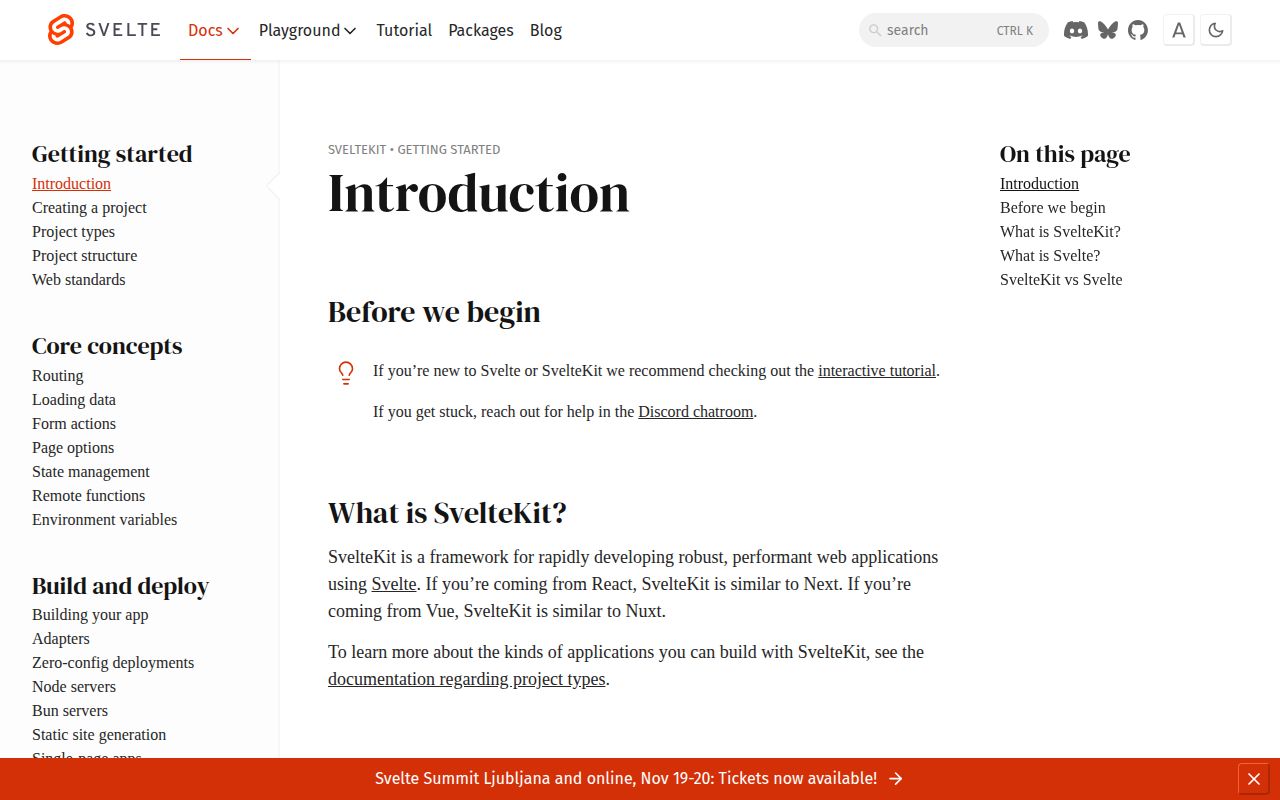
SvelteKit supplies the application layer that plain Svelte leaves open. Routes can load data on the server, render the first request as HTML, then navigate in the browser. A page can also be prerendered at build time. Those choices can live beside each other instead of forcing the whole site into one mode. Form actions, hooks, environment handling, service workers, image tooling, and the Vite development loop sit in the same model.
That range is the reason to choose it. A product site may prerender marketing pages, server-render account pages, and keep app navigation client-side without splitting into 3 projects. The same routing structure works for a Node server, a serverless target, or static output. If all you need is a browser-only dashboard talking to an existing API, some of the framework will remain unused, though the docs explicitly support that arrangement.
The adapter is a deployment decision, not a final checkbox
A SvelteKit build is finished by an adapter. The repository maintains official adapters for Cloudflare, Netlify, Node, Bun, static output, and Vercel. adapter-auto recognizes supported hosts, while a self-managed server normally uses adapter-node. Platform data can enter request hooks through the adapter, so moving hosts may touch more than the build command if your code reads provider-specific bindings.
The official set covers 6 common targets. Anything else depends on a community adapter or one you write. That is a meaningful boundary for less common clouds, edge runtimes, and internal hosting platforms. Even official targets have their own behavior. Open issues in October 2026 included Cloudflare runtime types colliding with DOM types and concurrent Vite servers contending over the same SQLite proxy. Those reports do not make the adapter unusable, but they justify testing on the actual target.
What happened when we ran it
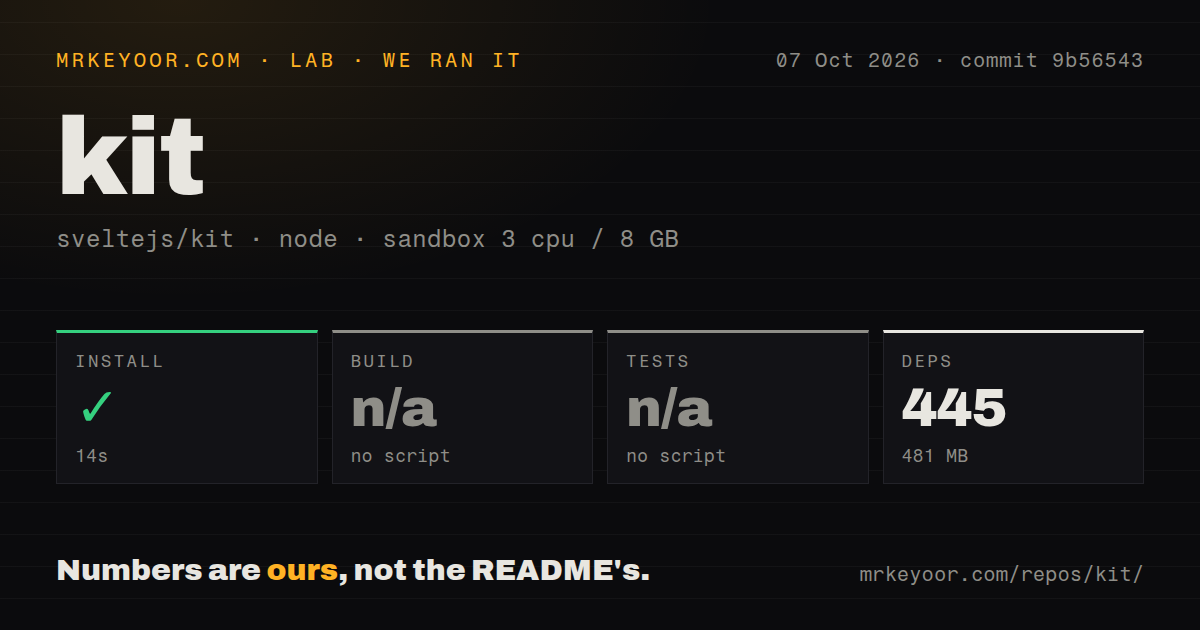
Our sandbox installed commit 9b56543 in 14 seconds. Pnpm added 445 packages, and the resulting dependency tree occupied 481 MB. The checkout itself was 8.7 MB with 3,126 files and roughly 111,546 lines of source. We used a fresh unprivileged Debian container with 3 CPUs, 8 GB of RAM, Node 22, and no secrets.
The runner found no plain root build script, so it skipped the build. It found no plain root test script either, so tests were skipped as well. This is not a compiler or test failure. It means the generic root-level commands our sandbox looks for were absent. The scan did find 6 CI workflow files, a pnpm workspace, no Dockerfile, and no root tests directory.
Those skipped steps need context. The contribution guide tells maintainers to run pnpm test:kit, pnpm test:others, package-level checks, linting, and Playwright commands from specific directories. It also says some packages need rebuilding before their tests while packages/kit does not. A contributor can test the project, but a CI wrapper that assumes every Node repository offers npm test and npm run build will learn nothing until it is configured for this monorepo.
Version 3 raises the floor and moves configuration
SvelteKit 3 is a real migration, not a new number over the same setup. Its guide requires Node 22.17, TypeScript 6, Svelte 5.57.1, Vite 8.0.12, and vite-plugin-svelte 7. Configuration moves from svelte.config.js into the SvelteKit Vite plugin. The generated $lib alias becomes a package import you declare as #lib, with file extensions added to imports. Several navigation and path APIs also change.
The supplied sv migrate sveltekit-3 command handles many changes, and the maintainers recommend reaching the latest 2.x release first so deprecation warnings can guide the move. Still, read the migration diff. CSRF origins, reverse-proxy origin handling, deployment polling, form navigation, and route resolution can affect production behavior. An app behind a proxy deserves direct tests around forms and generated URLs after the config move.
October activity is high, and so is the review surface
GitHub showed 20,845 stars and 834 open issues and pull requests on October 8, 2026. A search limited to issues returned 730 open issues, which leaves the repository API total as a mixed queue rather than a bug count. The project was pushed that same day. Release 3.0.1 arrived on October 6 with a fix for generated relative imports under Node's nodenext module resolution. Recent issue discussion and pull requests show maintainers responding during the major release window.
SvelteKit earns its place when you want Svelte on both sides of the request and expect rendering needs to vary by route. The price is framework ownership: Vite, Svelte, adapter behavior, and the current major migration move together. For a new Svelte product, that trade is usually sensible. For an existing version 2 application, the better decision is to run the migrator on a branch and prove the chosen adapter before committing to version 3.