Kandev turns agent sessions into reviewed tasks
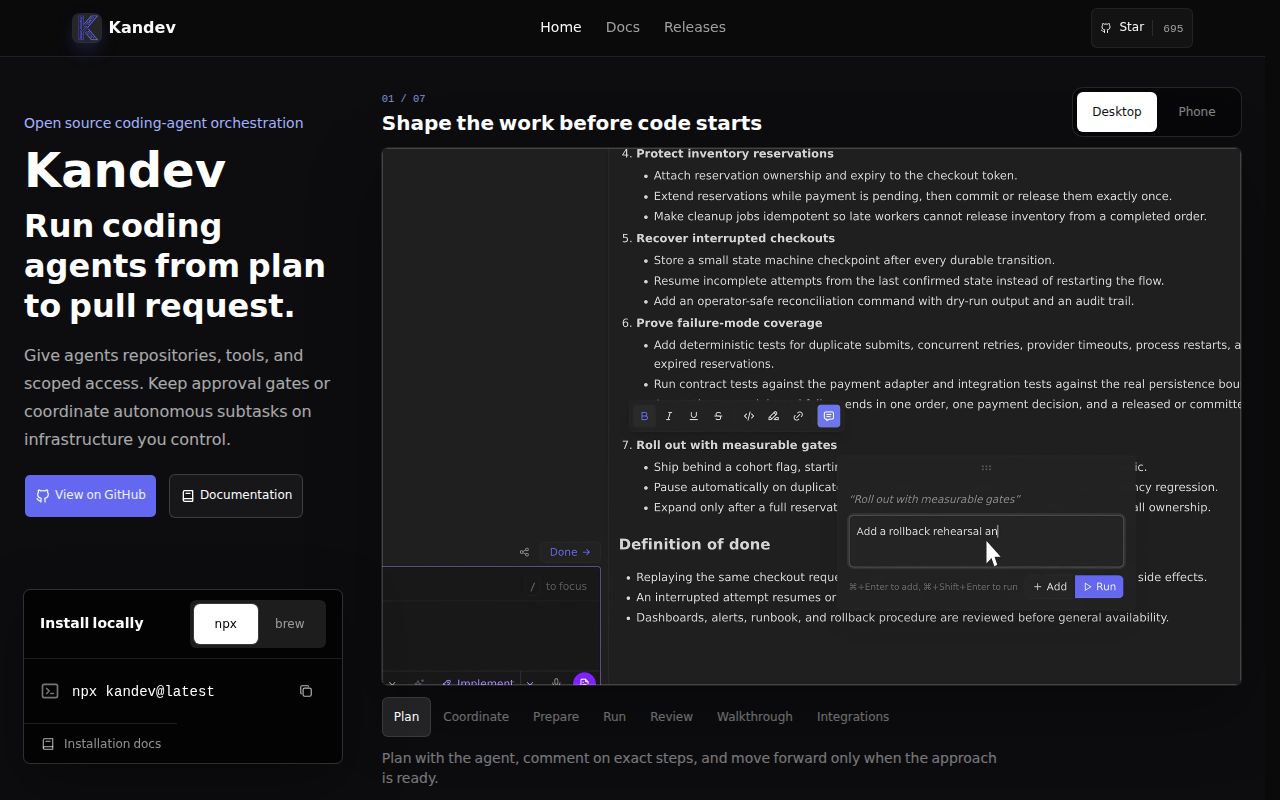
Kandev starts with a Kanban board rather than a chat window. A task can move through workflow steps, launch different agent profiles, work in an isolated Git worktree, and stop at review gates before a pull request. The integrated workspace includes files, an editor, terminal, browser preview, conversation, and Git changes. That shape is useful when several agent jobs are running at once and the hard part becomes knowing which branch changed, what needs review, and which task is blocked.
Provider breadth is a major part of the pitch. The README lists Claude Code, Codex, Copilot, Gemini CLI, OpenCode, Cursor, and many other agents connected through ACP or adapter packages. A terminal passthrough can host a CLI that does not speak ACP. Executors can be local processes, Docker containers, SSH hosts, or Sprites cloud environments. Kandev's own MCP surface lets task agents create subtasks, coordinate dependencies, message sibling tasks, inspect conversations, and signal workflow completion.
What happened when we ran it
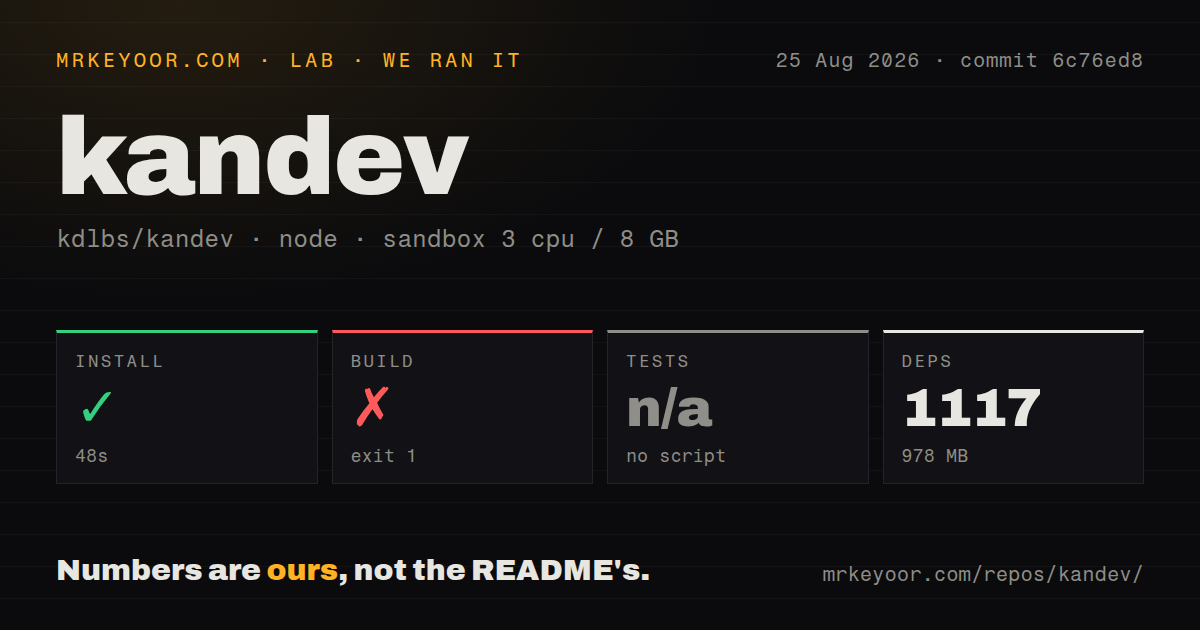
Our sandbox cloned commit 6c76ed8 and found 13,206 files, about 2,138,001 source lines, and 120.3 MB checked out. The project lives under ./apps/ in a pnpm monorepo. Installation succeeded in 48 seconds, pulling 1,117 packages and using 978 MB on disk. The repository had 20 CI workflow files, workspaces, no root Dockerfile, and no tests directory according to the lab signals.
The recursive build failed with exit code 1 after 7 seconds. It covered 7 of 8 workspace projects: the CLI syntax checks completed, then the desktop Tauri package tried to run cargo metadata. The log reports No such file or directory, followed by the desktop workspace failure. This is clear evidence that our Node sandbox lacked a command required by the desktop build. It does not say whether the web or backend would fail in the complete documented toolchain.
Our harness found no test script or target in the measured project path, so tests were skipped. The README documents a repository-level make test command after a larger bootstrap process, but that path was not part of the lab result and must not be treated as a pass. Source development pins Go 1.26.0, Node 24, and pnpm 9.15.9, with mise managing tools. Playwright browser dependencies require another bootstrap command for end-to-end work.
Packaged installs avoid the 978 MB workspace
Homebrew and Scoop install native bundles without requiring Node at runtime. npx and global npm are available for users comfortable with the JavaScript distribution. Data, the SQLite database, and worktrees live under ~/.kandev by default. A packaged trial is the sensible evaluation path because it avoids the source build that failed in our sandbox. Nightly npm builds exist, while stable remains the default update channel.
Desktop trust is the awkward exception. The v0.91.0 release warns that its macOS and Windows installers are unsigned development builds and may require manual operating-system security bypasses. That warning should stop company-wide deployment until the organization decides how it will verify artifacts. A browser-connected service can avoid the desktop package, but then the operator owns the server, network exposure, provider credentials, backups, and updates.
Human review is present, configuration still decides safety
Kandev's stated model keeps people in control through workflow gates, change review, and explicit shipping decisions. Worktree isolation prevents parallel tasks from editing one checkout, and task views group diffs and pull requests by repository. Those are good controls. They do not make every agent action safe by themselves. Profiles can hold secrets, prepare scripts, environment variables, credentials, and unattended permission behavior, while agents can create or message other tasks through MCP.
Review therefore depends on how workflows are built. A team should begin with one repository, one executor, and a mandatory approval step before merge or deployment. Container or remote execution can separate agent processes from a workstation, but copied ignored files such as .env values can reintroduce sensitive access inside a worktree. External MCP endpoints also need authentication and network policy because they can manage tasks from outside the application.
Version 0.91.0 is active and still pre-1.0
The latest release arrived on August 21, 2026, and the repository was pushed on August 25. Its change list includes fixes for skipped reviewers, tasks stuck in review, unsafe clone authorities, config-import races, secret resolution, agent wakeups, and task queue ordering. These fixes show maintainers working on the exact coordination failures an orchestrator must handle. They also show how many state transitions sit between a card moving across the board and a trustworthy result.
GitHub's open count of 94 combines issues and pull requests. The most recently fetched page was dominated by pull requests, so that number cannot be presented as 94 bugs. The project has an AGPL-3.0 license, no telemetry according to the README, and service guides for systemd and launchd. Windows service installation is not yet supported, and persistent service updates differ by npm, Homebrew, local checkout, user mode, and system mode.
Kandev is a credible option for a small technical team already feeling the pain of parallel agent work. Its board, review surface, worktrees, executor profiles, and task MCP all address coordination rather than pretending another chat UI is enough. Start from a packaged v0.91.0 release, keep the service on a VPN, and test backup, restore, cancellation, review, and secret boundaries. Our 7-second build failure says source contributors need the full pinned toolchain, including Cargo for the desktop package.