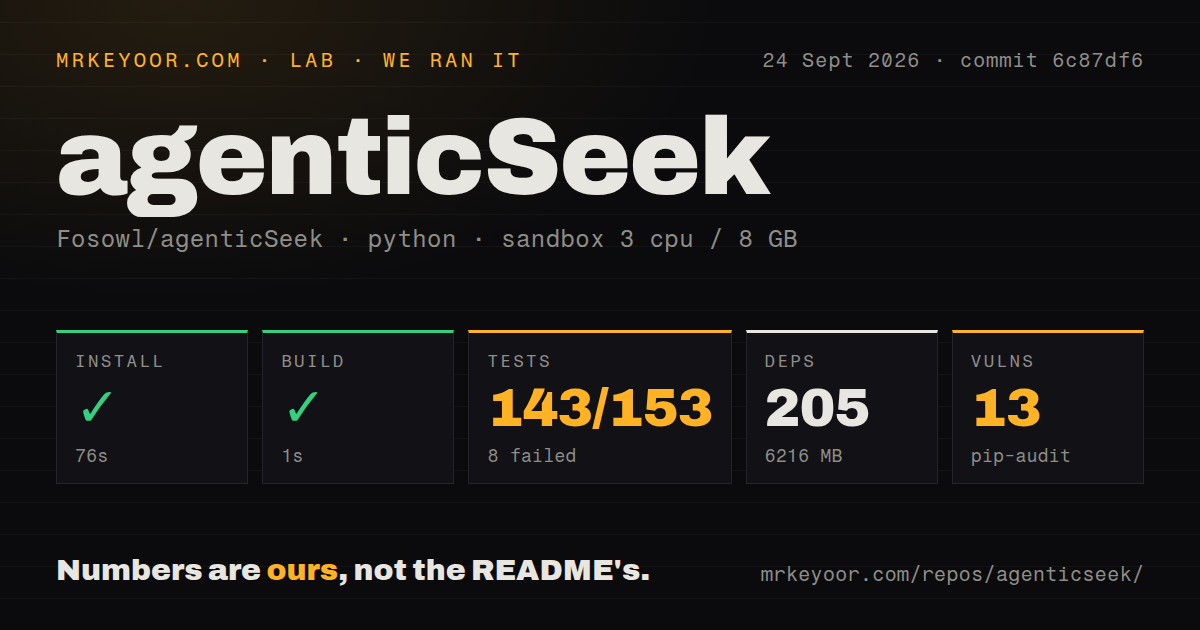
6,216 MB of dependencies ends in 8 failed tests and 2 errors
AgenticSeek promises a private assistant that can browse, plan, write code, execute it, and work with local files. It routes a request to specialized agents and can use Ollama, LM Studio, an OpenAI-compatible local server, or several hosted providers. A React web interface and CLI sit on top of a Python backend, while SearXNG supplies search. MCP support extends the tool set. This is an ambitious stack with direct access to consequential actions.
Our clean checkout was much smaller than its environment: 156 files, about 10,749 lines of source, and 12.3 MB. Installing 205 packages took 76 seconds and expanded disk use to 6,216 MB. That is before any local model weights or Docker images. The 1-second build passed, but storage and setup costs make this a workstation project rather than a small Python utility.
What happened when we ran it
Our sandbox installed AgenticSeek in 76 seconds, added 205 packages, and used 6,216 MB. The build succeeded in 1 second. Pytest ran for 53 seconds and exited 1: 143 tests passed, 8 failed, and 2 collection or setup errors occurred out of 153. The summary also recorded 14 passing subtests and 1 warning.
Seven listed failures came from LiteLLM provider tests. Each stopped with ModuleNotFoundError: No module named 'openai._models'; 'openai' is not a package. An eighth expected a message saying LiteLLM was unavailable for local use, but received a different message saying LiteLLM was not installed. The supplied log tail does not identify the 2 collection or setup errors, so their cause is unknown from this run.
Pip-audit found 13 known vulnerabilities in the installed environment. Our scan found a Compose file and a tests directory, but 0 CI workflow files and no Dockerfile. These results describe commit 6c87df6 in an unprivileged Python 3.12 Debian container with 3 CPUs, 8 GB of RAM, and no secrets. They do not test model quality, browser task success, or search reliability.
Local use needs Docker services and a 14B-class model
The README recommends Python 3.10 rather than the 3.12 image used by our lab. Its default web path uses Docker Compose to start SearXNG, Redis, a frontend, and the backend. Operators must set a work directory that the agent can read and change. The browser interface appears on port 3000 after the backend health endpoint is ready. First startup can also pull several images.
Keeping model traffic local adds another service. The documentation calls for a GPU capable of running Magistral, Qwen, or DeepSeek at 14B scale, then points the app at Ollama, LM Studio, or another compatible server. Cloud APIs avoid that hardware cost but send task content to the provider and require a key. The project's claim of zero cloud dependency applies only when you choose and can run a local model.
Networking differs between modes. A backend inside Compose reaches SearXNG at searxng:8080; the host-run CLI must use localhost and the published port. The README warns that putting the container hostname in CLI configuration will not work. Issue 381 adds another operational trap: its reporter hit a Chrome and ChromeDriver version mismatch while building the backend path on Windows.
Two open reports describe generated code running without isolation
Issue 483 reports that the Python interpreter passes generated code to exec() with full built-ins plus os and sys, while its optional safety flag defaults to false. Issue 494 reports the corresponding shell path: safe_mode starts false, the normal agent call does not enable it, and unsafe-command detection therefore does not run. Both reports were open when checked.
Those are repository reports rather than findings from our sandbox, which did not execute generated code. They are still disqualifying for ordinary personal use until verified and fixed. Web pages, search results, and files can contain instructions an agent was never meant to follow. A work directory limit does not provide process isolation when generated Python or shell commands can reach the host environment. Use a disposable virtual machine or tightly restricted container if you investigate this code.
Search and routing still behave like an early prototype
The README calls AgenticSeek an early prototype and says agent routing can choose the wrong specialist unless the prompt is explicit. It also labels web form filling experimental. Issue 410 shows SearXNG searches hitting CAPTCHA challenges in DuckDuckGo and Qwant, while a query with search operators produced a malformed Wikipedia request. A private search layer can still inherit blocking and syntax differences from upstream engines.
GitHub recorded 27,300 stars, 3,061 forks, and 28 combined issues and pull requests on September 24, 2026. The last push was September 21. GitHub returned no latest release, so a large audience and recent code do not provide a versioned stable point. The README also says the side project has no roadmap or funding, which sets expectations more honestly than the feature list alone.
AgenticSeek is worth watching because local model choice, search, code work, and agent routing live in one inspectable repository. It is not ready to receive your home directory. The failed suite, 13 advisories, 6,216 MB environment, and open execution reports all point to the same buying decision: experiment in isolation, or choose a narrower tool whose action boundary you can verify.