Vibe Kanban now makes the most sense as a local agent console
Vibe Kanban's README lists 10+ agent CLIs behind one browser interface. It gives them a board, isolated workspaces, terminals, branch management, diffs, inline comments, and an app preview. The April 2026 company shutdown changed the buying decision, although those local tools remain. For one developer supervising several jobs, the appeal is seeing work and reviewing changes without living inside several terminal windows.
Our commit a4274e4 checkout contained 2,203 files and about 224,357 lines of source in 81.4 MB. It is a pnpm monorepo with a Rust backend and several web packages, plus separate remote, relay, and desktop pieces. This is closer to adopting a development environment than adding a small task-board package.
Bloop retired hosted planning and kept local workspaces alive
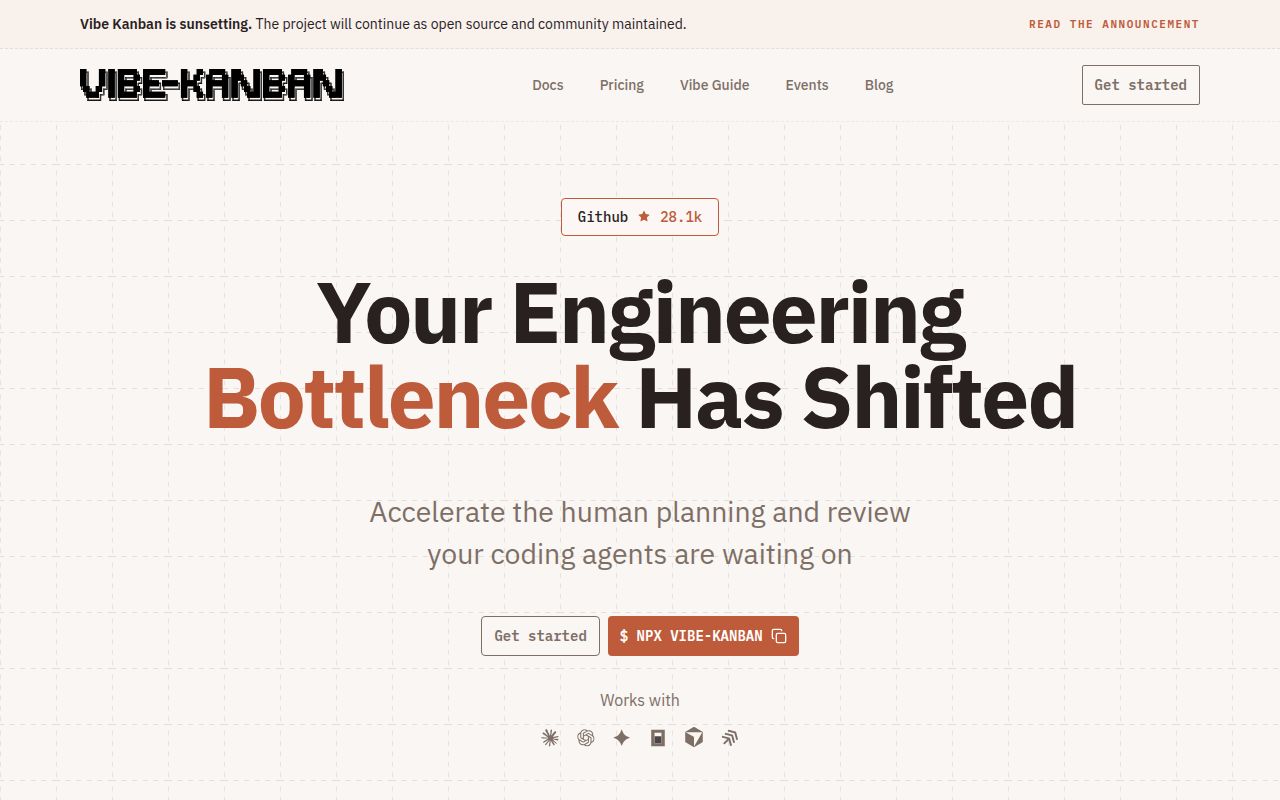
Release v0.1.44 followed Bloop's April 10, 2026 shutdown announcement and routed project pages to an export-only screen. Bloop said remote issues, comments, projects, and organisations would remain available for 30 days, then Vibe Kanban would move to a fully local architecture. Subscriptions ended and recent invoices were refunded. The announcement kept local workspaces alive and handed the open-source project to community maintenance.
The 2,203-file monorepo now has two different stories. Local users can run an agent in a branch, watch its terminal, open the app preview, and review the diff. Team planning and shared project records belonged to the retired hosted service. A self-hosted remote stack may recreate parts of that experience. The former vendor service and its support relationship are gone.
What happened when we ran it
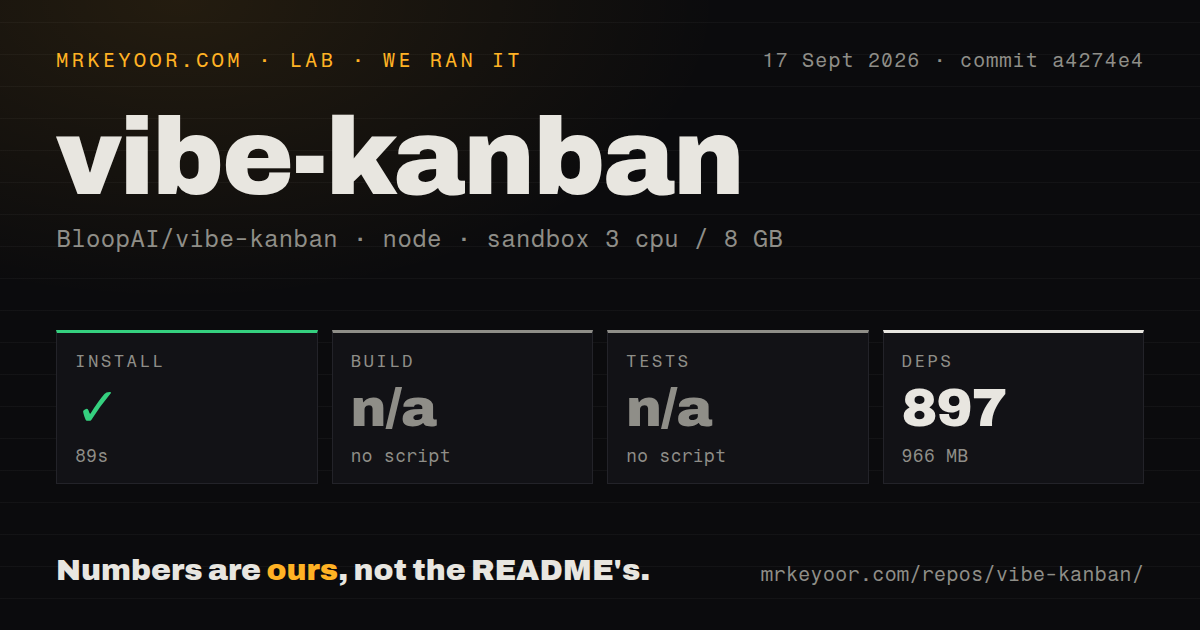
Our sandbox installed commit a4274e4 in 89 seconds. Pnpm added 897 packages and consumed 966 MB on disk. Our measurement setup used an unprivileged Debian container with 3 CPUs, 8 GB of RAM, and no secrets. Dependency installation completed cleanly. We did not start an authenticated coding agent or measure workspace behavior, preview latency, or agent output quality.
In our 3-CPU run, the root package had no standard build script, so the build step was skipped. It also had no standard test script or target, so the test step was skipped. Those are unverified steps, not passes. Named scripts exist for checks, linting, the local web package, the npm bundle, and Rust components. A buyer should select the relevant commands and run them explicitly.
Our scan found 9 CI workflow files and no tests directory. The repository also exposes a package-specific test:npm command, which is narrower than a project-wide test target. None of those signals gives us a test result because the lab did not run them. This monorepo does not present one obvious root command that proves the full product before adoption.
Local use still depends on authenticated agent CLIs
After a 966 MB install, the chosen agent still has to be installed and authenticated before npx vibe-kanban can coordinate it. Vibe Kanban creates a workspace with a branch, terminal, and development server, then surfaces the changes for review. It does not replace the agent's account, permissions, model limits, or safety controls. Teams still decide which repositories an agent may edit and which commands it may execute.
Our install used 966 MB before an agent CLI, model access, or generated work entered the picture. Development also calls for Node.js 20 or newer, pnpm 8 or newer, stable Rust, cargo-watch, and sqlx-cli. The one-command npm path is simpler than contributing from source. Either way, local processes receive meaningful access to code and Git worktrees, so a trial belongs in a disposable repository before it touches a valuable checkout.
Self-hosting the former cloud requires several services
Our 8 GB sandbox did not exercise the remote deployment path. The self-hosting guide asks for Docker Compose v2 or newer, at least 2 GB of RAM, 10 GB of disk, a domain, and TLS. Authentication needs GitHub or Google OAuth, or one bootstrap admin credential. The example stack adds Caddy, PostgreSQL 16, Electric, and the remote server. Relay mode adds wildcard DNS and certificates plus another service.
A remote deployment starts from an 81.4 MB source checkout after our local dependency install already reached 966 MB. It then needs JWT, database, and Electric passwords, with optional email and attachment credentials. Reverse-proxy users must set VK_ALLOWED_ORIGINS or browser API requests receive 403 responses. The documentation remains detailed, but it still carries Cloud pages after the shutdown, so distinguish self-hosted components from the retired Bloop service.
September commits show maintenance without a new stable release
The 2,203-file repository received five commits on September 16 and 17, 2026. They covered startup wiring, a security policy, corrected error labels, and a fix for stored sessions with heavy stderr. GitHub showed 384 open issues, separate from pull requests, and only 1 issue closed in the preceding month. The latest GitHub release remained v0.1.44 from April 24. Commits are landing, while release handling and issue closure remain thin.
Our 89-second install produced a 966 MB dependency tree, then the standard build and test checks had no targets to run. That result is acceptable for a careful local experiment if visual diff review saves you time. It is a weak foundation for a new hosted team workflow. Export existing data, pin the commit you trust, and assume your team owns the next repair.