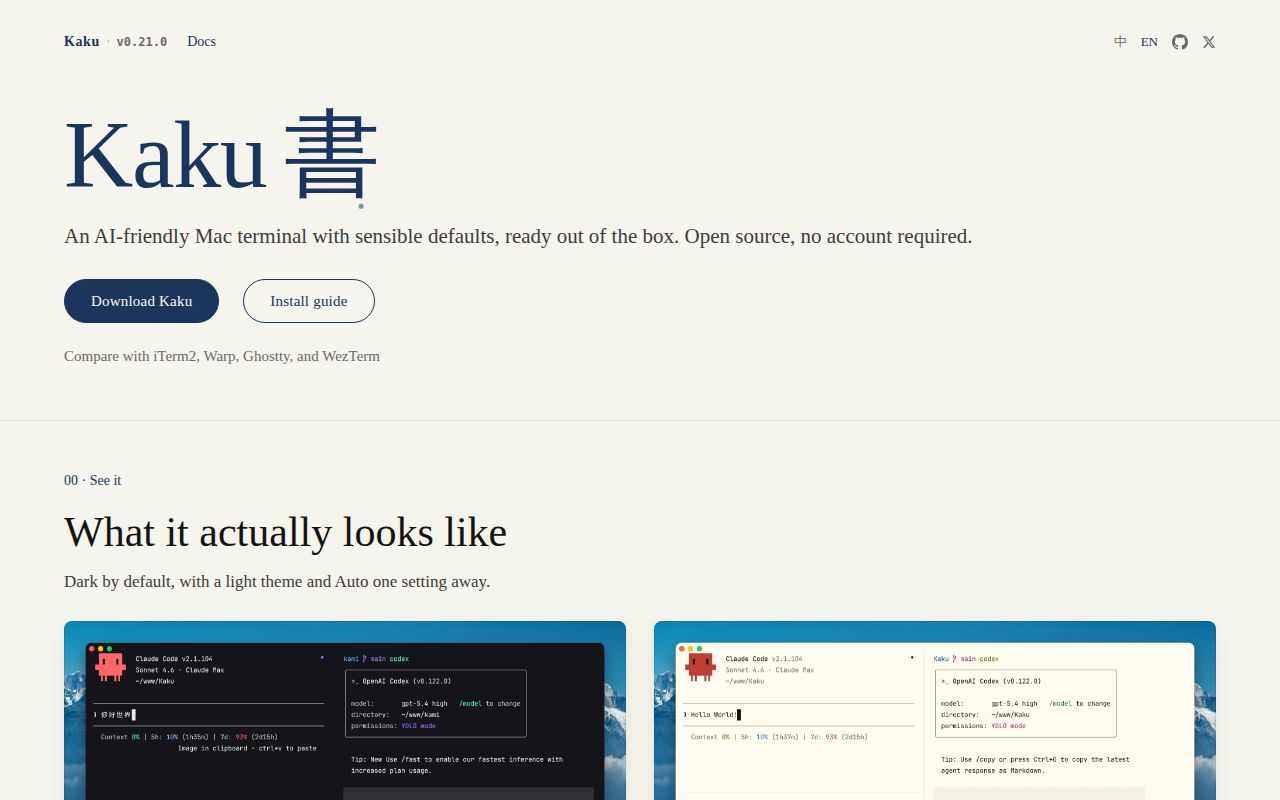
Kaku is a Mac terminal with the first week of setup already done
Kaku starts from WezTerm and chooses defaults for a Mac developer: JetBrains Mono, dark and light themes, copy on select, familiar Command-key shortcuts, tabs, split panes, link handling, and session recovery. Lazygit, Yazi, completion, syntax highlighting, autosuggestions, and directory jumping fit into the same setup. A new user can install a DMG or run the official Homebrew cask instead of building a terminal configuration piece by piece.
The opinionated layer stays editable. Kaku creates a Lua file that loads its bundled defaults before applying user overrides, so fonts, themes, keys, padding, scrollback, and pane behavior remain available through WezTerm's configuration surface. That inheritance is valuable if the defaults mostly fit. If you routinely replace the whole setup, installing upstream WezTerm gives you the same foundation with fewer Kaku-specific shell hooks.
The source tree contains 1,048,174 lines because Kaku carries its engine
commit 3859669 contained 6,104 files, about 1,048,174 lines of source, and occupied 176.7 MB before package installation. The repository includes a tests directory and 4 CI workflow files, while our scan found no Dockerfile. This is not a slim theme repository wrapped around an external executable. It carries a large Rust terminal codebase with Kaku's Mac behavior, shell integration, assistant, configuration, and bundled resources.
That scale changes contribution work. A menu adjustment can sit beside rendering, multiplexing, notification, platform, and font code. The app's download experience hides that complexity, as it should, but anyone planning to fork Kaku or maintain private patches inherits it. The README calls the product macOS-only. Windows and Linux support are described as something that may happen later, not a committed delivery plan.
What happened when we ran it
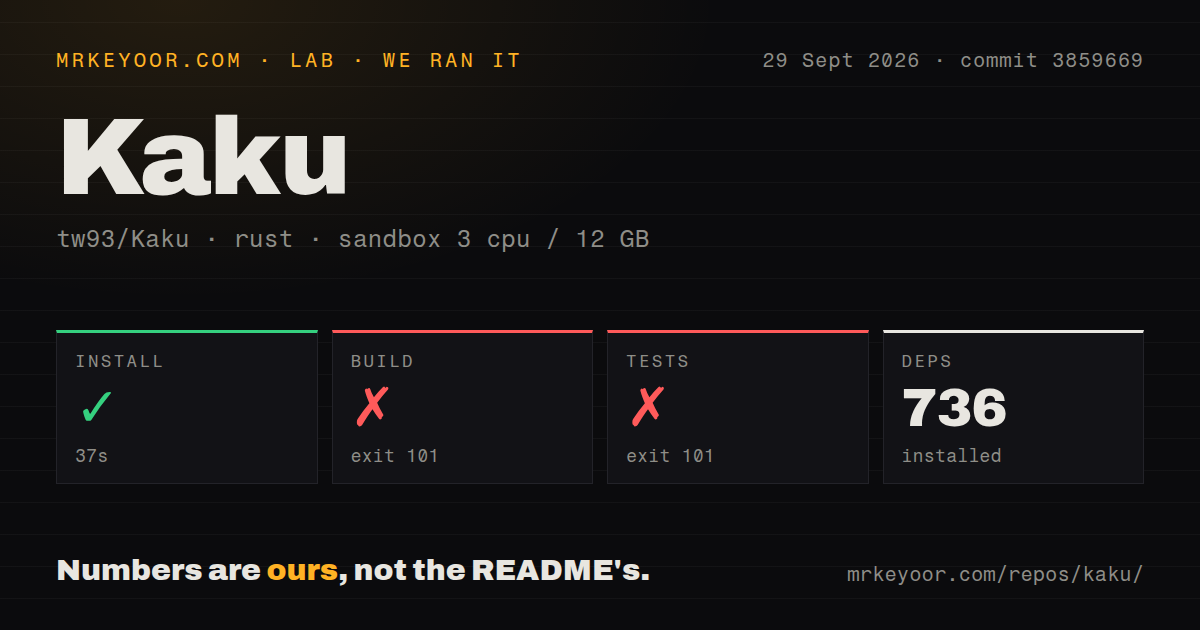
Our unprivileged Debian container installed commit 3859669 in 37 seconds and added 736 packages. The build ran for 604 seconds before exiting with code 101. Rust reported that crates/wezterm-toast-notification/src/lib.rs could not resolve an import named macos, then stopped compiling that library while other jobs were still finishing. The log does not identify a missing system package or prescribe a fix.
The test command reached the same point. It ran for 91 seconds, exited with code 101, and ended on the identical unresolved macos import in wezterm-toast-notification. There is no test pass or fail count because compilation did not finish. The sandbox had 3 CPUs, 12 GB of RAM, and no secrets. Kaku officially targets macOS, but we will not turn that product scope into an unsupported claim about why conditional compilation failed.
The assistant sends context only when you choose a provider
Kaku does not bundle or relay an AI service. Its settings accept an OpenAI-compatible base URL, API key, model names, or the user's existing Codex connection. Automatic error recovery sends the failed command, exit code, working directory, and git branch to that configured model. Natural-language commands send the request plus directory and branch. Suggested commands are placed at the prompt for inspection; even dangerous commands are never executed automatically.
The chat panel can include terminal context and use approved tools for project files, shell commands, web search, and memory. That is useful inside an AI-coding session and sensitive inside a regulated environment. Teams should decide which provider receives the context, which tools stay enabled, and whether assistant memory belongs on the workstation. Disabling the assistant leaves Kaku as a terminal, so the data boundary is a configurable product choice rather than a requirement for basic use.
Version 0.21.0 has fresh shell and input reports
Release V0.21.0 Ink shipped on September 26, 2026 with the official Homebrew cask, session recovery, context-menu changes, tab numbering, theme adjustments, and a TLS library update. GitHub showed 6,040 stars and 5 open issues and pull requests on September 29. The repository's last push was September 28, and issue activity continued the following day. Those dates show active maintenance.
The small queue contains concrete workflow defects. Issue 560 says typing cd ~/ under fish on version 0.21.0 loses the tilde. Issue 561 gives a repeatable Powerlevel10k warning caused by shell integration writing escape sequences before the first prompt. Issue 557, written in Chinese, reports the tab list disappearing after the app stays open for a while, although the tabs remain and return after restart. These reports deserve checks against your shell and session length.
Kaku is easiest to judge as an installed Mac app
The product decision is narrower than the million-line repository suggests. Install Kaku on a Mac, run kaku doctor, open the shells and multiplexers you actually use, and keep a long session alive. Test composed characters, prompt startup, tab recovery, pane dimming, links, SSH work, and any Lua carried over from WezTerm. Configure the assistant last, after the terminal behavior earns trust.
Our Debian run cannot answer whether the DMG feels faster, whether session recovery saves the right layout, or whether the assistant gives good commands. It does establish that a generic Linux source build is not a clean fallback: 604 seconds ended at a platform-named import before compilation finished. Choose Kaku for its Mac-specific defaults. Choose WezTerm, Ghostty, or Alacritty when operating-system reach is part of the requirement.