Short answer: adopt the process, inspect the audit
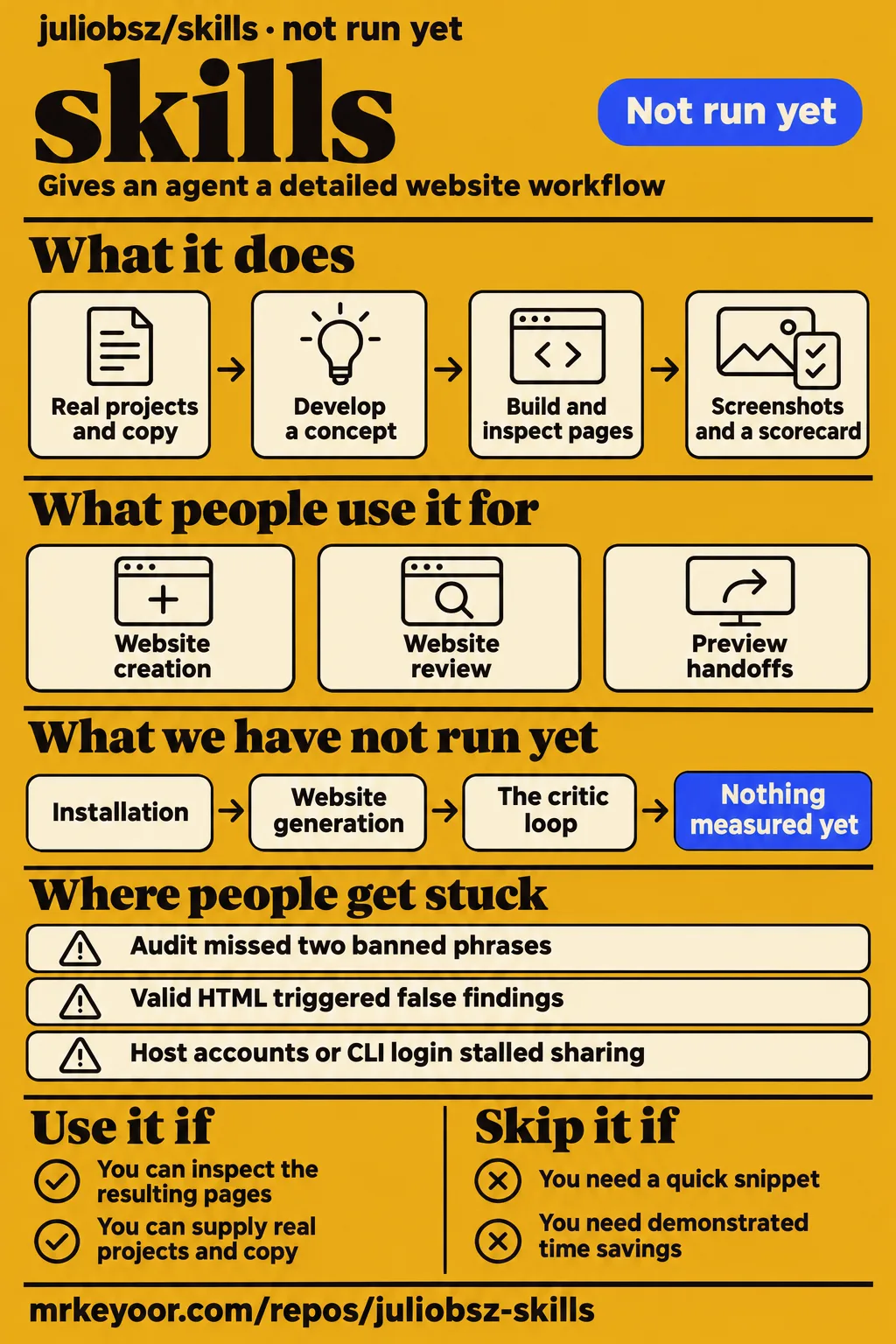
Issue #2 reports that two prohibited copy patterns produced "0 FAIL, 0 WARN" in the audit. That clean result is the reporter's reproduction, not our test. It explains the adoption decision better than a design promise: juliobsz/skills gives an agent a detailed website workflow, but the feedback driving its repairs deserves inspection. Use it if you can judge the resulting pages yourself; skip it if you need an independent quality certificate. Copy-audit reproduction
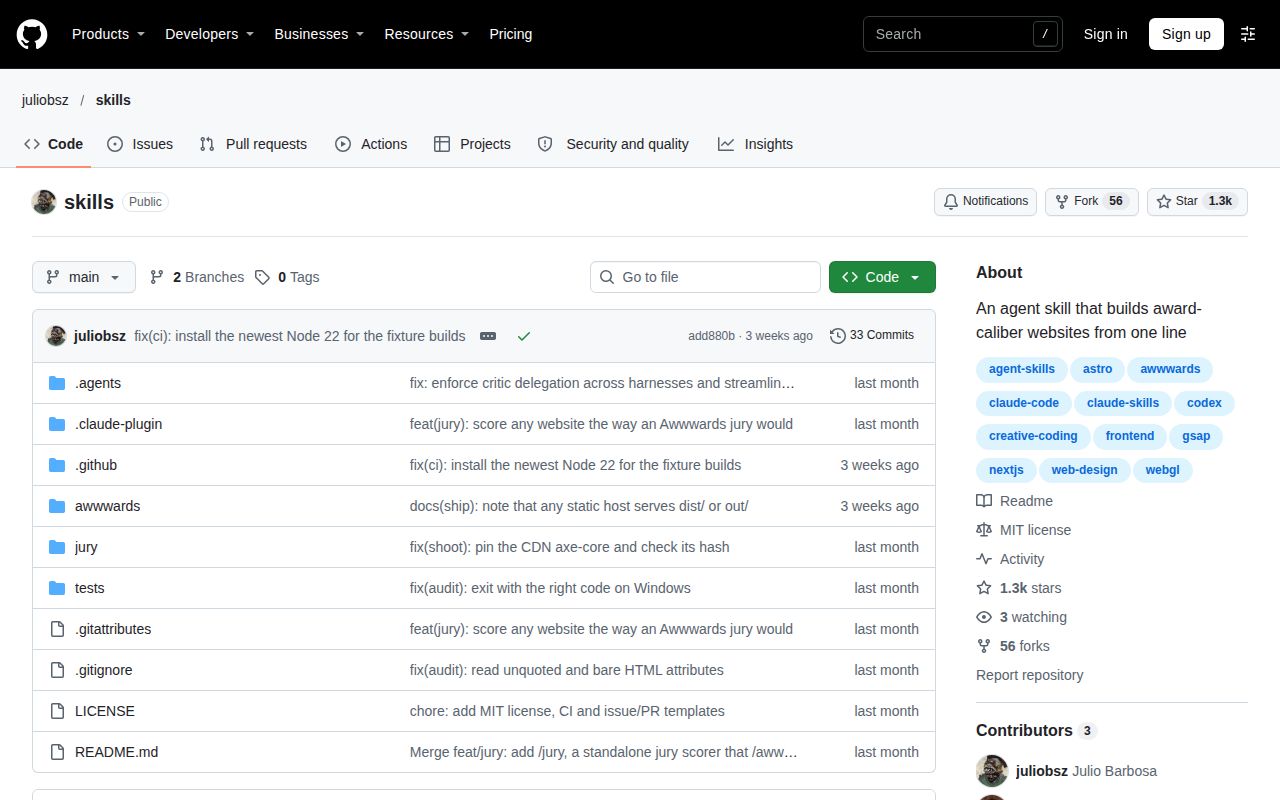
The collection supplies /awwwards for building websites and /jury for reviewing them. Its README describes concept selection, written art direction, implementation, screenshots and a fresh critic. The useful question is whether that procedure helps you reach an acceptable site with understandable evidence. A score alone answers less: an audit that misses prohibited copy can leave the critic working from an incomplete report. Website workflows in the README
What people use skills for
The README documents /awwwards for website creation and /jury for website review. A portfolio owner can bring real projects and let the workflow develop a concept, while a developer can request a review of an existing site or local production build. The documented output includes design decisions, screenshots and a scorecard. Start with the job you need completed, then choose the command that supplies the relevant procedure. Documented website use cases
The supplied accounts also show how people use skills more broadly. The table keeps the repository-specific preview experience separate from examples involving other workflows. That distinction helps a reader searching for "skills review": similar names describe different packages, and an account of Salesforce exploration answers a different question from an account of building a portfolio. Each example below links to the person or report behind it.
| Who used it | What they used it for | Reported result |
|---|---|---|
| Issue #10 reporter | Used juliobsz/skills' awwwards workflow and tried to share a preview | Account or CLI login requirements stalled the handoff. Preview-handoff report |
| Mario Giancini | Combined commands, skills and memory files across several work roles | Described a layered personal system for managing that work. Personal workflow account |
| Reddit user Outrageous_Let5743 | Used a separate Salesforce exploration skill with a Python helper | Described checking available data and endpoints, with Markdown explaining execution order and presentation. Salesforce workflow account |
For this repository, real content is part of the input. The README says missing projects, photographs and copy become clearly marked placeholders. Supply those materials before evaluating a portfolio's fit: the design needs something specific to organize. A useful brief therefore includes the audience, the site's job and actual work to show, rather than asking the agent to supply a convincing professional history. Content requirements and placeholders
What happened when we ran it
Our run at commit add880b on 2026-11-15 stopped before project execution. The harness reported "no supported ecosystem (language: JavaScript); no Dockerfile". Its recorded allocation was 3 CPUs and 8 GB RAM, with image n/a. The outcome was a stopped evaluation; the allocation describes the sandbox. The table preserves the checkout, prerequisite failure, conflicting run label and cleanup result so readers can distinguish each recorded event.
| Recorded item | Answer or outcome | Verdict | Why |
|---|---|---|---|
| Checkout | add880b on 2026-11-15 | Identified | This is the attempted evaluation's commit and date. |
| Harness execution | NOT RUN: no supported ecosystem for JavaScript; no Dockerfile | Stopped | The harness supplied no installation, build or test result. |
| Sandbox allocation | 3 CPUs, 8 GB RAM, image n/a | Configuration | These fields record the allocated environment. |
| Safety prerequisite | FAILED: none of compose.yaml, compose.yml, docker-compose.yaml or docker-compose.yml existed | Failed step | The safety rule required a Compose file. |
| Generic run label | Claimed deployment with Docker Compose, with every port bound to 127.0.0.1 | Contradictory record | The stopped harness and missing Compose prerequisite contradict deployment success. |
| Teardown | ok | Cleanup succeeded | The supplied teardown record reports successful cleanup. |
Issue #2 supplies a concrete observed audit result through an attributed reproduction. The reporter put the banned phrases "where X meets Y" and "not just X, but Y" into a fixture and reported "0 FAIL, 0 WARN". The audit therefore allowed both prohibited patterns through in that example. The same report says "seamless" triggered a filler-marketing warning, making the discrepancy specific to coverage of the written rules. Reported fixture and result
The safety record labels the repository unsafe, but its stated reason is the missing Compose prerequisite. That is a failed harness requirement. The separate generic deployment sentence conflicts with both this step and the authoritative stopped-run summary, so it supplies no working-site result. Read the records together rather than treating a successful-sounding label as proof that a page was served.
Where people get stuck: feedback can point in opposite directions
Issue #2 reports missed prohibited copy, while issue #7 reports false findings on valid HTML. Both affect the feedback an agent receives: one leaves a problem unreported, while the other asks for repairs to correct markup. The supplied synthesis records maintainer-reported fixes for both. The table also retains the documentation mismatch, preview barrier, demo problem and failed fixture build that matter when following this workflow.
| Report | Recorded problem | Recorded response | Practical acceptance check |
|---|---|---|---|
| Issue #2: copy rules | Two banned phrases returned "0 FAIL, 0 WARN" | Maintainer reported a fix | Compare page copy with the written content rules. |
| Issue #7: HTML attributes | Valid unquoted attributes triggered language, viewport and favicon findings | Maintainer reported a fix | Read the markup behind each finding. |
| Issue #3: project images | The Next.js example read fields absent from the documented Project type | Maintainer reported a fix | Follow the nested cover model and handle an absent source. |
| Issue #10: preview delivery | Host accounts or CLI login stalled sharing | Maintainer marked the request fixed | Choose the preview destination before building. |
| Issue #1: demo access | Logged-out visitors could not view the uploaded demo | Maintainer moved the demo to YouTube | Open the demo without a GitHub session. |
| Issue #11: latest dependencies | Weekly fixtures failed against latest releases | Closed with 0 comments | Include a fresh-scaffold build in acceptance work. |
Issue #7 says both workflows feed audit.txt into the critic loop. Its example lists false missing-language, missing-viewport and missing-favicon findings for HTML containing those elements with unquoted attributes. The reporter also identifies other findings on that page as correct. That distinction matters: accepting or rejecting the whole report would lose useful information. Inspect each disputed finding before allowing it to drive a repair. HTML audit and critic-loop report
The Next.js example needs a consistent content model
Issue #3 reports a type error caused by disagreement between two documentation files. The Next.js example accessed p.img and p.alt, while the documented Project type placed image data under cover. The reporter expected p.cover.src and p.cover.alt and noted that src could be absent. The correction therefore involves both the field path and the missing-image branch, rather than a mechanical rename alone. Cross-file type mismatch
An absent source means a procedural cover according to the reported content documentation. Follow that branch when adapting the example, using the implementation available in the project. A complete replacement component would need that implementation and its surrounding imports. For review purposes, the useful check is concrete: trace the page's image access back to the declared content model, then check how the page renders projects that omit the optional source.
Preview delivery is part of the website job
Issue #10 describes a finished-build handoff stalled by hosting login. The reporter wanted an owner to open the site on a phone before choosing a host, and said every host in the deployment table required an account or CLI login. This is a separate acceptance task from producing build output: the intended reviewer needs a reachable page. Decide who will open the preview and how that person will receive access. Preview delivery report
The README lists Vercel, Netlify and Cloudflare accounts for deployment and says deployment happens only after confirmation. Keep that approval step in the handoff plan, alongside the destination and person responsible for access. For a client portfolio, a build, a deploy decision and a reviewable preview are distinct deliverables. Writing them into the brief makes the endpoint clearer for both the agent and the person accepting the site. Deployment requirements
Scores and session length need a human stopping rule
The README calls 8/10 its own score and leaves final judgment to the user. It also describes a full run as a long session with heavy token use, involving concepts, a design system, implementation and repeated screenshots and fixes. Choose the workflow for work that merits those steps. Before starting, state which content, interactions and mobile views must be acceptable, so another critic round has a concrete purpose. Documented session length and scoring
Keep the scorecard beside the evidence it references. A useful repair resolves a reader-visible problem or a specific technical finding; a higher score is easier to interpret when the underlying change is visible. For a portfolio, that might mean a readable project page, working navigation or a corrected placeholder. These are suggested acceptance checks, and they keep the decision tied to the site the owner will actually use.
Security starts with the scripts the agent can run
The README says these skills instruct an agent to run builds and scripts on your machine. Read each SKILL.md and its helpers before installation, with attention to the permissions of the agent following them. The documented deployment rule requires confirmation. Treat the workflow as executable work carried out through the host agent, and decide who may approve deployment before beginning a client or unpublished project. Repository security guidance
The installation documentation also says the distribution CLI collects anonymous usage data. It names DISABLE_TELEMETRY=1 and DO_NOT_TRACK=1 as opt-outs. That behavior belongs in the installation decision alongside the selected agent and hosting service. Set the preferred option before running the installer, and use one installation route: the README warns that combining its plugin and skills CLI routes makes each skill appear twice. Installer behavior and duplicate entries
juliobsz/skills vs alternatives
Vercel's collection documents React performance guidance and interface-code review, while Anthropic's collection demonstrates a broader range of skill patterns. Choose by the task you want to delegate: a website's creative process, an existing implementation's review, or a reusable procedure in another domain. The table separates those choices from ordinary prompts and tool connectivity, which can remain useful alongside a website skill.
| Choice | Prefer it when | Evidence behind the distinction |
|---|---|---|
| juliobsz/skills | You want concept selection, art direction, website implementation and a critic loop | Website workflow README |
| Anthropic Skills | You want examples across creative, technical and business workflows | The README presents demonstrations and educational material. Anthropic collection |
| Vercel Agent Skills | You want React or Next.js performance guidance and interface-code review | The collection documents both areas. Vercel collection |
| Saved prompt | You have one bounded request whose instructions you can supply directly | Anthropic recommends packaging procedures repeated across conversations. Skills comparison |
| MCP | Your workflow needs access to external data or systems | Anthropic distinguishes connectivity from procedural knowledge. MCP and skills explanation |
Anthropic's examples span creative applications, technical tasks and enterprise workflows. Vercel's README includes React and Next.js performance guidelines and web-interface checks. Those documented scopes make the collections useful alternatives for different jobs. For a developer already holding a design and codebase, targeted implementation guidance may fit the immediate task better than adopting juliobsz/skills' concept-to-handoff procedure. Anthropic's documented scope; Vercel's documented scope
What the other reviews get wrong
Skills can include executable code, and Anthropic's tutorial describes requesting a skill by name. Those facts correct two categorical claims in the supplied research: that skills cannot contain Python or JavaScript helpers, and that users can only hope an agent selects them. This repository makes explicit commands central to usage, documenting /awwwards and /jury after installation. Executable-code guidance; Named activation guidance
Automatic selection also depends on matching. Anthropic's tutorial says a task can fail to match a skill's name or description and recommends adjusting the wording or mentioning the skill by name. That is more useful installation advice than promising automatic application in every chat. Keep entity names equally precise: the supplied Reddit interface-skills listing names jakubkrehel/skills, whereas this review concerns juliobsz/skills. Matching guidance; Other repository's listing
FAQ
People report using skills for preview handoffs, Salesforce exploration and personal workflows; the preview issue concerns juliobsz/skills. For someone evaluating this repository, the immediate questions are how to install its commands, make activation explicit and interpret their output. The answers below keep those decisions together, using the supplied README and attributed accounts rather than extending the review into unrelated training or career searches. Repository usage report
How do I integrate skills into an agent?
The README documents npx skills add juliobsz/skills -g, followed by a new agent session. It also offers manual copying and a Claude Code plugin route. Choose one route to avoid duplicate entries. The documented CLI requirement is Node 22.20+, while helper scripts require Node 20+. These instructions give a first-time user a specific installation path and the corresponding runtime requirements. Installation and requirements
Why is an installed skill not running?
The README tells users to start a new session when /awwwards or /jury cannot be found, because agents read the skills directory at startup. It then recommends npx skills list -g to inspect the installation location. Anthropic's tutorial adds a matching check: adjust the task wording or request the skill by name when its description fails to match the request. Command troubleshooting; Activation guidance
Are people actually using skills, and what do they use them for?
Issue #10's reporter used awwwards and encountered a preview-hosting barrier. The broader accounts describe other uses: Giancini combines commands, skills and memory files across roles, while a Reddit commenter coordinates Salesforce exploration through a Python helper and Markdown instructions. For this adoption decision, the preview report is the directly relevant account because it describes the reviewed workflow reaching a handoff problem. Preview account; Personal workflow; Salesforce account
Should I use predefined skills, create my own, or work without them?
Reddit commenter Basic-Source-5827 recommends starting with a clean baseline and creating targeted skills for recurring mistakes. Apply that advice by naming the repeated job first. If you repeatedly need concept selection and website critique, this collection supplies that procedure. If your problem is a particular implementation rule, a smaller instruction or focused skill gives you less material to maintain and inspect. Commenter's recommendation
What we have not tested yet
Installation, website generation and the critic loop have no execution results from our stopped sandbox attempt. The supplied evidence contains no measured time savings, token costs, design-quality comparison, screenshots or known-answer hands-on Q&A. The sandbox allocation identifies neither the actual Node version nor the operating-system version. The current README was read separately from commit add880b, so its capabilities are documentation claims rather than executed behavior at that commit.
The supplied records contain no independent post-fix output for issues #2, #3, #7 or #10. Issue #11 is closed with 0 comments and supplies no successful subsequent fixture build. The preview record also leaves the final documentation change unresolved. A complete replacement for the Next.js example needs the surrounding implementation, including its procedural-cover branch; this review supplies no newly executed code example. Fixture failure record
The README reports critic scores of 6.15 and 6.10 against jury scores of 7.28 and 7.24 on two October 2026 winning sites. It says the jury estimate rests on those two winners and that performance on weaker sites is unmeasured. It also excludes motion feel and sound from scoring and requires a reachable page or local build for login-protected content. These are the maintainer's calibration results and stated boundaries. Scoring calibration and limits
Model consistency, assistive-technology accessibility, security isolation, full preview delivery and repeated client use remain outside the supplied evaluation. So do the rendered review's layout, resolved links, related modules and template behavior. Maintainer replies establish responses, not adoption or a support guarantee. The useful next evaluation is one real brief with saved content, pages, raw audit output and a phone-accessible preview, including reproductions of both reported audit failure directions.