Eight documented skills focus on frontend and Vercel work
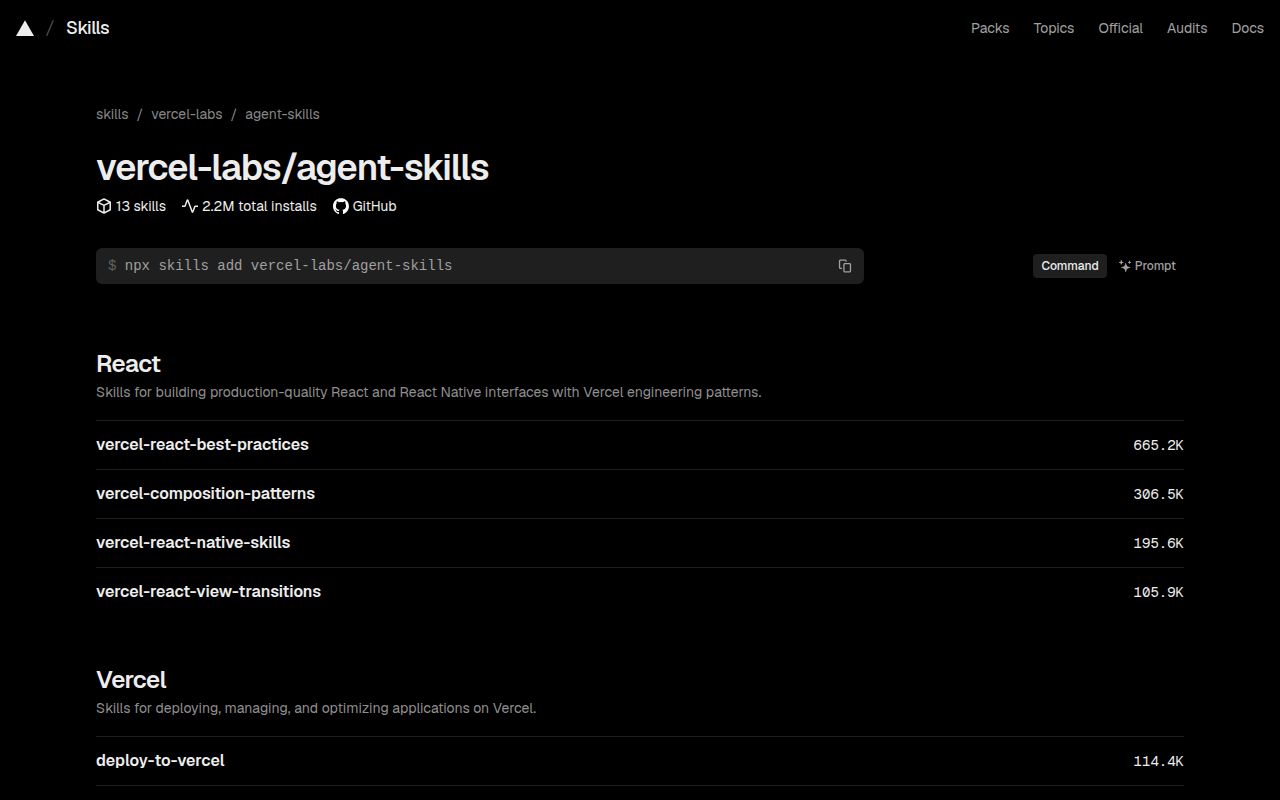
The README presents 8 skills. Four are review guides for React, React Native, web interfaces, and writing. Others cover React view transitions, component composition, Vercel cost and performance analysis, and claimable deployment. That focus makes the collection more coherent than a miscellaneous prompt dump. It is also narrow: backend architecture, databases, security engineering, and non-Vercel operations are outside the documented set.
Each skill is a directory with SKILL.md plus optional scripts and references. An Agent Skills compatible client reads the frontmatter description to decide when the instructions apply. Installation is delegated to npx skills add vercel-labs/agent-skills, so this repository supplies content while vercel-labs/skills handles discovery and placement. Keeping those roles separate helps when debugging an installation problem versus a bad instruction.
React guidance contains 70 rules across 8 categories
The current React best-practices skill says it contains 70 rules covering waterfalls, bundles, server work, client fetching, rerenders, rendering, JavaScript, and advanced patterns. Each rule has its own explanation and code examples, with a compiled AGENTS.md for clients that prefer one document. Priority labels help an agent address request waterfalls before tiny loop optimizations.
Instructions are still advice interpreted by a model. They do not know an application's product constraints unless the task supplies them, and a generally good React rule can conflict with local architecture or a framework version. Issue 319 reports broken relative links in the compiled document and one referenced rule file that does not exist. This is why code review should verify the underlying rule and the resulting diff rather than accept the skill's label as proof.
What happened when we ran it
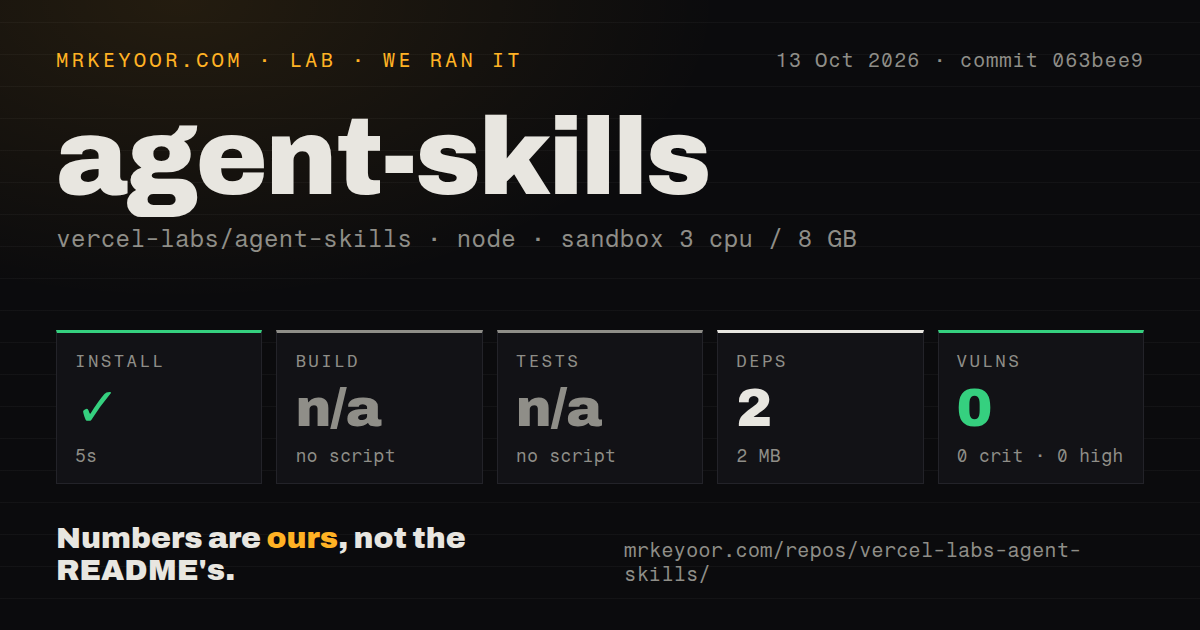
Our Node 22 sandbox installed 2 npm packages in 8 seconds and consumed 2 MB. Npm audit reported 0 known vulnerabilities: 0 critical, high, moderate, or low. The checkout at commit dd089a8 contained 445 files, about 29,129 source lines, and 7.7 MB. Those numbers describe the collection's package environment, not the dependencies of projects an agent later reviews or deploys.
There was no build script or target, so the build step was skipped. There was also no tests script or target, so no repository-wide tests ran. Our scan found 2 CI workflow files, no Dockerfile, and no tests directory. A clean audit plus a tiny install reduces package-manager risk, but it does not validate the prose rules, shell helpers, external services, or model decisions made during skill use.
Web review instructions change with another main branch
The web-design-guidelines skill tells the agent to fetch its rules from vercel-labs/web-interface-guidelines on every review. The URL points to main, not a commit. Issue 316 correctly describes the consequence: two uses of the same installed skill can apply different criteria without this repository changing or publishing another immutable discovery release. The issue does not claim the current remote file is malicious.
For an informal UI pass, fresh upstream rules may be desirable. Regulated review, regression tracking, and reproducible audits need a pinned commit or vendored copy. Pull request 317 proposes that direction, but the live skill we fetched still uses the mutable URL. Record the retrieved revision if a web review becomes evidence for a release decision, and never treat fetched instructions as permission to widen the user's task.
Vercel Optimize requires live account context
The Vercel optimization skill is far more than a checklist. It requires Vercel CLI 53 or later, Node 20 or later, an authenticated session, a linked application, and a correctly resolved project scope. Route-level recommendations need Observability Plus. The instructions collect metrics first, limit source inspection to candidates selected from those signals, and stop when project or account scope is ambiguous.
That design is careful because usage from a personal organization must not be mixed with metrics from a team project. It also means adoption can expose production metadata and billing context to the local agent workflow. Run it only inside the named project and account, review its commands, and keep authentication tokens out of echoed shell text as its own guide requires. A generic frontend repo gains nothing from this skill without Vercel data.
Deployment packages and uploads the current project
The deployment skill is operational. According to the README, it detects more than 40 frameworks, excludes .git and node_modules, packages the project into a tarball, uploads it, and returns preview plus claim URLs. That can be convenient from Claude Desktop or a chat, yet it creates a live external artifact from local files. Exclusion of two directories is not a complete secret scan.
Use an explicit approval gate before any agent invokes it. Inspect the archive manifest, confirm the target environment, and remove credentials or private fixtures first. A preview URL is still a deployment, even if ownership has not been claimed. Teams with established Vercel projects, access controls, and deployment logs will usually prefer their normal CLI or CI pipeline over a claimable one-off service.
Immutable discovery releases improve distribution
Every change to a skill on main publishes an immutable GitHub release with a discovery index and one artifact per skill. The latest fetched release points to commit dd089a8 and was published August 21, 2026. GitHub recorded a later push on August 26, 30,495 stars, and 173 combined issues and pull requests. Current activity includes React guidance fixes and proposed new skills.
The release mechanism gives installers a stable artifact, which is valuable even though some skill behavior can still fetch mutable content. The collection is worth using when a specific instruction set fits the job. Install less, inspect more, and keep operational skills behind human confirmation. Those habits matter more than the 8-second package install because the important behavior begins after the files reach the agent.