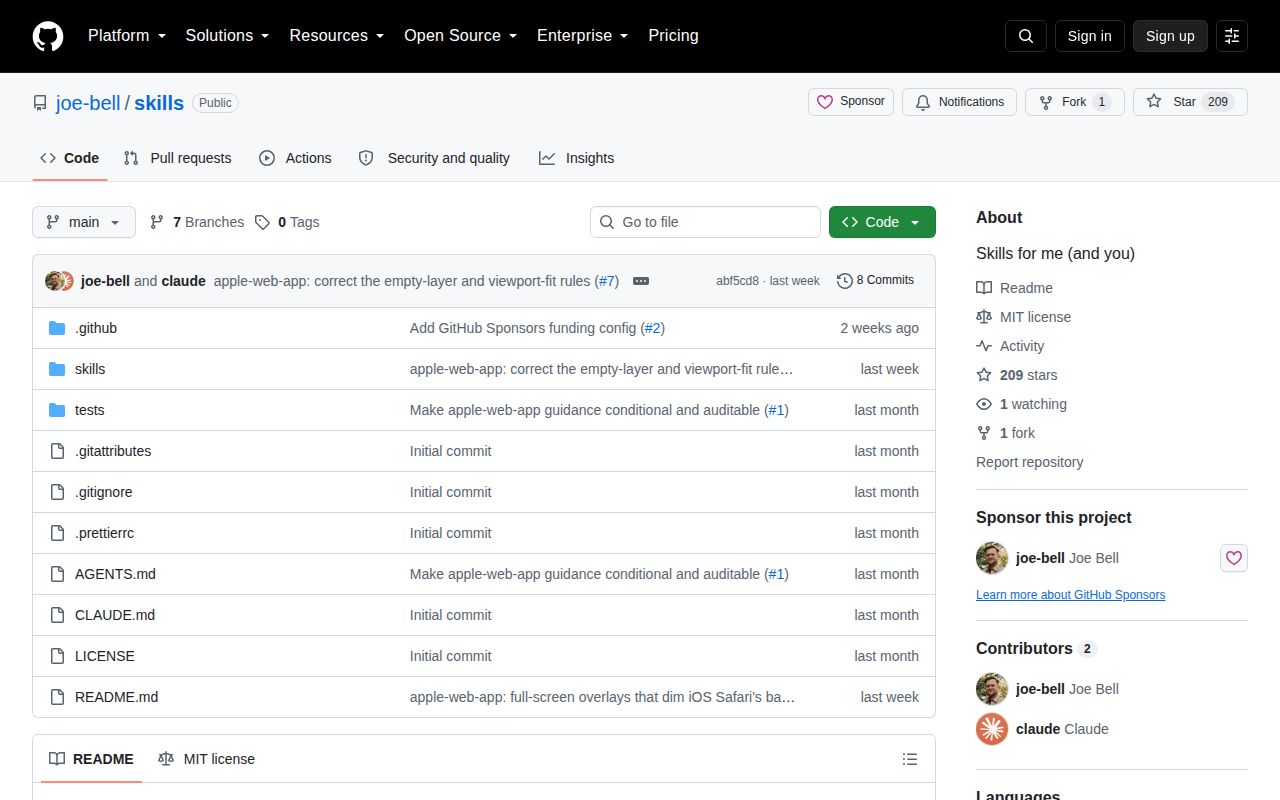
The 2-skill catalog makes the value easy to judge
The collection has 2 jobs. apple-web-app tells an agent how to implement, debug, or audit websites on iPhone, iPad, and macOS Safari. letterboxd-diary fetches a public diary RSS feed and turns recent watches into compact Markdown. That narrowness is the main virtue. You can read the relevant skill before giving it access to a project or a network call, and you can decide whether its rules fit the task.
The Apple skill is the deeper of the 2. Its version is dated 2026-09-23.6, and it routes different symptoms to separate reference files covering safe areas, overlays, installed navigation, icons, splash screens, theme colors, keyboards, and Tailwind CSS v4. It also draws boundaries. Service workers, offline caching, background sync, and push belong elsewhere. An agent following the file should avoid turning a Safari layout fix into an unrelated PWA rewrite.
Apple skill version 2026-09-23.6 separates code checks from device proof
Version 2026-09-23.6 tells the agent when to stop claiming certainty. Generated HTML, CSS, image dimensions, and unauthenticated assets can be checked from code or a desktop environment. Status-bar sampling, splash selection, and safe-area timing still need observation on the target installed app. If hardware is unavailable, the skill tells the agent to finish independent checks and label the remaining device claim unverified.
The repository was pushed on September 23, 2026 after device and Simulator findings changed earlier Safari guidance. The latest commit corrects when Safari samples a fixed overlay near the screen edge and records a Tailwind CSS v4 pseudo-element trap. This is concrete maintenance rather than a generic prompt telling an agent to “support iOS.” It also warns against disabling pinch zoom or text selection across an entire page, a common shortcut that creates a worse interface.
The Letterboxd skill uses 4 routes before giving up
Version 2026-09-22.9 starts with identity and permission. A username from the request takes priority, then a saved environment or instruction value, and only then should the agent ask. It forbids storing that username inside the installed skill folder because an update could overwrite it or a shared copy could expose it. Network access is limited to Letterboxd through the skill's allowed tool declaration.
The retrieval ladder has 4 routes: curl, the host's fetch tool, asking the user to paste the feed URL back, and a browser tool. The file separates a wrong username from a blocked domain, a server error, or a fetcher that strips XML namespaces. That sounds fussy until an agent blames an HTTP problem on the user and starts guessing account names. Ratings come from the feed's rating field rather than from punctuation in a film title.
There are firm limits. The input is a public diary RSS feed, and it does not expose a private account or the films someone merely saved to a watchlist. The feed is also a moving window rather than a complete viewing history. Anyone who needs durable analytics, private data, or a full export should use another path. This skill is best for questions such as “what were the last 5 films?” and nothing broader.
What happened when we ran it
Our September 29 sandbox did not run commit abf5cd8. The repository's language is Markdown, our lab does not have a supported executable ecosystem for it, and the repository provides no Dockerfile. There is therefore no measured install time, build result, test count, dependency footprint, or vulnerability result for us to report.
That absence changes what this review can prove. We inspected the 2 skills and their cited limits, but our lab run did not execute an agent session against an Apple device or a Letterboxd feed. A Markdown skill can alter an agent's decisions even though it has no conventional binary. Read the file before installation, then test the resulting behavior against your own agent host and target device.
The catalog has 209 stars and no support promise
On September 30, GitHub showed 209 stars, no open issues or pull requests, and no published release. The README says “built for me, shared in the open” and follows it with no support, guarantees, or liability. Take that literally. The last push was September 23, 1 week earlier, so the code is current even though the project has no release cadence to follow.
A zero-item issue queue does not prove a support community. The 8-commit history mostly records the author refining his own observations, sometimes with named AI co-authors in commit metadata. That working style suits a personal skill shelf. It gives a company less assurance than an official platform manual or a project with versioned releases, multiple maintainers, and an issue trail showing how outside reports are handled.
Install 1 matching skill rather than treating it as a toolkit
The Apple skill is worth borrowing when an agent keeps flattening Safari-specific behavior into ordinary responsive CSS. The Letterboxd skill earns its place when you ask the same recent-watch question often and want tight network permissions plus consistent formatting. Both files contain more operational judgment than their short README suggests.
Still, this is a 2-item personal collection. The sensible purchase decision is almost literal: read the named SKILL.md, check that its exclusions leave your task inside the boundary, and install only that skill. If neither Apple web-app debugging nor public Letterboxd diaries appears in your work, the repository has nothing else waiting for you.