The useful part is collaborative workflow editing
Jev Workflow Builder lets colleagues connect decision nodes and language-model nodes on a shared canvas. The README promises multiplayer state and cursors, preview runs, and a REST entry point for invoking the graph. Its source uses React Flow for the diagram and Liveblocks for shared storage. If you're building a collaborative decision editor, these connections are more instructive than a screenshot of boxes and arrows.
Our checkout contained 37 files and about 5,828 source lines, occupying only 0.3 MB. That compact codebase is approachable for a developer studying how graph editing connects to server execution. The README explicitly calls it a demo. I would judge it as an implementation example whose parts you adapt, rather than assume that a small repository supplies the operational controls of an established automation platform.
What happened when we ran it
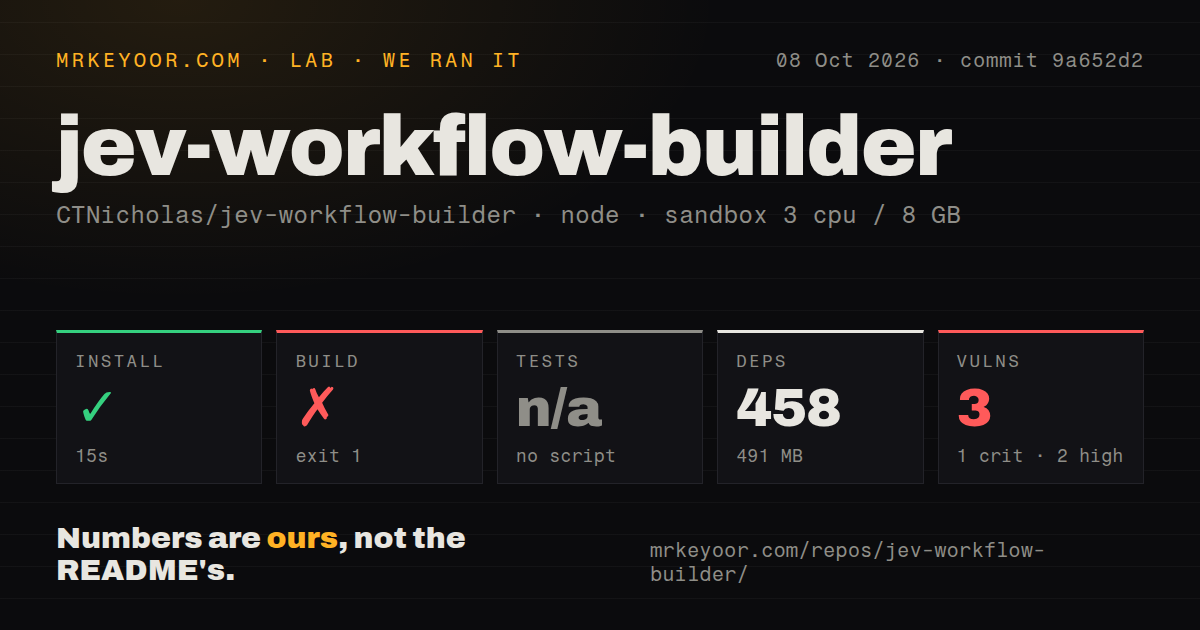
Our sandbox installed Jev Workflow Builder commit 9a652d2 in 15 seconds, adding 458 packages and occupying 491 MB. The build failed with exit code 1 after 22 seconds. The October 8, 2026 run used the lab-node:22 image in an unprivileged container with 3 CPUs, 8 GB of RAM, and no secrets. No test script or target was available, so the test step was skipped.
The build log points at new Liveblocks(...), where the constructor receives process.env.LIVEBLOCKS_SECRET_KEY. It then reports failure to collect page data for /api/workflows/[workflowId]/runs. That establishes a failure while preparing a server route in our credential-free environment. The excerpt doesn't supply the underlying constructor exception, so it cannot prove that adding a key alone produces a successful build or a working workflow.
Npm audit reported 3 known vulnerabilities: 1 critical and 2 high, with none moderate or low. The supplied block doesn't identify affected dependencies, exploit conditions, or fixes. We therefore can't attach those severities to a particular public route. Our scan found 0 CI workflow files, no Dockerfile, and no tests directory. This run gives a concrete reason to inspect dependencies and verification before adapting the example for deployment.
Liveblocks is required even when model replies are mocked
The setup instructions require accounts and keys for Liveblocks, TypeSafe, and Vercel's AI Gateway. Those services have separate jobs: Liveblocks maintains shared workflow state, Jev answers typed questions, and the gateway supplies language-model generation. Our 491 MB install didn't demonstrate any authenticated service call. It only established that dependency installation completed in the sandbox.
The source adds a useful nuance absent from the short README. Without TYPESAFE_API_KEY, Jev answers come from keyword matching. Without AI_GATEWAY_API_KEY, the language-model node streams a canned response. Both paths mark the result as mock. That helps illustrate graph behavior while you're developing, but a moving preview isn't evidence that Jev classified the input or a language model drafted the response. Liveblocks still has its own constructor and secret requirement.
The graph executor rejects cycles and records node results
The executor reads a snapshot of the workflow graph from Liveblocks storage and checks its execution order. It returns an error when the graph contains a cycle or lacks an input node. Branches can require any incoming condition or all incoming conditions, and upstream answers become available to later questions. These are concrete implementation choices you can study within the roughly 5,828 lines our scan counted.
Run status and node messages go into Liveblocks feeds. The API can return a run identifier immediately or wait for the final trace when the caller requests it. That makes the execution path inspectable in source and lets another application invoke a workflow. It doesn't give us evidence of durable recovery after a server interruption, correct billing behavior, or reliable execution under concurrent load. None of those outcomes was measured by our lab.
Sample identities need replacing before private workflows
The Liveblocks auth route accepts a sample user identifier or selects a random example user. It then grants write permissions across the example room prefix. A separate source file contains the sample identities. This is convenient gallery behavior, but it is a poor fit for private team workflows without application-specific identity and room authorization.
The workflow-run route checks whether the server has its Liveblocks secret, then looks up the requested workflow and starts execution. That server configuration check doesn't authenticate the caller. Our 22-second failed build never exposed a running endpoint, so this is a source finding rather than an observed attack. A developer adapting the demo should add caller checks to the run route as well as replacing the example collaboration permissions.
September activity provides little operating history
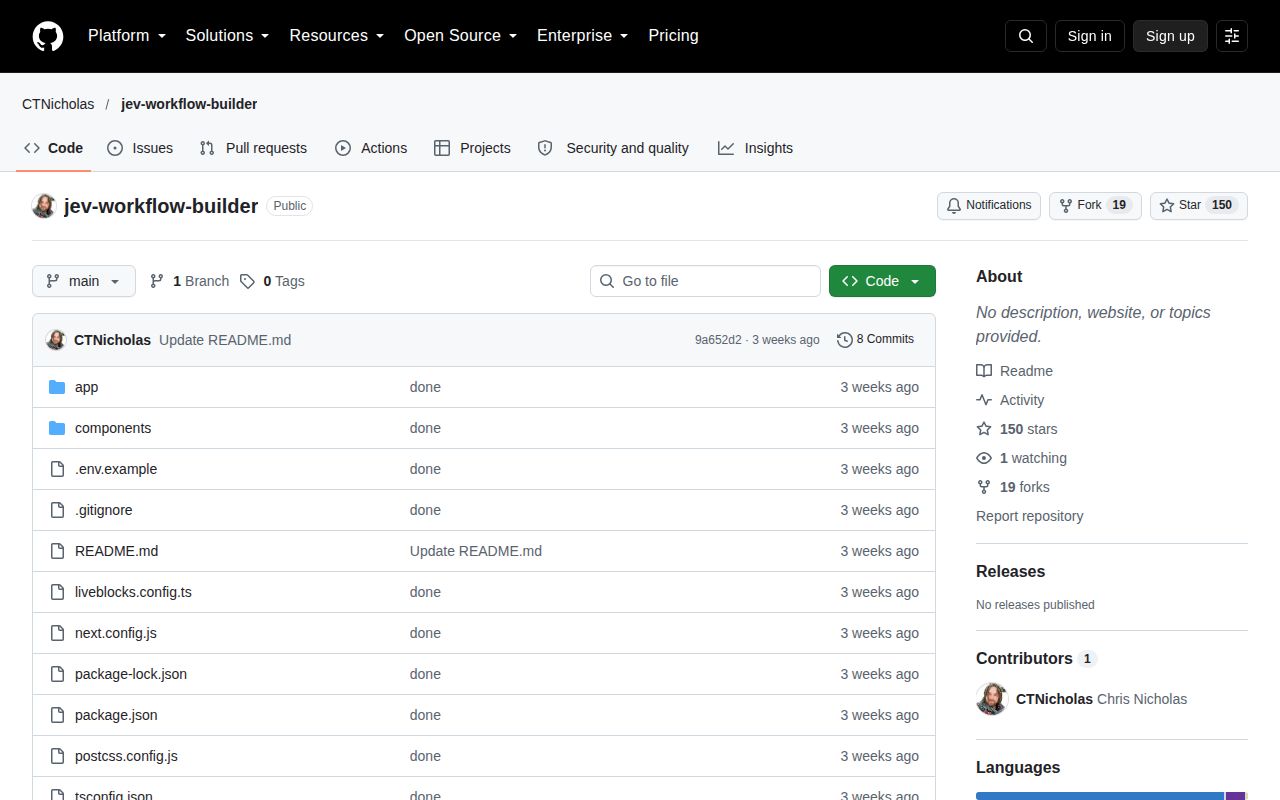
GitHub records a last push of September 21, 2026, with 150 stars and 0 open issues and PRs. The latest-release endpoint returns no release, and the recent issue list is empty. Those facts show a small public example with little visible issue discussion. They don't establish either abandonment or trouble-free operation. The README offers local development instructions but no detailed deployment or recovery guide.
The absence of a test target matters more alongside our 3 audit findings and failed build than it would in a diagram-only example. This project includes server execution and calls that can use paid services. Before trusting an adapted version, prove one authenticated workflow from input through branch selection to output, then exercise failed service calls. Keep mock results visible so nobody mistakes an illustrative preview for completed work.
Pick an editor foundation or an automation platform deliberately
React Flow is the narrower alternative when you want to build the canvas and own execution yourself. Flowise addresses visual AI workflows, while n8n is worth considering for broader automation and integrations. Jev Workflow Builder earns attention when Liveblocks collaboration around Jev decisions is exactly what you're implementing. Budget for real authorization and dependency review before letting its run route spend service credentials.