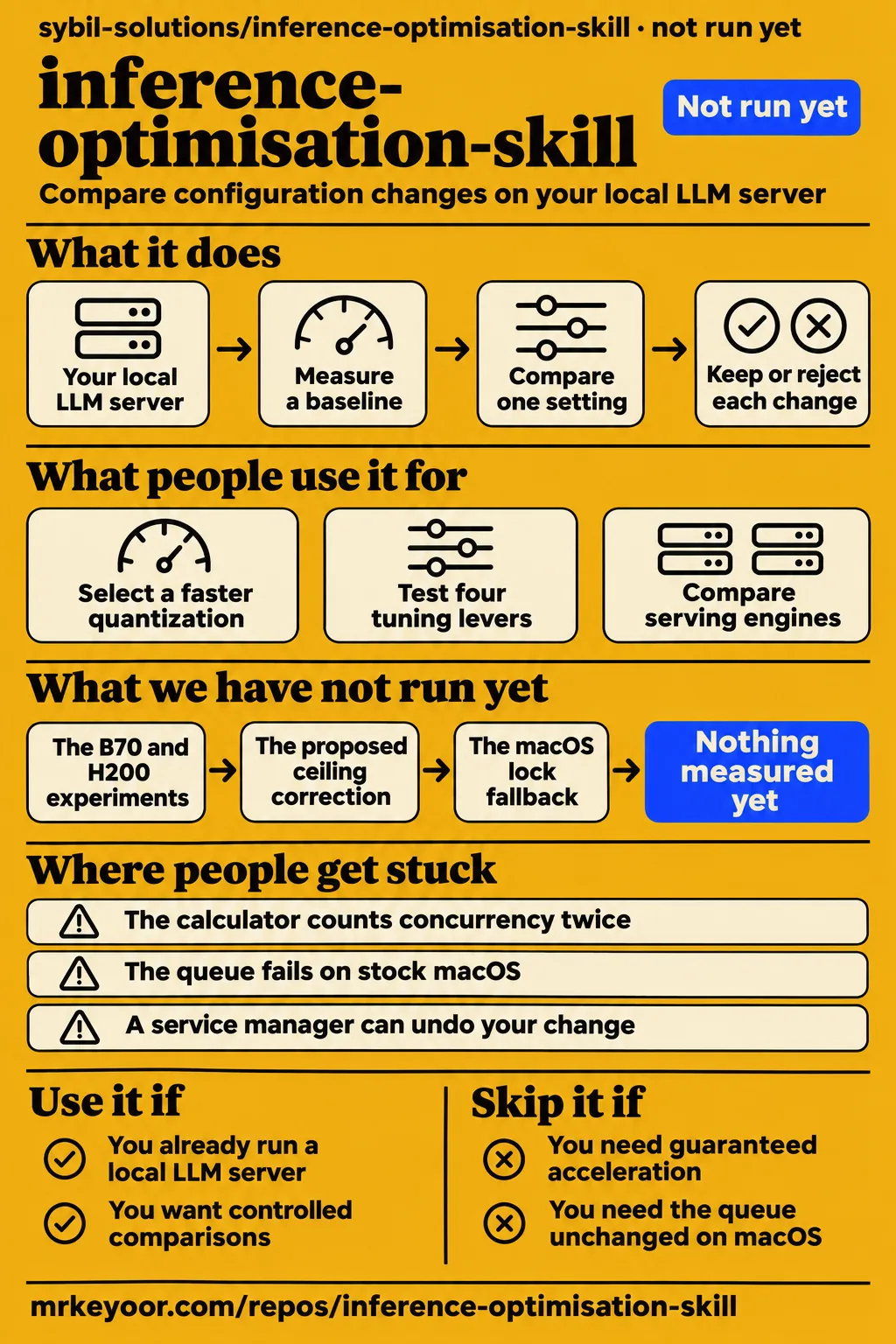
inference-optimisation-skill gives you a controlled way to tune a local LLM server, with room for the answer to be "keep the current configuration." Independent DEV author prodbymarcu tested four tuning levers and banked no wins. That is the most useful counterweight to the speedup headlines: the workflow can reject changes as well as find them.
Use it if you already operate a model server and want a written reason for every configuration change. Skip it if you expect an unattended agent to deliver a guaranteed speedup or need the bundled queue to work unchanged on stock macOS. Our November 23 lab attempt stopped before execution; this review weighs the documented procedure, external experiments and specific bug reports.
What people use inference-optimisation-skill for
External users have used the methodology both to select a faster quantization and to reject every candidate they tried. The authors also publish serving results from the experiments that informed the skill. Those are different kinds of evidence, and you should keep the distinction when deciding what to expect on your machine.
| Who used it | What they did | Reported outcome |
|---|---|---|
| The-Focus-AI | Benchmarked Qwen3.8-27B with its Pi LoRA on an M4 Max with 64 GB memory | Selected Q4_K_M as the default after six-sample median decode of about 19.5 tok/s, versus about 14 for Q8_0 |
| prodbymarcu on DEV | Cloned the skill and applied its methodology to a live coding lane on a dual-3090 Arch machine | Tried four levers, banked no wins and shipped no changes |
| Sybil Solutions | Tuned Qwen3.8-27B on an Intel Arc Pro B70 using vLLM and custom XPU kernels | Reports 91.2 tok/s for one user, 365 tok/s for sixteen, and an agent-session replay falling from 193 to 147 seconds |
| Sybil Solutions | Qualified DeepSeek-V4.1-Flash on four H200 NVL GPUs using vLLM and speculative decoding | Reports moving from crashes under load to 229.1 tok/s decode and 17,546 tok/s prefill, with all six gates passing |
The Mac result is especially useful if you assume smaller weights always mean faster generation. Quantization stores model weights with fewer bits. In The-Focus-AI's local comparison, Q3_K_M and Q5_K_M both ran slower than Q4_K_M on Metal, Apple's GPU framework. The project's separate coding-benchmark improvements concern its adapted model; they should not be credited to this tuning skill. The quantization table describes inference speed with the LoRA enabled and reasoning disabled.
What happened when we ran it
The recorded sandbox configuration was 3 CPUs and 8 GB RAM, with no image specified. These are configuration details, not a measured hardware requirement for serving a model.
| Lab step | Recorded result | What it means |
|---|---|---|
| Repository execution | NOT RUN: unsupported ecosystem, Python; no Dockerfile | No install, build, test or inference result |
| Hands-on safety check | FAILED: none of compose.yaml, compose.yml, docker-compose.yaml or docker-compose.yml exists | The deployment path required a Compose file and stopped |
| Teardown | teardown: ok | Cleanup was recorded, not successful application execution |
The safety log calls the checkout an "unsafe repo" because its rule requires a Compose file. That is a deployment-policy label, not a finding of malicious code. There was no model request to narrate and no speed measurement to compare with the README.
A generic November 23 run entry says "deployed with its own docker compose", contradicting the failed safety step. The explicit NOT RUN result and that failed step take precedence here. A run-description template cannot turn a stopped deployment into a working server.
Where people get stuck: ceilings, queues and unchanged servers
Issue #1 reports that the bundled calculator counts concurrency twice and that the queue fails on stock macOS. The independent DEV experiment adds a separate trap: a service manager can undo your configuration change while the benchmark continues printing plausible numbers.
| Problem | What to do with the report | Reported status |
|---|---|---|
| Inflated multi-user decode ceiling | Issue #1 proposes removing the final multiplication by n; inspect the arithmetic before using the estimate to rank work | Open report at fda968e |
| Missing flock on macOS | Issue #1 proposes a mkdir-based locking fallback | Proposed fallback, not a recorded upstream fix |
| Linux-only setsid detachment hint | The same reporter suggests nohup alone on macOS | Reported workaround |
| Both A/B arms use the original engine | prodbymarcu switched through the manager's model-swap mechanism and recorded each arm's resolved configuration | Bogus measurements excluded |
| Unreliable prefill and MFU estimates on IQ1_M | prodbymarcu dropped those rows before drawing conclusions | Excluded, no corrected calculation reported |
| --mtp-q4 candidate crashes while loading | prodbymarcu discarded the candidate at the stability gate | No speed figure assigned |
The concurrency report changes how you read optimization headroom. Its dense-model example uses 10 GB of weights and 100 GB/s bandwidth, with no drafts or KV cache. At four concurrent requests, the script reportedly returns 160 tok/s against a physical maximum of 40. A target that appears far below an inflated ceiling can send you hunting for gains the hardware cannot deliver. The reporter says single-user calculations stay unchanged; the complaint concerns aggregate multi-user scaling, not every number the calculator produces. Issue #1 gives both the original expression and the proposed correction.
On macOS, make queue portability an explicit precondition. Check for flock, decide how the lock will be acquired and released, and check the detach command separately. The proposed mkdir fallback includes an exit trap to remove the lock directory. It is a suggestion in an issue, so treat it as code to review rather than a verified release feature. A queue without its lock defeats the method's requirement that GPU jobs run one at a time.
A service manager can erase your A/B experiment
prodbymarcu's first comparison measured the same running configuration in both arms because the manager respawned the original engine. The author stopped the supervisor, killed the engine tree and launched the comparison. Numbers appeared. Then the manager brought the live engine back using its saved command line, making the apparent difference meaningless. The author excluded those measurements and changed how model swaps were performed.
This is a useful reason to adopt the workflow even if you never find a faster setting. A configuration file records your intention; the resolved configuration records what answered the request. Keep the binary or image revision, model revision and effective launch settings beside each result. Otherwise an orderly ledger can preserve a very orderly fiction.
The same experiment produced one small positive candidate, one load crash and two slower arms. The --spec-min-p change's median rose 2.6%, but its samples straddled the baseline. The author left it unbanked for a later retest with prompts resembling real agent traffic. Nothing shipped to production. If your requirement is evidence for changing a busy coding server, that is a better outcome than promoting the best-looking sample.
The workflow measures more than writing speed
The README covers decode, prefill, KV cache capacity, startup and time to first token under a memory cap. Decode means generating output tokens; prefill means processing the input prompt. The KV cache stores attention state from preceding tokens, and TTFT is the wait before the first output token arrives. The skill requires full-context stability before accepting a result.
How do you speed up a local LLM? Measure a baseline, change one setting, compare it with controls on both sides and keep the result only after checking output and stability. The documented procedure asks for medians, rejects looping output and failed requests, and tests retrieval of planted text at long context. That last check matters if your coding agent reads large files: a fast short answer says little about whether the server still handles your working context.
How do you serve a model efficiently? Choose the metric your users need, then tune within memory, context and concurrency constraints. What do inference engineers optimize each day? In this workflow, the work includes compile caches, decode graphs, speculative decoding, KV sizing, prefill and eventually kernels. SKILL.md orders cheaper configuration changes ahead of kernel work. A single tokens-per-second headline cannot choose those priorities for you.
Shell access makes overnight tuning an operating decision
PROMPT.md gives the coding agent shell access on the machine that serves the model and asks it to restore the best server afterward. That is meaningful authority: the work can involve server restarts, memory pressure and changes to power profiles. The prompt explicitly calls for a memory watchdog, draining requests before stopping a server and reporting the state left behind. These are documented instructions for the agent, not a security boundary enforced by reading a Markdown file.
For an overnight run, write down which service the agent may change, what memory limit applies and what counts as an acceptable quality trade. The prompt already has fields for those constraints. Its credential guidance says to use the harness's secret mechanism and never print or publish credentials. You still own the agent's permissions and the machine it can affect.
Memory accounting needs particular care on unified-memory GPUs. SKILL.md says GPU allocations can escape cgroup counters and MemAvailable, and instructs the operator to include driver residency plus process anonymous memory. The README describes mem.sh for this purpose. A memory cap based only on the usual process or container figure can miss the allocation the procedure tells you to count.
inference-optimisation-skill vs vLLM, SGLang and llama.cpp
vLLM, SGLang and llama.cpp are serving engines you can tune with this workflow; changing engines is a different decision from adopting the experiment protocol. The practical alternative to the skill is often your own benchmark notebook or an ad hoc flag sweep.
| Choice | What the comparison supports | When to choose it |
|---|---|---|
| Controlled workflow vs ad hoc sweeps | prodbymarcu rejected all four tested levers rather than shipping noise | Use the protocol when a configuration change needs an auditable reason |
| SGLang vs vLLM on B70 | Sybil reports 82.6 vs 75.7 tok/s on the same card and day | Include engine selection in your own comparison rather than assuming a universal winner |
| llama.cpp Q4_K_M vs vLLM EXL3 with custom XPU kernels | Sybil reports 25.0 vs 91.2 tok/s | Treat the result as a comparison of complete stacks, since quantization and kernels also changed |
| Q8_0, Q5_K_M and Q3_K_M vs Q4_K_M on Metal | The-Focus-AI selected Q4_K_M; Q5 and Q3 were slower | Benchmark the actual format and backend instead of assuming fewer bits always win |
The vLLM README documents an OpenAI-compatible server, SGLang is a serving framework, and llama.cpp includes llama-server. Pick the engine for your model and hardware first. Then use a fixed workload to decide whether a setting or a different stack improves what you care about. The skill does not replace the engine or supply the model weights.
What the other reviews get wrong
oVu X's DEV introduction and ainotesus's X post make speed gains sound more automatic than the independent experiment supports. oVu X opens with "Your Local LLM Is Slower Than It Should Be," while ainotesus describes a skill that makes local servers measurably faster. prodbymarcu's zero-win experiment is a concrete reason to narrow that promise to controlled evaluation.
The oVu X article also says it works on any hardware. The methodology has broad ambitions, but issue #1 identifies two specific obstacles to running the queue unchanged on Apple machines. Its explanation of a theoretical ceiling also needs the concurrency qualification: the open arithmetic report concerns exactly the calculator used to set expectations.
Developers Digest's November 17 article correctly labels the authors' speedups as unreproduced. Its statement that GitHub interest is the only public signal is now too narrow a reading list. The-Focus-AI's quantization comparison and prodbymarcu's methodology run give you concrete external outcomes to inspect. They broaden the evidence without turning the authors' entire results table into independent benchmarks.
Questions people ask
To distinguish a hardware limit from a software limit, SKILL.md tells you to measure bandwidth and compute throughput, count the model's work and compare a baseline with a practical ceiling. Issue #1 makes checking the multi-user arithmetic part of that job.
Is my local LLM limited by the hardware or by its software configuration?
Measured bandwidth, model component sizes and a baseline help you estimate the available headroom; a low token rate alone cannot answer the question. SKILL.md asks for measured hardware behavior rather than spec-sheet values. The YouTube overview titled "Compute Ceilings for Local LLM Tuning" frames this same hardware-versus-software question; it is an explanation of the approach, not an independent reproduction of the headline gains.
How can Qwen3.8-27B go from 25 to 91 tok/s on the same GPU?
Sybil's README compares llama.cpp Q4_K_M with vLLM EXL3 and custom XPU kernels on an Arc Pro B70. The reported figures are 25.0 and 91.2 tok/s. Multiple parts of the stack changed, so you cannot assign the difference to one engine flag or to installing the skill.
Would you let an AI agent optimize your local LLM configuration overnight?
Only with explicit limits on the service it may change, memory use, context and quality trades. PROMPT.md includes those constraints and instructions to drain requests and restore the best server. The supervisor incident in the independent run is a reason to establish how server swaps work before leaving the agent unattended.
Does ceiling.py count concurrency twice and overstate multi-user decode ceilings?
Issue #1 reports that defect at fda968e and proposes removing the trailing multiplication by concurrency. Its four-user dense-model example gives 160 tok/s where the physical maximum is 40. It says concurrency-one results are unchanged. Treat this as an attributed bug report rather than our executed reproduction.
How can queue.sh serialize benchmarks on macOS without flock?
The issue reporter proposes using mkdir to acquire a lock directory and an exit trap to release it when flock is unavailable. The report also suggests nohup alone in place of the Linux-only setsid hint. Review both locking and detachment before relying on a long queue.
Should a small --spec-min-p improvement inside the sample spread be retested or left unbanked?
Leave it unbanked and retest against representative prompts. prodbymarcu did exactly that with the 2.6% median candidate whose samples straddled the baseline. A promising direction can remain in the log without becoming the new production configuration.
Does speculative decoding always make a local model faster?
No. Drafting tokens adds work, and higher acceptance can still cost more time than it saves. SKILL.md says to measure per-step time when acceptance rises without a token-rate gain. Sweep draft length for the actual context and concurrency instead of copying another machine's setting.
Do I need Claude Code to use inference-optimisation-skill?
No. The README supports other agents that read SKILL.md and documents a command-line path without an agent. You need a model server and the ability to configure the benchmark target, not a particular coding assistant.
How do I speed up a local LLM?
Start with a baseline and a ceiling estimate, then compare one change with control runs before and after it. SKILL.md requires repeated decode samples and medians, followed by output and stability checks. If the candidate cannot beat its neighboring controls, keep your current configuration and record the rejection.
How do I serve a model efficiently?
Set a memory cap, the context length that must work and the number of simultaneous users before tuning. PROMPT.md asks you to rank decode, prefill, capacity, startup and TTFT by importance. That gives you a reason to prefer one change over another when throughput and responsiveness pull in different directions.
What do inference engineers optimize each day?
This skill's documented work includes persistent compile caches, decode graphs, speculative decoding, concurrency, KV sizing, prefill and kernel changes. SKILL.md puts kernel work after configuration levers plateau. It also requires a record of failures, so the next experiment starts with what the previous one ruled out.
What we have not tested yet
Our lab produced no executed installation, build, test suite or inference workload for this repository. We have not reproduced the B70, H200, Mac or dual-3090 experiments, tested the proposed ceiling correction or macOS lock fallback, or audited the scripts' security. The sandbox image was unspecified, and actual runtime versions require raw toolchain logs.
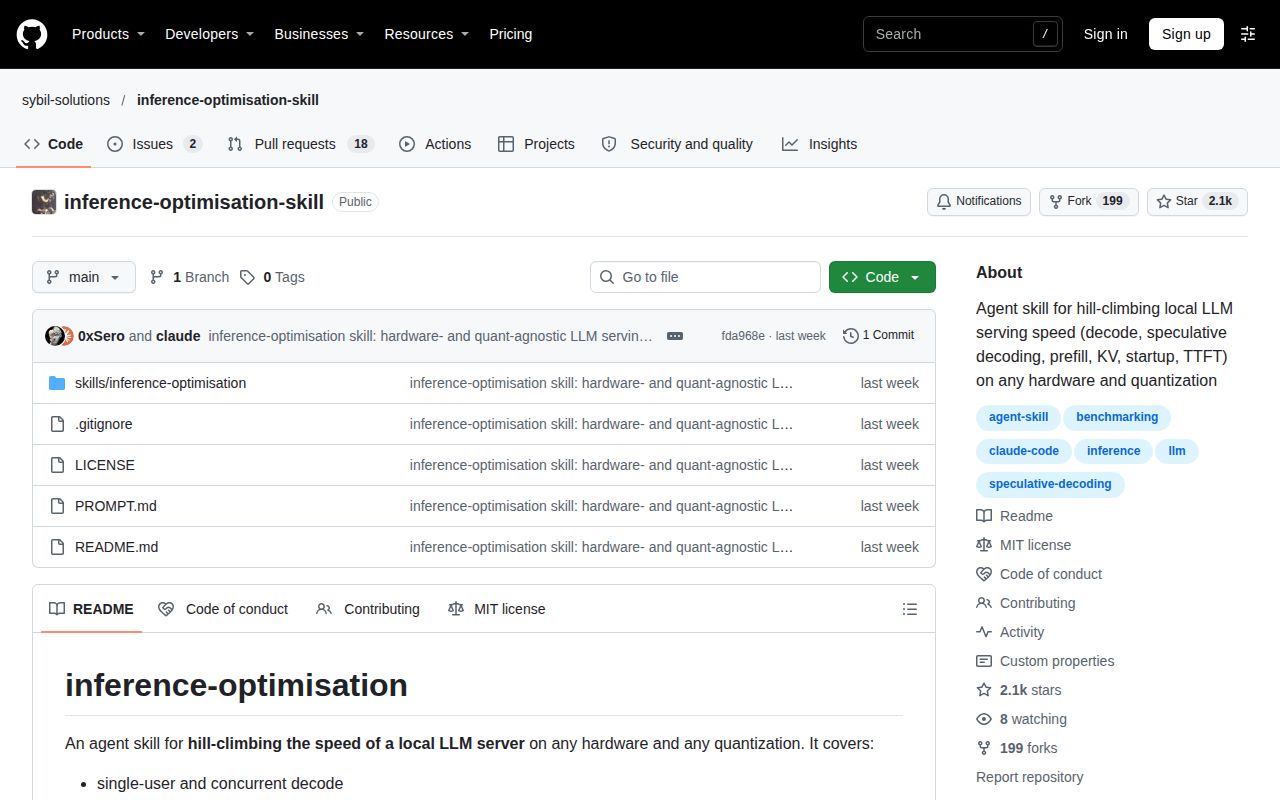
Issue #1 is open in the checked research, with no merged correction shown. Issue #2 is an informational BuildRun guide submission, not a second independent benchmark or a resolution of #1. GitHub's November 23 API response gives a November 16 last push; that date and the open reports describe a young snapshot, not proof of abandonment. The latest-release endpoint returned 404, which says nothing about whether the documented source workflow can run.
The X search also contains broader promotional claims about user reports and speedup ranges without the underlying experiments needed to assess them. Those claims are excluded from the performance comparison. For your first evaluation, the useful deliverable is a ledger containing the effective server configuration, neighboring controls and reasons for accepting or rejecting each change, including the result "nothing improved."