Passing source checks leave the import question open
Immich-Go is worth considering when a Google Photos migration needs the metadata surrounding each image. The README describes matching Takeout media with JSON metadata to preserve albums, descriptions, and locations. That is the documented purpose of its source-specific importer; our sandbox did not verify the resulting library.
For an Immich owner with a backed-up export, the useful next step is a representative pilot. A collision report names the exact commit measured here, so a successful build alone is insufficient grounds for committing a whole collection.
Immich-Go requires an existing server. If you are still choosing where the library will live, the supplied Immich review addresses the server choice. This review addresses importing into it.
What happened when we ran it
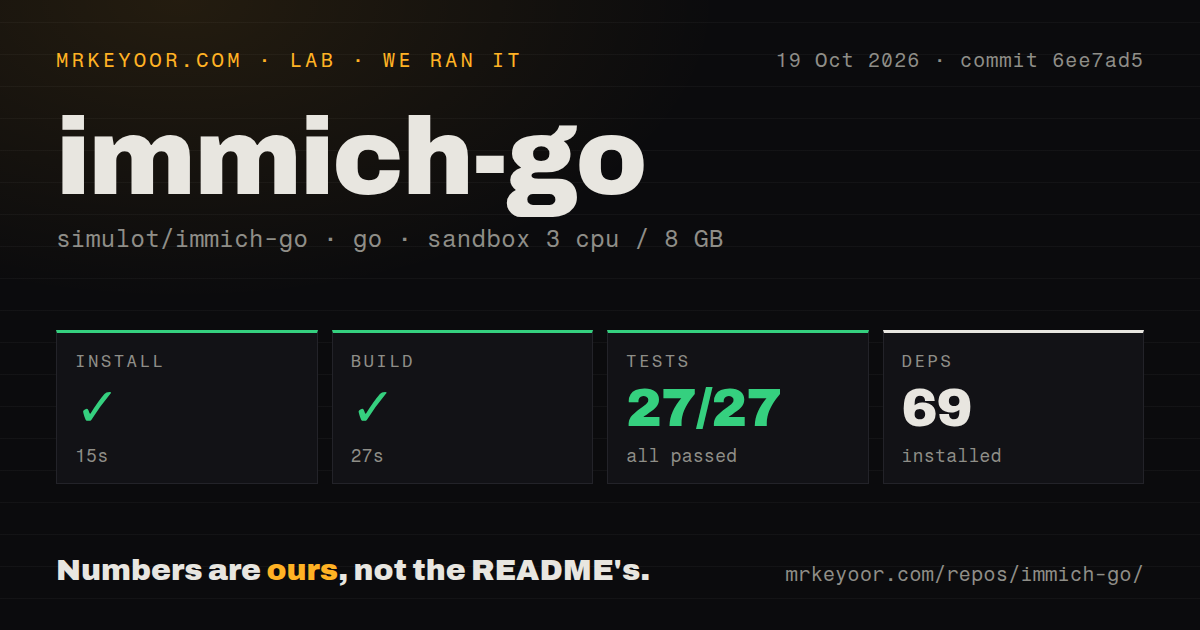
Our sandbox installed Immich-Go commit 6ee7ad5 in 15 seconds, recorded 69 dependencies, and built it in 27 seconds. Tests completed in 9 seconds: the Go summary reported 27 passed and 0 failed out of 27.
The 2026-10-19 run recorded 3 CPUs, 8 GB RAM, and image golang:1.24-bookworm. That configuration label does not establish actual Go or operating-system versions.
No import into a running Immich server was measured. The run did not establish metadata accuracy, migration completeness, or upload speed. It supports a narrower conclusion: the measured source installation, build, and tests succeeded.
A Takeout collision report names this commit
Issue 1473, opened October 18, 2026, describes different files with identical paths in separate Takeout ZIP series. The reporter says one file can be discarded as a local duplicate and the retained file can receive the other file's metadata sidecar.
The report distinguishes an import using v0.32.0 from a unit-test reproduction on main commit 6ee7ad5. That is the same commit our sandbox measured. The reported failure was not reproduced in our lab.
The reporter also describes three places where same-name files can be merged: the folder catalogue, fileTracker, and upload advice. Their proposed catalogue change addresses one layer. The supplied report does not establish a complete fix across all three.
For exports spanning multiple ZIP series, require a verified fix or a representative import that accounts for colliding paths before proceeding with the full library. Compare file identities as well as counts and metadata. A count alone would not establish that each retained file has the correct sidecar.
Installation and permissions still need checking
The README directs users to prebuilt binaries and says neither Node.js nor Docker is required. It lists Windows, macOS, Linux, and FreeBSD availability and claims Immich V2/V3 compatibility. Those are upstream statements, not platform or server combinations validated by our run.
Provide the server address and an API key with appropriate permissions. The upload guide says pausing Immich background jobs requires an admin API key. Grant permissions for the behavior you intend to use.
Read the organization settings before importing. The documentation describes album creation, duplicate handling, and stacking. Its best-practices guide distinguishes keeping RAW/JPEG files separately from stacking them or retaining one format. Choose the intended behavior before judging the pilot's result.
Check a pilot against the retained export
The best-practices guide recommends downloading all Takeout parts, testing a small subset, and checking dates, locations, and albums afterward. It includes a dry-run example for local folders and a separate pilot using real data. A dry run does not establish what an actual transfer will leave in the destination.
For this review's decision, choose a pilot containing the awkward cases in your collection: repeated paths across series, metadata sidecars, and RAW/JPEG pairs where applicable. Retain the archives and logs. Compare the resulting files and metadata with the source, including file identities for collision cases. This is a recommended acceptance check, not a migration performed by our lab.
Alternatives answer different questions
Immich's official CLI uploads photos and videos and supports recursive folder uploads. Consider it when a folder upload meets your needs. Its documented installation options use Node.js/npm or Docker. The same page recommends community-maintained Immich-Go for Google Photos Takeout imports; it does not establish an equivalent Takeout-metadata workflow in the official CLI.
PhotoPrism is an application for browsing, organizing, and sharing photos and videos. Consider it if the destination is still undecided. It changes the library application being evaluated, and the supplied evidence does not establish that it resolves the collision reported for Immich-Go.
Recent activity does not settle maintenance health
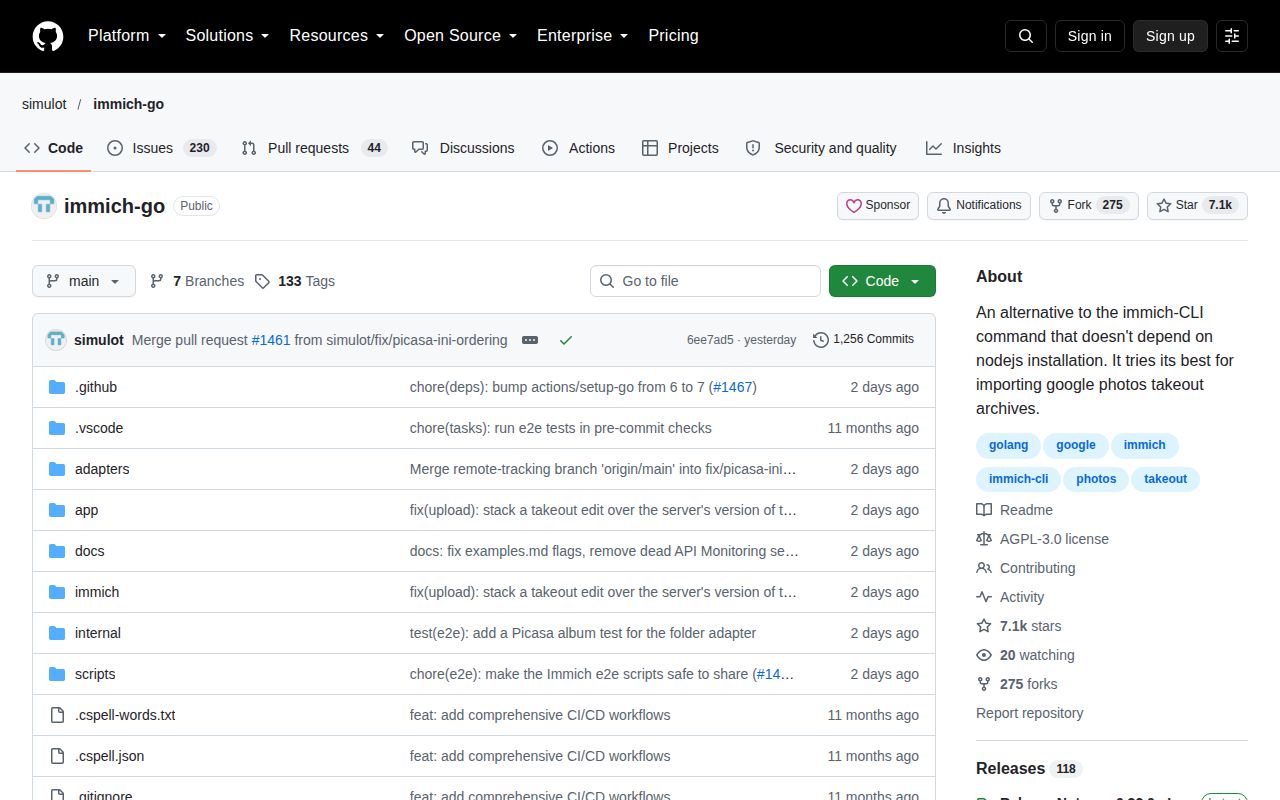
The supplied repository metadata, observed on October 20, 2026, records a last push of October 18, 2026 at 18:49:36 UTC. Issue 1473 was also opened on October 18. These establish recent recorded activity, but do not establish response times, fix completeness, or overall maintenance health.
The documentation provides source-specific explanations and validation advice. This review leaves documentation quality unscored because the supplied candidate provides no explicit scoring rubric and the commands were not validated through a migration.
Upstream calls Immich-Go an early version and asks users to keep backup copies. Retain the export until the destination accounts for the files and metadata you intended to import, including files sharing paths across Takeout series.