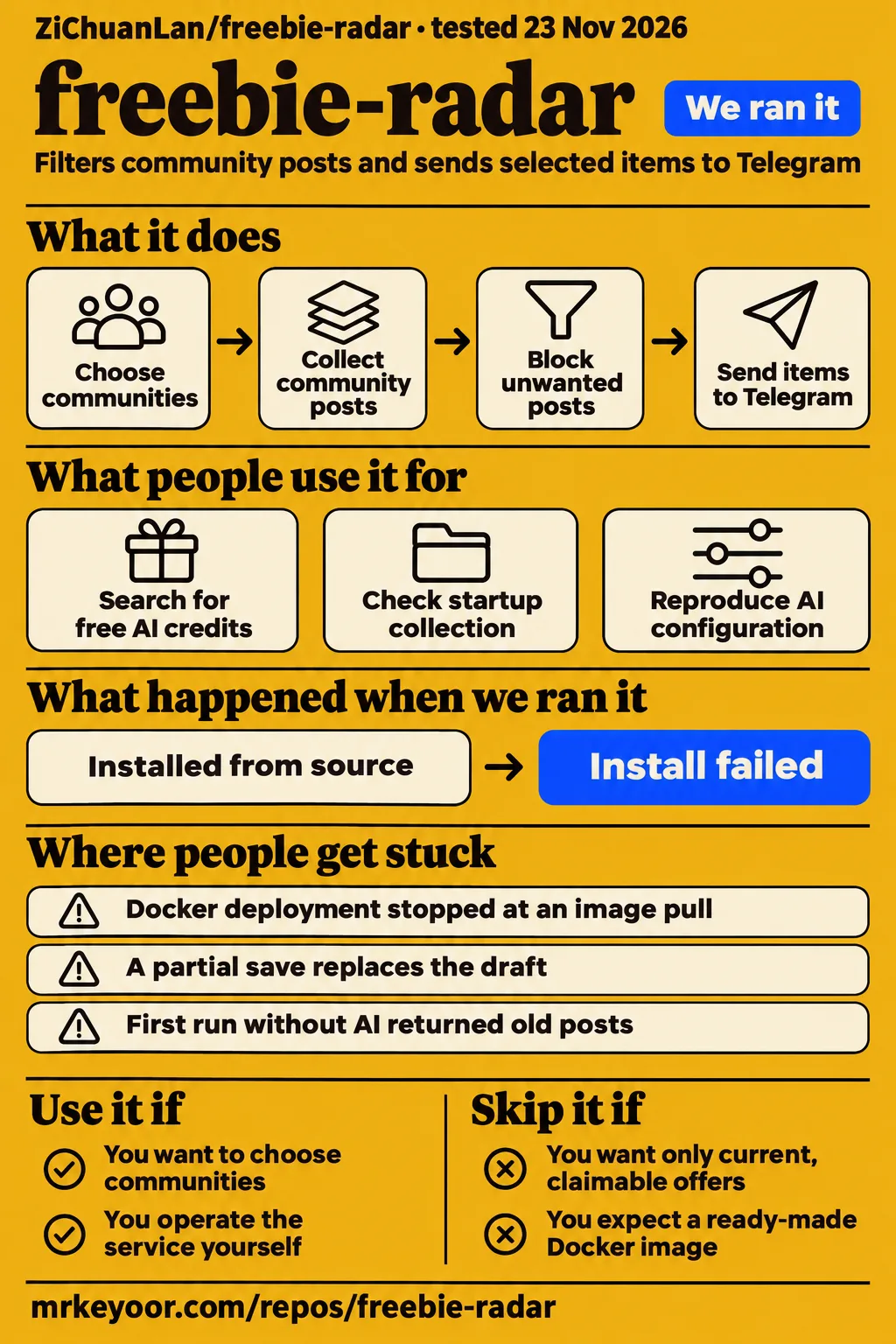
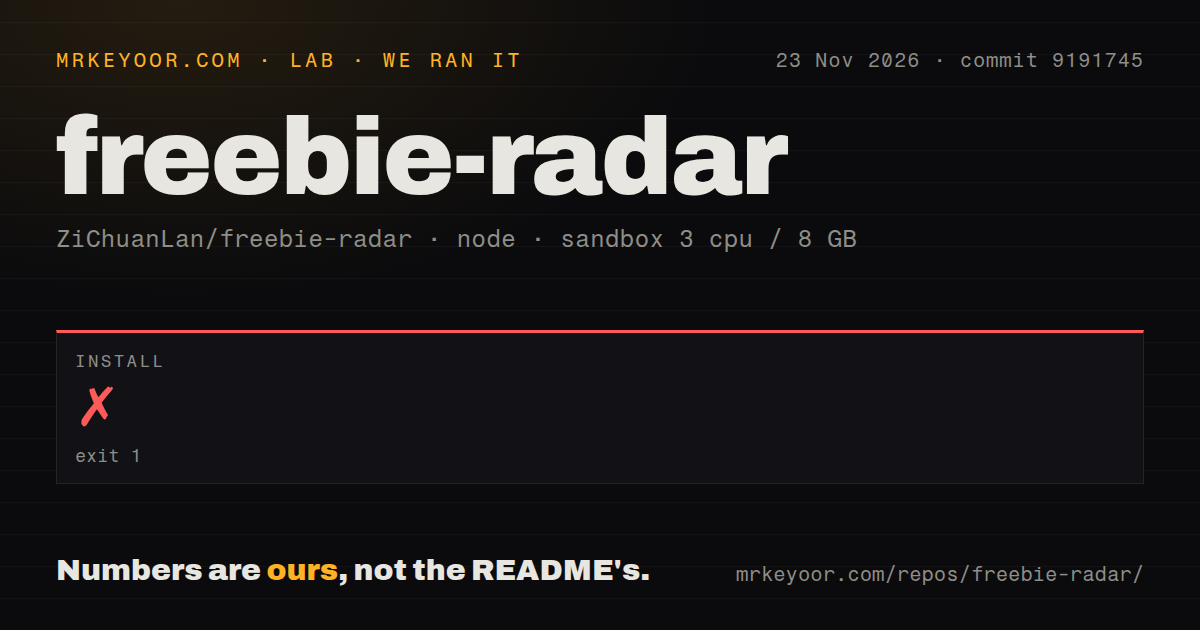
Our dependency install failed in 12 seconds, and the separate Docker deployment stopped at an image pull. Use freebie-radar if you want to choose your own information sources and tune what reaches Telegram. Skip it if you want a beginner-ready service that delivers only current, claimable offers: the setup attempts below stopped before a working feed, and WillLeeAI's first run returned old posts and noise.
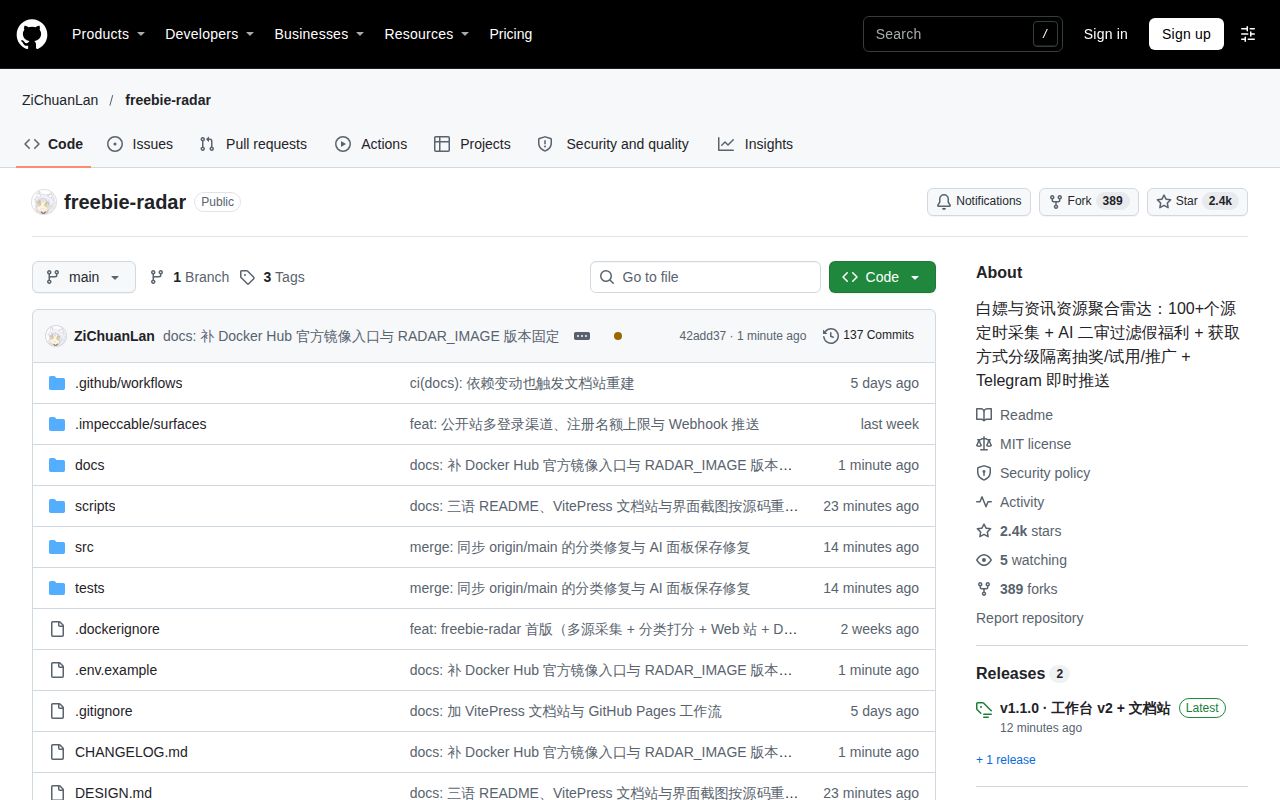
Freebie-radar, also called Resource Radar, is a self-hosted information aggregator with optional AI review. Its attraction is control over the selection process. You decide which communities to follow, which posts to discard and which categories deserve an alert. The useful question is whether that control saves you enough reading to justify operating the collector.
What people use freebie-radar for
WillLeeAI used freebie-radar to automate discovery of free AI credits and developer tools without enabling AI review. In WillLeeAI's first-run account, the author reported collecting 753 items, including old posts, games and noise, with rule-based labels still needing checking. This is a concrete use for a developer seeking a narrow feed: collecting candidate offers, then deciding which sources and filtering settings belong in that feed.
The Freebie Radar CN Deals template publisher used its independent Railway packaging to check startup collection and reported 735 items collected after boot. That result belongs to its packaging of commit 9de586d. The listing describes a scheduler that immediately runs sources without a last_run_at value, then ticks every 30 seconds. This use case concerns deployment startup and collection, separate from WillLeeAI's search for developer offers.
Project maintainer ZiChuanLan used a local instance with a real frontend, Playwright and a mock OpenAI-compatible endpoint to reproduce the AI configuration workflow in issue #6. The maintainer reported that testing preserved the draft and saving stored the key, then identified a different partial-save draft-loss path. This is a configuration troubleshooting use case, with the issue distinguishing the reporter's account from the maintainer's reproduction.
Freebie-radar collects community posts and routes them through rules, optional AI classification and configurable Telegram delivery, according to the project's README. It covers developer resources alongside games, software promotions, open-source projects and news. RSS, a standard feed format that readers can subscribe to, is another input, so your selection can extend beyond its built-in communities.
The classification has separate jobs. Content kind distinguishes a freebie from a deal or news post. Category identifies the subject, such as AI or cloud services. Acquisition mode distinguishes a direct giveaway from a conditional offer, lottery, trial, promotion or paid item. That separation is worth having if you want AI credits but don't want a short trial described as something you can keep.
For Telegram, the README documents separate routes with category, acquisition mode, keywords, price ceilings and minimum scores. A route can send immediately or collect a batch. You could keep software giveaways separate from hosting discounts rather than let every new item ring the same bell. These settings let the operator express different delivery preferences for different kinds of posts.
| Who used it | What they did | What happened |
|---|---|---|
| WillLeeAI on X | Automated a search for free AI credits and developer tools without enabling AI review | Reported 753 items, including old posts and noise, with rule-based labels still needing checking |
| Freebie Radar CN Deals template publisher | Checked startup collection in its independent Railway packaging of commit 9de586d | Reported 735 items collected after boot |
| Project maintainer ZiChuanLan | Reproduced the AI settings workflow using the real frontend, Playwright browser automation and a mock model endpoint | Reported that testing preserved the draft and saving stored the key, then identified a different partial-save draft-loss path |
What happened when we ran it
Our Docker deployment failed after 39 seconds while pulling freebie-radar:latest. The attempt used the project's own Compose configuration on November 23, 2026, at commit 9191745d6368, with every port bound to 127.0.0.1. Our measurement setup kept the Compose deployment separate from the dependency-install sandbox below. The deployment stopped before a working application was available.
The deployment record begins with the exact text hands-on step deploy: FAILED in 39 s; Image freebie-radar:latest Pulling Image freebie-radar:latest pull access denied for freebie-radar, followed by repository does not exist or may require 'docker login'. Its WARNING says some service images must be built from source and names docker compose build radar in the failed deployment log. That is the point where our deployment stopped.
| Recorded check | Result | What it tells you |
|---|---|---|
| Docker deployment | Failed in 39 seconds at the image pull | WARNING directs the operator toward docker compose build radar |
| Dependency installation in the separate sandbox run | Failed, exit 1, in 12 seconds | pnpm rejected ignored esbuild build scripts |
| Sandbox configuration | 3 CPUs, 8 GB RAM, image label lab-node:22 | Recorded configuration for the dependency-install attempt |
| Repository scan | 155 files, about 33,725 source lines, 3 MB checkout | Size of this checkout |
| Project signals | 2 CI workflow files, Dockerfile, Compose file and tests directory | Repository files recorded by the scan |
| Cleanup | Teardown completed successfully | The recorded attempt was cleaned up |
In the separate sandbox run at commit 9191745, our pnpm install failed with exit 1 in 12 seconds. The tail names ERR_PNPM_IGNORED_BUILDS and lists esbuild@0.21.5 and esbuild@0.28.2 as ignored build scripts. It suggests pnpm approve-builds to choose which dependencies may run scripts. A warning also says the package.json pnpm field is no longer read and that pnpm.onlyBuiltDependencies was ignored.
The README documents source setup with Node.js 22.5 or newer and pnpm 10, and its Compose quick start includes --build. That command matters to the recorded image-pull stop: the documentation explicitly includes a local build. The dependency-install failure is a separate result, with its own pnpm error and 12-second duration. Our run produced two setup findings rather than a live collection result.
Where people get stuck: images, drafts and browser logins
Issues #7, #6 and #5 concern a ready-made Docker image, AI configuration drafts and a creator's removal request. The first asks for easier deployment, the second contains a disputed reproduction and a separate diagnosis, and the third receives contact information. Keeping those outcomes separate gives an operator a clearer answer than treating all three closed discussions as completed product fixes.
| Problem | What the discussion or documentation says to do | Recorded outcome |
|---|---|---|
| Beginner finds Docker setup too difficult | In issue #7, the reporter asks for a ready-made image; ZiChuanLan replies that it is waiting for a refactor | Closed, with a wait-for-refactor reply |
| AI draft disappears or key seems unsaved | The reporter in issue #6 used PATCH /api/ai; the maintainer disputed the original reproduction and identified a partial-save path | Workaround reported; maintainer diagnosed a separate path |
| Creator wants original material removed | In issue #5, ZiChuanLan offers email or a GitHub issue as a contact route | Closed, with contact information supplied |
| Zhihu, Xiaohongshu or Xiaoheihe needs login | Use a logged-in browser helper | Railway alone does not cover these sources |
| A source has Cloudflare protection | Compose offers the optional cf profile and FLARESOLVERR_URL | Documented additional service |
The AI-panel exchange deserves more attention than the issue title. The reporter filled in an endpoint, model and API key, tested the draft and said the form cleared. ZiChuanLan then drove a real frontend with Playwright against a fake OpenAI-compatible endpoint. In that reproduction the draft stayed put. After saving, the input cleared, but the response showed hasKey=true and a masked key hint.
The maintainer identified a separate path: a partial save, such as changing a switch, replaces the form with the server's settings snapshot. Unsaved edits elsewhere in the form can be displaced by that replacement. In the issue #6 diagnosis, the relevant operation is setForm({ ...j.settings }) after a partial PATCH. That explains why testing a draft and saving an individual setting need separate treatment.
Broad collection makes filtering your main job
The AI documentation describes a pipeline of rule screening, semantic review and acquisition-mode classification. Its examples explain the need: a post asking for a free image host contains relevant keywords but offers nothing, and a free update to a paid game is different from a free copy of the game. Those distinctions are the AI review's stated job.
You can configure which sources get AI review, append filtering preferences and revisit historical items. The docs also allow selected giveaway-focused sources to bypass that step. The settings therefore define a selection policy: which material gets sent to a model, which labels it can return and which sources take a direct path. The README also lists strict, rule_fallback and ignore_ai modes for Telegram delivery.
For a developer interested in AI credits, our recommendation is to start with that category and a small source selection. Add cloud offers if their conditions are worth reading. This recommendation follows the available controls and WillLeeAI's account of old posts and noise. A useful alert should identify an offer whose eligibility and expiry terms the reader can act on, rather than simply add another item to the collected total.
Security defaults: set ADMIN_TOKEN before public access
The README leaves ADMIN_TOKEN empty by default and describes that state as open. Setting it protects management configuration and write interfaces while leaving the resource feed and daily selections publicly readable. The README separates public reading from administrative access, so putting the service on the internet includes an explicit decision about the management password.
The Compose file binds to 127.0.0.1 by default, drops all Linux capabilities and sets no-new-privileges. The same file maps ./data on the host to /data in the container and sets DATABASE_PATH to /data/radar.db. Those settings put the network binding, process restrictions and database location in one configuration an operator can inspect before changing the deployment.
Zhihu, Xiaohongshu and Xiaoheihe need a logged-in browser helper, according to the Railway listing. That adds a browser workflow to the service deployment. The Railway packaging also keeps its SQLite database on a persistent /data volume and asks operators to retain one replica. Backing up radar.db and keeping ADMIN_TOKEN safely are explicit parts of that publisher's operating instructions.
English documentation exists; much of the material is Chinese
The project leads with a Chinese README and links to an English README. Its source selection includes Chinese developer and hosting communities, and the AI feature description specifies Chinese reasons alongside classification output. The README names LINUX DO, NodeSeek, V2EX and NGA among its sources, alongside GitHub, Reddit, Bluesky, Telegram channels and game-promotion services.
For an English-speaking developer, the decision starts with the sources they want to read. An OpenRouter feed or a game promotion can be relevant alongside Chinese forums, while a broad hosting-community feed may require more language effort. Choosing those sources before setting a notification schedule connects the collector's configuration to the actual reading task. The English README link and the language of individual posts answer different needs.
freebie-radar vs hosted newsletters, local Docker and a VPS
Choose FreshRSS for feed reading, a newsletter for an editor's selection, or freebie-radar for configurable classification and Telegram routing. FreshRSS describes itself as a self-hosted RSS feed aggregator, while the Railway publisher describes a newsletter as an editor-curated, usually narrower option. Hosting freebie-radar locally, on Railway or on a VPS changes which operating tasks you own.
| Option | Why choose it | Work or constraint you accept |
|---|---|---|
| Hosted deal newsletter | Prefer an editor's narrower selection | The newsletter chooses sources and filtering policy |
| Freebie Radar CN Deals on Railway | Prefer managed hosting and a generated public domain | Usage-based hosting bills and a persistent SQLite volume |
| Local Docker deployment | Want control of the host, network and proxies | Collection depends on the machine staying on |
| VPS deployment | Want server and storage control | You manage the server, Docker, firewall and storage |
FreshRSS is a self-hosted RSS feed aggregator. Its README also documents basic website scraping based on XPath for sites without RSS or Atom feeds, as well as JSON support. Choose it when subscribing to selected feeds and reading their posts is the whole job, rather than adopting freebie-radar's offer classifications and Telegram routing. Its documentation describes a reader workflow with tags, multiple users and client APIs.
RSSHub aggregates content from many sources into its RSS ecosystem, as described in its README. Consider it when bringing a site into a feed-based workflow is your main need. Its README also points to RSSHub Radar, a browser extension for discovering and subscribing to RSS and RSSHub feeds on websites. That is a different starting task from configuring offer categories and notification routes in freebie-radar.
What the other reviews get wrong
Like Do describes freebie-radar as collecting from 57 sources. That figure is stale beside the README's 111 built-in sources, with 62 enabled by default. Like Do's overview also describes AI filtering of fake offers. The AI documentation gives a more specific account: rule screening, optional semantic review, acquisition-mode classification and selected sources that bypass AI.
Built-in and enabled describe different things. The first count describes the source catalogue; the second describes its default selection. The README names community forums, game services, software-promotion sites and custom RSS among the inputs. The larger catalogue corrects Like Do's 57-source description, while the 62-source default helps explain why an operator should review the initial selection before using Telegram as a narrow alert channel.
The video How to Claim Free PC Games on Your Phone! discusses Epic Freebie Games Radar, a separate game-alert app. Its narrator recommends that app and Telegram alerts while discussing store promotions. ZiChuanLan/freebie-radar is the repository reviewed here; keeping the repository name attached to the product avoids confusing those game-alert recommendations with this collector's classification and delivery features.
Questions people ask
The upstream Compose file defines a local build, while the Railway publisher lists a separately packaged image pinned to commit 9de586d. That distinction answers the beginner's image question more accurately than calling every Docker route an upstream image download. The questions below cover the image request, the AI-settings report, the creator's contact request and the Railway publisher's operating instructions.
Is there a ready-made Docker image that makes installation easier for beginners?
The Railway publisher lists ghcr.io/onepush-dev/freebie-radar:9de586d as its independent packaging. Upstream's Compose configuration includes a local build. In issue #7, the maintainer answered the beginner's request with "等重构", meaning to wait for a refactor. The upstream README's documented startup command is docker compose up -d --build, which includes building the application locally.
Why does the AI configuration panel lose my draft or fail to save my API key?
ZiChuanLan disputed the original reproduction and identified a different partial-save path that replaces the draft with server settings. The issue #6 reporter used PATCH /api/ai as a workaround. In the maintainer's reproduction, saving stored the key even though its input cleared afterward: the recorded response included hasKey=true and a masked key hint. Testing the draft preserved the entered values in that reproduction.
How can I contact the maintainer to request removal of my original content?
ZiChuanLan supplied zichuanshanfeng@gmail.com and said you can also open a GitHub issue. That response appears in issue #5, where a creator requested removal. The creator said the website's AI had automatically added material concerning their original content and asked how to make contact. The maintainer's reply supplies the two contact routes directly.
Do I need an AI key to use freebie-radar?
No. The Railway publisher says AI review is optional and the feed works without a key. Its setup instructions distinguish the optional model connection from the core feed. Adding AI requires an OpenAI-compatible endpoint, model and key, configurable through service variables or the AI engine page. Those AI values are not preset in the Railway template.
How do I open the admin area on Railway?
Open the generated public domain and sign in to the admin area using ADMIN_TOKEN from the service's Variables tab. The Railway publisher documents that login route. Its instructions identify the admin area as the place for sources, the AI engine, push settings and blocklists. PUBLIC_BASE_URL controls the address used in RSS, digests and push links when the domain changes.
Does collection start automatically on boot?
Yes, according to the Railway packaging's documentation. Its scheduler immediately runs sources without a last_run_at value and then ticks every 30 seconds. The publisher reports 735 collected items after boot. The same instructions say an operator can trigger collection from the admin area to refresh the feed, so startup scheduling and a manual refresh are both documented routes.
Can Zhihu and Xiaohongshu sources run on Railway alone?
No. They need a logged-in browser helper, as does Xiaoheihe. The Railway listing states this requirement. These sources therefore add a browser component to the hosting decision. The independent package still runs its main public service on port 8080 and stores the SQLite database on /data; the browser-helper requirement is an additional part of collecting from those three sites.
What should I back up?
Back up the /data volume containing radar.db and retain ADMIN_TOKEN safely. The Railway publisher names both and asks operators to keep one replica because SQLite lives on the local volume. For local Compose, the README maps the database to ./data/radar.db on the host. The database location therefore depends on which deployment route you choose.
Is Freebie Radar CN Deals the same as PerkRadar?
No. The Railway listing explicitly distinguishes Freebie Radar CN Deals from PerkRadar. Its image is ghcr.io/onepush-dev/freebie-radar:9de586d, built from upstream commit 9de586d with Dockerfile defaults changed. The publisher identifies the listing as packaging of ZiChuanLan/freebie-radar. That name and commit distinguish the community deployment from both PerkRadar and our separate setup attempts at commit 9191745.
What we have not tested yet
Our attempts ended before a working feed, so we have not tested live collection, AI filtering accuracy, Telegram delivery, UI language, backup restoration or sustained operation. The image label lab-node:22 does not establish actual runtime or OS versions. Build and test results are absent from the failed dependency-install attempt. CI files and a tests directory record repository structure rather than successful execution.
The 39-second image-pull failure is narrower than a failed reproduction of the README's complete Compose quick start, which includes --build. Docker's mention of login is part of its error message rather than a demonstrated credential diagnosis. The pnpm log identifies ignored build scripts and an ignored configuration field, but it does not explain why that package-manager configuration was in effect. Neither setup stop proves that collection fails after startup.
We have not measured source reachability, relevance, expiry accuracy, successful claims, operating memory or the model bill for a representative feed. The reported totals of 753 and 735 items describe different configurations and commits; they do not measure usable offers or savings. The filtering recommendation above is an editorial choice, without a measured improvement from narrower settings. FreshRSS and RSSHub have not been compared on matching sources, timing or operating effort.
The browser-helper workflow and its credential-storage boundary have not been tested here. Issue #6's excerpt does not identify a shipped revision fixing the separately diagnosed partial-save draft loss, and issue #5 does not confirm removal of the creator's material. Issue #7's exchange does not demonstrate delivery of an upstream image. The separate game-alert video's claiming discussion supplies no execution or security evidence for this repository.
Our next useful run would build the upstream Compose service, collect from a fixed source list and check which alerts lead to current offers a reader can actually claim. That would extend the current setup record with a collection outcome and offer checks. The review's current recommendation is for operators willing to configure and run the collector; it is unsuitable for readers expecting a reproduced beginner setup or an already curated stream of claimable offers.