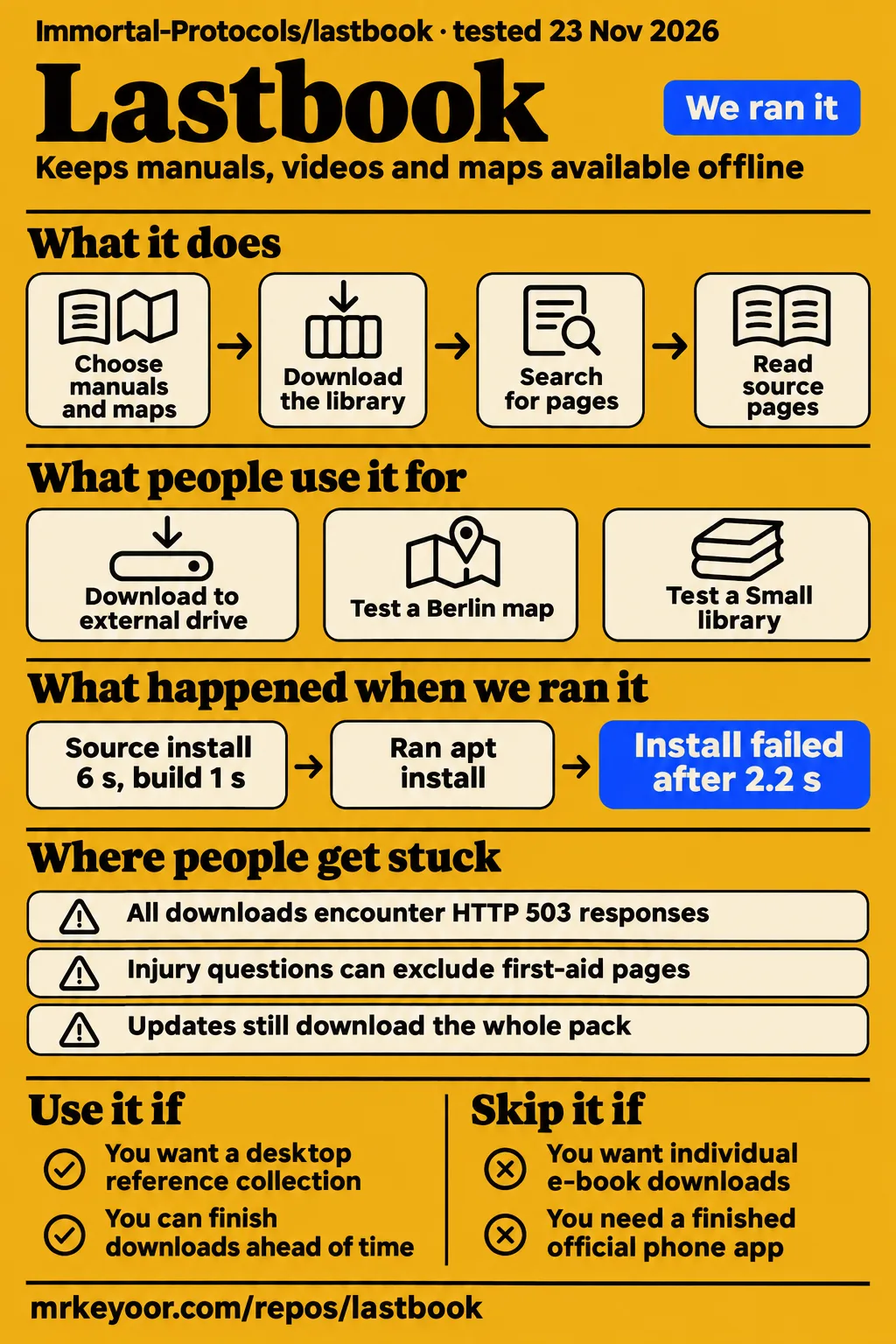
Our Lastbook packaging run installed dependencies in 6 seconds and built in 1 second, with tests skipped because the harness found no test script or target. It suits desktop users preparing reference materials before an outage. People who need individual e-books for an e-reader or a finished official mobile app should choose another route. The download and catalog reports below explain those exclusions. Our run covers the source packaging path, not the experience of retrieving emergency advice.
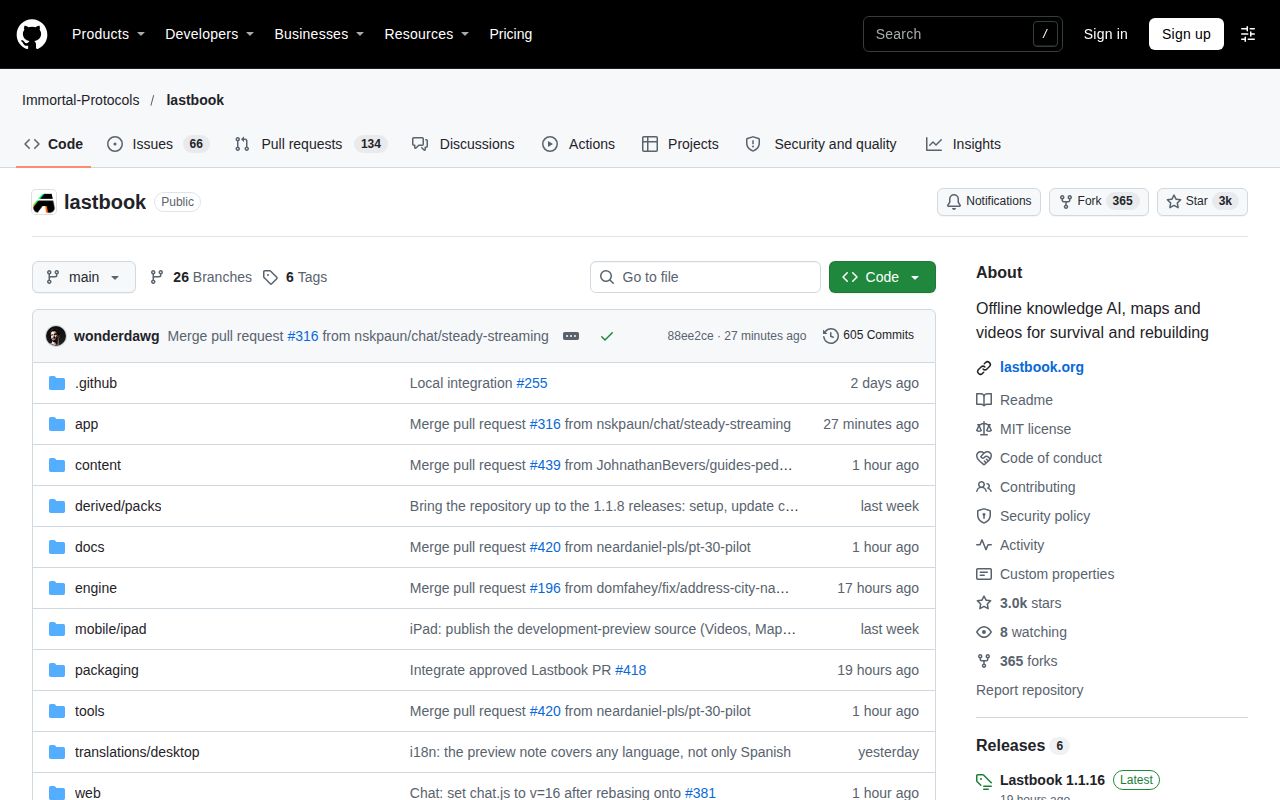
Lastbook, from Immortal-Protocols, brings manuals, videos, encyclopedias, maps and optional local AI onto your computer. The useful question is whether you can finish downloading the material you need and find the right page later. That is a narrower, more practical purchase decision than the project's survival pitch, even though the application itself is free.
What you can do with Lastbook
Lastbook's desktop library combines offline reference materials, maps and optional local AI after setup. The project README describes short guides linked to source pages, whole-PDF reading, videos and offline encyclopedias. You can follow a guide into a manual instead of accepting an AI answer on its own. Without the optional model, Chat still searches for pages. That gives you a useful reason to consider the app even on a computer that cannot hold the model in memory.
| Who used it | What they did | What happened |
|---|---|---|
| The reporter of issue #208 | Downloaded All to an external drive through macOS setup | Reported HTTP 503 responses and a restart from zero after 44.1 GB. The report separates download speed from reset handling. |
| Contributor viscous-values | Exercised a packaged 1.1.13 build with a staged partial All download | Normal resume and a hard kill preserved progress, but an ETag change truncated 119 GB of completed work. Their staged reproduction identifies the trigger. |
| The reporter of issue #154 | Compared Medium-library document results before and after proposed how-to phrase expansion | Drowning and hypothermia searches lost the relevant first-aid hits while ordinary how-to searches improved. Their comparison names the replaced documents. |
| Contributor gnqgpsr495-ui | Checked a contributed Berlin map on macOS | Repeated the initial server-mode check in the native desktop app; normal Setup installation and upgrade preservation were the next shared checks. The maintainer records that distinction in #31. |
The official download page lists Mac, Windows and Ubuntu desktop packages. Install the application first, then choose Small, Medium or All, a local map and optional AI. An installer is only the front door: the reference collection arrives afterwards. A download button that looks modest can therefore lead to a much larger storage commitment.
This review concerns Immortal-Protocols/lastbook. Searches for lastbookstorela and festivals lastbookstorela com concern the separate Last Bookstore website, whose About page describes a physical book and record store. For the ambiguous strings lastbookmark, lastbooks and lastbooking ir, this page addresses only Immortal-Protocols/lastbook; the suggestion list mixes those terms. In particular, a Microsoft LastBookmark API page is unrelated to this offline library.
What people use Lastbook for
People outside the standard desktop path are using contributions to address regional coverage and phone access.
- GitHub user banfimatei tried setting up Lastbook in the Netherlands, had to select a US state, and proposed skipping the map until a useful region could be added.
- Contributor msw0696 extended the iPad target to iPhone and checked a Small library with a state map in the simulator. The contributor requested physical-device checks next.
- The qqrm/lastphone project ported the engine and interface into an Android application and offers an ARM64 alpha. Its README identifies physical-device speed, thermal behavior and battery use as work requiring measurements.
These tasks suggest a useful first session on your own computer: choose the material you actually need, complete its download, and try your own questions while another reference is available. Starting with the largest collection adds transfer exposure before you know whether the smaller one answers your questions.
What happened when we ran it
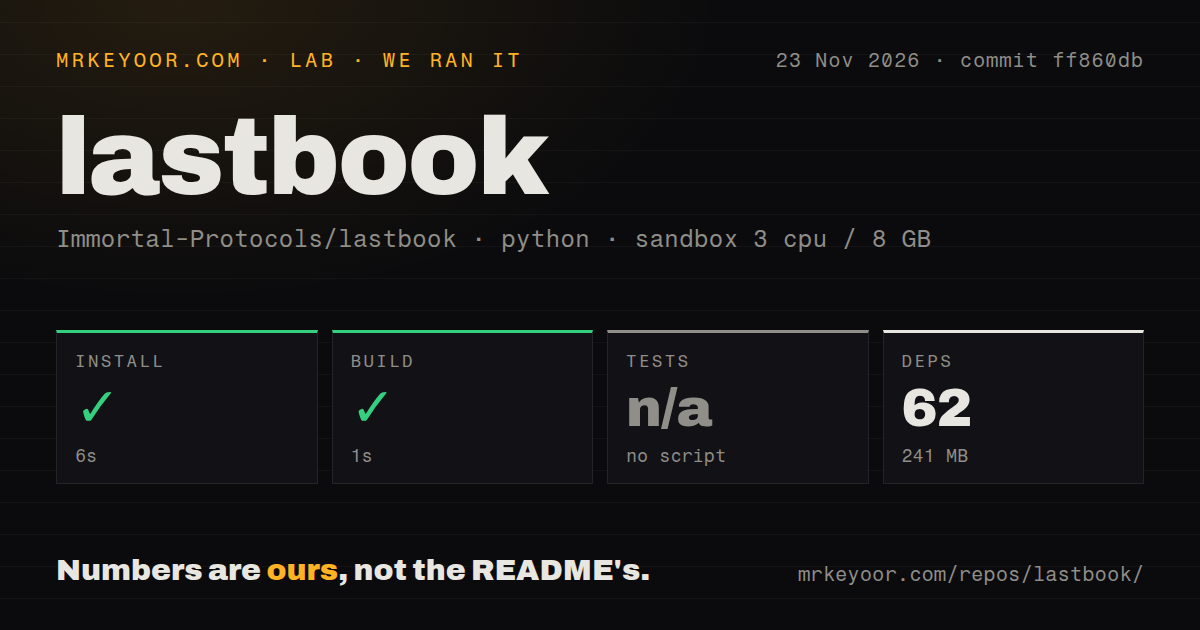
Our November 23 packaging run installed successfully in 6 seconds and built successfully in 1 second at commit ff860db. The sandbox measurement records the Python project under packaging/, with 62 dependencies and 241 MB on disk. Those figures describe the development environment, not a downloaded library or an AI model.
| Recorded step or signal | Result from our sandbox |
|---|---|
| Install | Succeeded in 6 seconds; 62 dependencies; 241 MB on disk |
| Build | Succeeded in 1 second |
| Tests | Skipped: no tests script or target detected |
| Checkout | 847 files, approximately 82,189 source lines, 43.9 MB |
| Repository scan | Zero CI workflow files detected; no Dockerfile or tests directory detected |
The configured sandbox had 3 CPUs and 8 GB RAM and used the image label ghcr.io/astral-sh/uv:python3.12-bookworm. Actual runtime and operating-system versions require the raw toolchain logs. In that run, dependencies installed, the build step completed, and the harness stopped short of tests because it had no detected target. There is no passing test-suite result to report.
The scan's lack of a tests directory needs careful reading. The current README explicitly points contributors to app/tests/ and contributor test instructions. A detection result from one checkout and recipe cannot support calling the whole project test-free. Equally, a fast packaging step says nothing about how long a household will spend downloading All.
Where people get stuck: large downloads and the wrong search results
Issue #208 separates slow All-library delivery from app-side recovery bugs, and issue #154 separates guide ranking from document retrieval. Those distinctions determine whether an update addresses your problem.
| Problem people reported | What changed or was proposed | Status to use in your decision |
|---|---|---|
| All downloads encountered repeated HTTP 503 responses | Maintainer wonderdawg kept large-object delivery open; splitting downloads was proposed | Delivery remains an open issue, separate from client retries. #208 |
| Busy-server retries and interrupted transfers lost partial progress | The maintainer corrected the shipping history to 1.1.12, carried into 1.1.13 | Contributor viscous-values then reported ordinary resume and hard-kill recovery working in 1.1.13. #208 |
| A changed ETag discarded a partial download | The setup contract compares portions of the existing file before retaining it under a changed ETag | Version 1.1.16 release notes announce retention when downloaded bytes still match. Release notes |
| Injury questions also contained fire-starting or water-treatment phrases | Guide fixes shipped, while a proposed document-search fallback needed more work | Maintainer wonderdawg reported that the proposed fallback failed its emergency cases. #154 |
| Users wanted persistent watched markers and favorites | A contributor revised watched-marker work; broader progress features stayed in discussion | The thread records proposals beyond the existing Continue watching row. #340 |
An ETag is the server's identifier for a particular file version. Changing that identifier can mean the bytes changed, but it can also accompany a re-upload. In the setup contract, Lastbook compares stretches of the saved download with the server before continuing and still checks the finished file's checksum. The release announcement is a specific improvement, not a promise about bandwidth from your country.
The search report is the more consequential warning. The author of #154 asked about water in the lungs after drowning. Under the proposed phrase expansion, first-aid pages were replaced by water-treatment and wastewater material. A phrase intended to help with treating drinking water had constrained an injury question. The maintainer later said the shipped guide-ranking fixtures exercised a different path, so those changes did not close document retrieval. More relevant pages stored on disk cannot compensate for a query that filters them out.
GitHub's November 23 API snapshot reports a last push on November 23, 2026. Together with the version-specific maintainer responses in #208 and #154, that shows current development activity. It does not tell you how many households have completed setup or relied on Lastbook during an outage.
Storage grows beyond the installer and the library ZIP
The setup contract requires free space equal to download size plus unpacked size plus 2 GB on the target disk. That is the documented staging formula, not a storage benchmark from our sandbox. Setup builds the new library beside the working one, checks it, then switches folders. You need room for that intermediate work, not just the final collection.
| Storage item | What it means |
|---|---|
| Desktop installer | The application package, before reference content arrives |
| Library download | The selected Small, Medium or All archive |
| Unpacked library | The usable documents, videos, maps and indexes |
| Optional AI | A separate model download and a separate memory requirement |
| Staging space | Download plus unpacked size plus the contract's 2 GB allowance |
The README's local-AI description identifies a model file of about 17 GB, with roughly 18 GB of memory for model and context before the reserve. Setup offers it according to fit. That is why the model should be a separate choice from the library: needing offline manuals does not imply needing generated answers or owning enough memory to run them.
Updates have a second storage and bandwidth cost. In #144, wonderdawg says the read-only command-line update plan is in 1.1.15, but Setup still downloads the whole pack. A plan that calculates changed files does not fetch them. On a metered connection, choose a collection you can afford to download again.
Privacy defaults are specific, and offline copying is useful
The README says the desktop app opens no listening network port and has no telemetry or account requirement. Its privacy section describes the window and engine communicating in memory, with network access reserved for user-started downloads and manual update checks. Downloads use allowed hosts and checksums. These are concrete architectural claims you can inspect, rather than a general promise that local software is automatically safe.
Lastbook can also copy an installed library to another drive without downloading it again. The setup contract describes checked, resumable copying: files are read back from the destination and compared with their expected checksum before completion. Copying again to the same destination continues the work. FAT-formatted drives are refused when a file reaches the filesystem's size limit. This is a practical way to share reference material with someone whose connection cannot handle a library download.
Check content rights before redistribution. The README's licensing section gives the project's original code and documentation an MIT license while retaining separate terms for library content, models and other components. Lastphone's license explanation makes the distinction explicit for its Android distribution too. An open-source application license does not grant permission for every manual inside it.
English, regional maps and mobile releases need separate checks
The official 1.1.16 download page offers desktop packages and excludes iPhone, iPad and Android. The mobile contribution thread instead describes an iPad development preview you build and sign yourself. Contributor msw0696 reported extending that target to iPhone using a Small library and state map in the simulator, then asked for physical-device checks. That is useful contributor progress, with a different audience from someone looking for an official phone download.
Regional coverage has a similar distinction between working contributions and the ordinary installation path. In #23, banfimatei says living in the Netherlands still meant choosing a US state to get through setup. A proposed skip-map option responds to that exact frustration. The Berlin work in #31 reached a desktop check, while the maintainer continued coordinating normal Setup installation and map preservation during upgrades.
Version 1.1.16 adds Simplified Chinese interface text, according to its release announcement. Earlier localization analysis in #3 describes English-word filters, an English embedding model and tokenization problems in other scripts. The maintainer confirmed merging the topic-search change while requesting separate index work. Translated controls and multilingual document retrieval answer different needs.
Lastbook vs Kiwix, Organic Maps, e-readers and Lastphone
A poster on r/xprivo suggests Kiwix plus Organic Maps for European users who want offline reference content and mapping while Lastbook's detailed map defaults focus on US states. That community comparison is a reason to consider another route, not a measured head-to-head winner.
| Choice | Why you might choose it | What the comparison actually rests on |
|---|---|---|
| Lastbook | You want guides, manuals, videos, maps and optional AI together on a desktop | The README describes that combined workflow. |
| Kiwix plus Organic Maps | You prefer separate reference and mapping apps, especially outside the US | r/xprivo poster officialexaking suggested the combination. Their explanation |
| An e-reader with individual PDF or EPUB files | Your priority is portable reading rather than a desktop library interface | Issue #270's author requested this route and public per-book downloads. The request remains open. |
| Lastphone Android alpha | You are willing to evaluate a separate Android port | Its repository offers an ARM64 alpha carrying Lastbook's engine and interface. Lastphone's status |
The Lastphone README calls its initial artifact a debug-signed development build. It explains how to use an existing data folder or install a published collection through its settings. That makes it interesting to Android contributors, while its status belongs beside the recommendation rather than hidden below a mobile compatibility badge. Choose your device and reading workflow before choosing the largest library.
What the other reviews get wrong
SourceForge's Lastbook mirror lists Apple iPhone as a supported operating system, while the official download page explicitly excludes phones and tablets. The mirror's platform list should not override the desktop download instructions. The iPad source preview and separate Lastphone alpha explain how mobile work can exist without becoming an official mobile release.
The November 18 r/xprivo overview by officialexaking says Ubuntu support is on the way. The official download page now lists Ubuntu 24.04 and 26.04 packages. That is an outdated status line, not evidence that Linux is unsupported.
GitHub Awesome's Trending Today #60 video describes hardware-aware setup and cited chat, then says the configured app blocks all web downloads. That last description is too absolute: the setup contract explicitly allows reopening Setup to upgrade, add AI or repair. It is a repository overview, without a recorded retrieval exercise in that passage.
The larger claim needs correction too. Farbood's November 16 post on X promotes Lastbook as containing everything required for survival and rebuilding. Issue #154's document-search reproduction and #261's missing country-specific emergency-number guidance show why that promise outruns the demonstrated coverage. The Windows listing itself says the material is not clinically reviewed.
Finally, calling search and chat simply English-only misses the November 23 language announcement, which adds Simplified Chinese alongside English and Spanish. Calling multilingual retrieval solved would overreach in the opposite direction: #3 concerns what reaches search, not just the words on buttons.
Questions people ask
The book list lives inside a downloaded library in library-data/catalog.json; the public library overview does not offer a searchable title-by-title download catalog, according to the maintainer in #270.
Why is Lastbook being built, and who benefits or loses?
Lastbook is intended to keep practical reference material available without internet access. Farbood's announcement asks people to download and improve it. Households that prepare a usable local collection are the intended beneficiaries. The announcement identifies no measured economic losers, so claims about displacing publishers or services would be speculation.
What could I still look up if the internet went down for several days?
Downloaded manuals, guides, videos, encyclopedias and maps remain the intended offline resources. The README ties access to the installed library; a title or map you never downloaded cannot help during the outage. Keep the pages you need, rather than relying on the application name as a guarantee of coverage.
Would you keep an offline library on your computer, and what would you want in it?
Yes, for advance reference preparation: the useful selection is the material you can download, open and understand. That is our recommendation in response to officialexaking's question on r/xprivo. Begin with needed manuals and local coverage, then decide whether additional videos, encyclopedias or generated answers justify the extra storage.
Is there a torrent or alternative server for faster, reliably resumable All-library downloads?
The maintainer in #208 says there is no official All-pack torrent or alternate mirror. Mirror support and smaller downloadable parts are proposals in that discussion. Setup can import a completed ZIP, but that does not provide an alternate public distribution service.
Where is the list of books included in Lastbook?
The installed catalog is library-data/catalog.json, and the maintainer posted Small-library PDF titles in #270. Installed-library export and filters shipped in 1.1.15, according to the maintainer's update. The public searchable catalog request stays open; an exporter needs a collection you already possess.
Can I download individual PDFs or EPUBs without installing the desktop app?
The public per-book download and e-reader export workflow requested in #270 remains open. The maintainer explicitly distinguishes that request from the desktop library and installed-catalog export. If you only want a few readable files, the current download path is an awkward fit.
Are contributions for mobile apps welcome?
Yes: maintainer wonderdawg welcomes mobile contributions in #37 and links the public iPad source. The thread specifies a development preview built and signed in Xcode, with contributor discussion of iPhone and Android approaches. It is an invitation to develop, not an official app-store release announcement.
Can Lastbook provide detailed maps outside the United States?
Contributors have demonstrated regional work, including Berlin, while maintainers coordinate shared installation and upgrade behavior. The Berlin check in #31 is more specific than a blanket international-coverage claim. The standard download path still asks you to choose a state map.
Can I skip the US map during installation?
Banfimatei proposed a skip-map option after having to choose a US state from the Netherlands. Issue #23 records that request, rather than instructions for a shipped skip button. Do not budget your setup around that proposed control.
Do Lastbook's maps work offline once downloaded?
Yes: wonderdawg explicitly confirms offline operation after download in #23. The useful follow-up is whether your installed map contains the region and address detail you need, since a basic world map and detailed state coverage serve different purposes.
Can guides display computed metric equivalents beside source measurements in US units?
Contributor Seb-the-Canadian asks for computed metric figures beside source safety limits in #23. The thread separates that question from map distance units. Its discussion gives no shipped guide-conversion outcome to recommend, so the original source measurement still needs your attention.
Can Lastbook search and chat handle languages other than English?
The author announces English, Spanish and Simplified Chinese coverage, while #3 tracks separate retrieval defects. The 1.1.16 release describes Chinese navigation and key controls specifically. Choose representative questions and inspect the retrieved source passages in your language rather than treating interface translation as a search-quality result.
What we have not tested yet
Our successful packaging run did not exercise the desktop window, a complete library download, offline media playback, map accuracy or local-AI answers. We have not tested emergency retrieval against known answers, physical iPhone or Android behavior, model speed, battery life, security properties or the downloader's recovery on our own connection. We also have no demonstrated emergency deployment to report. Community reproductions and upstream announcements inform the decision, with their original scope intact.
An earlier November 23 quickstart attempt at commit 74049cdc03d2 used a separate Debian container recipe. After cloning the repository, it stopped at the installer command with the exact error E: Unsupported file ./Lastbook_1.1.16_amd64.deb given on commandline. The finding repeats that error, and teardown completed successfully. That log does not diagnose whether the local package was present or valid, or establish a package compatibility failure. The current successful source-packaging result cannot repair that earlier desktop-install evidence gap.
The next useful lab test is a supported desktop installation with a completed library, followed by offline questions whose answers are checked against the source documents. Until then, the recommendation is for advance reference preparation, with the pages you need opened and checked before losing connectivity.