Short answer: evaluate it beside your existing monitoring
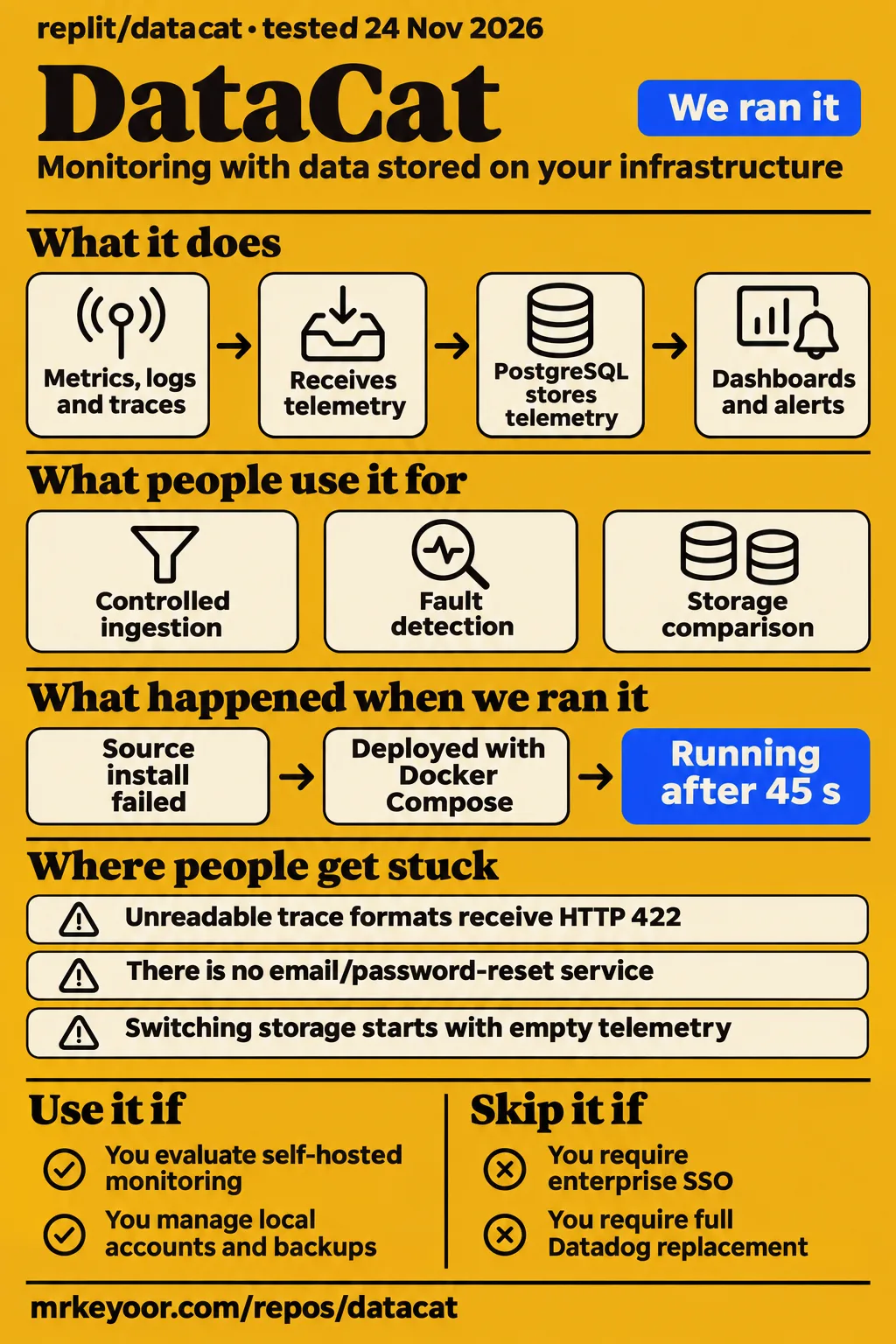
Use Replit DataCat for a separate self-hosted monitoring evaluation; skip adoption if your decision requires demonstrated full Datadog replacement coverage or enterprise SSO. The documented product combines metrics, logs, traces, dashboards and alerts, while sign-in uses local accounts and invitations. Our November 24 source-install attempt stopped after four seconds with a pnpm configuration conflict. That gives an operator a concrete starting point: resolve installation under the documented toolchain before making the monitoring migration decision.
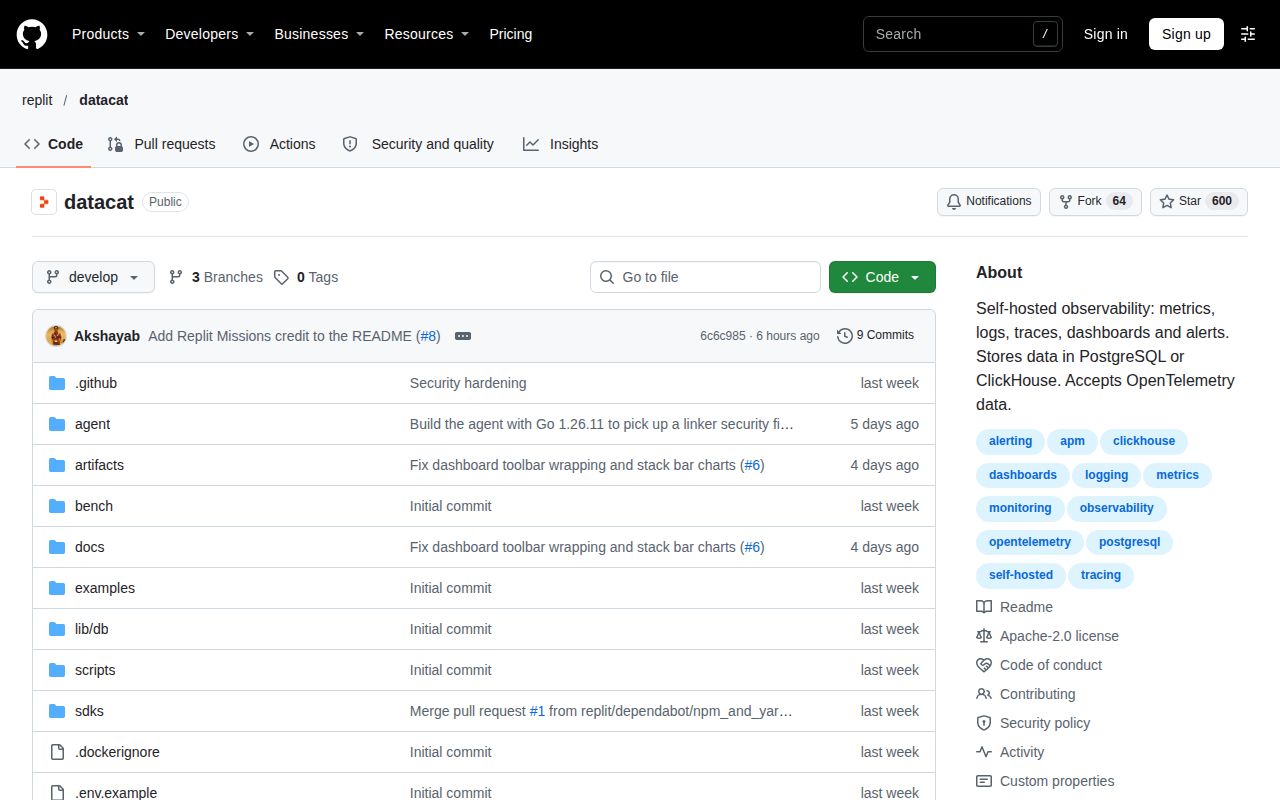
DataCat's README describes OpenTelemetry and Datadog-compatible agent intake, with data stored on your infrastructure. Metrics are numerical measurements, logs are event messages, and traces follow requests across services. DataCat places those signals in one application rather than requiring a hosted account. For an operator, the decision involves both the collection interface and the services behind it: PostgreSQL stores application data, and telemetry can use PostgreSQL or ClickHouse.
What people use DataCat for
AI Headroom reports two Replit benchmark uses: controlled ingestion and fault detection, and a PostgreSQL-versus-ClickHouse storage comparison. Those reports give this evaluation two concrete workloads to consider. The ingestion exercise asks whether known records arrive and an injected fault produces a timely result. The storage exercise asks how database choice changes disk use and queries over a large span dataset. Both are attributed to the launch-summary video.
| Who used it | Task and reported outcome | What you can take from it |
|---|---|---|
| Replit, as described by AI Headroom | Caught an injected database bug in 38 seconds and ingested telemetry over three hours with zero data loss | A controlled ingestion and fault-detection workload. |
| Replit, as described by AI Headroom | Compared storage for 102 million spans: 63.7 GB in PostgreSQL and 4.6 GB in ClickHouse | A storage-selection workload using a large span dataset. |
The video describes 26 million records plus 4.4 million logs ingested over three hours, and a 60-second goal for the injected fault detected in 38 seconds. A span represents one operation within a trace. The separate 102-million-span comparison therefore concerns that dataset. The self-hosting guide also separates narrow service-error lookups from seven-day aggregations, giving operators a more useful storage question than disk size alone: which queries must finish quickly during an incident?
What happened when we ran it
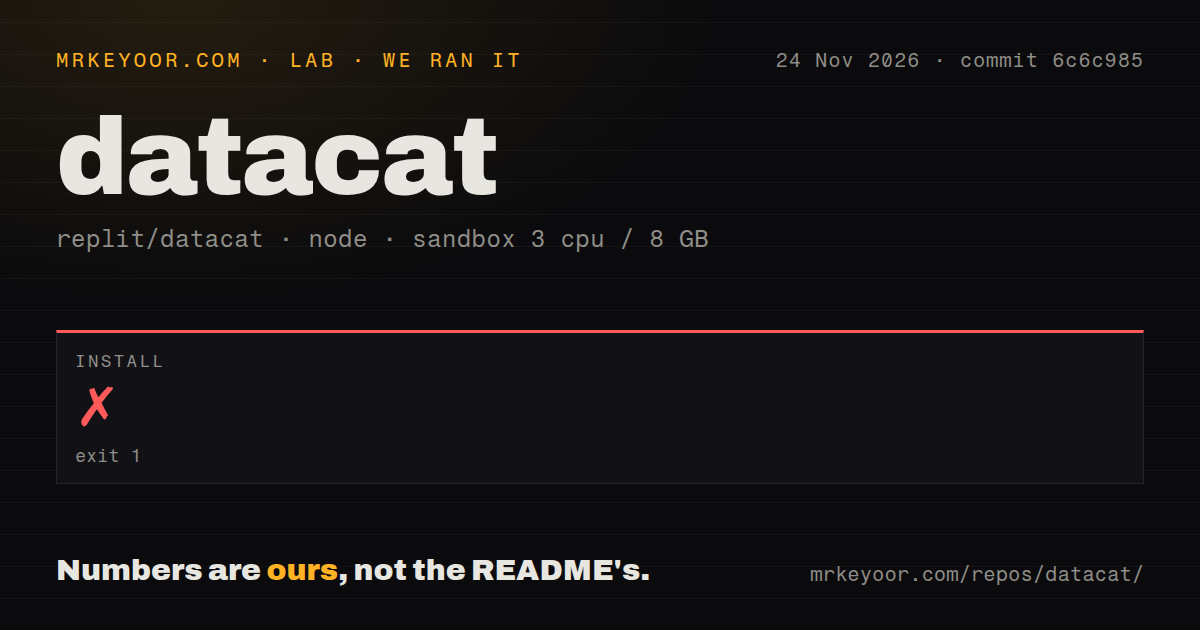
Our run at commit 6c6c985 failed during dependency installation with exit 1 after 4 seconds. The source-install measurement records November 24, 2026, three CPUs, 8 GB RAM and image label lab-node:22. pnpm printed a scope of four workspace projects and repeatedly reported ERR_PNPM_CONFIG_CONFLICT_BUILT_DEPENDENCIES. The accompanying message was "Cannot have both neverBuiltDependencies and onlyBuiltDependencies". A warning also said dangerouslyAllowAllBuilds was true and the listed dependencies would run their scripts.
| Source-run observation | Recorded result |
|---|---|
| Dependency installation | Exit 1 after 4 seconds |
| Error | Cannot have both neverBuiltDependencies and onlyBuiltDependencies |
| Workspace scope printed by pnpm | All 4 workspace projects |
| Checkout scan | 235 files, approximately 22,871 source lines, 2.1 MB |
| Repository signals | 2 CI workflow files, Dockerfile, Compose file, monorepo workspaces; no tests directory detected |
The harness records seven seconds in total, with four seconds assigned to installation. Build and test results are null. The checkout scan and installation log describe different things: one inventories files and recognizable repository structures; the other records the command's outcome. The README separately names server unit tests, end-to-end checks, library tests and agent tests. A directory scan should therefore stay a directory scan rather than becoming a claim about the project's complete test coverage.
A separate November 24 hands-on note records a Compose deployment at commit 6c6c9859c0bf with every port bound to 127.0.0.1. Its four recorded steps appear below. The deploy label and the source-install failure belong to separate execution records; neither should overwrite the other. Keeping their step names intact also makes the unexpected Ollama entries visible instead of silently treating them as observability tasks.
| Separate hands-on note | What it actually records |
|---|---|
| Deploy | Marked ok in 45 seconds |
| ollama-connect | Marked ok |
| model-pull | Marked FAILED, with a repeated manifest/pull fragment at 99%, 4.6 GB/4.7 GB, 8.8 MB/s and 7s |
| Teardown | Marked ok |
The failed model-pull excerpt repeats "pulling manifest" and layer identifier 2bada8a74506. The README's monitoring setup instead names databases, agent assets, application instrumentation and notification channels. Its source requirements are Node.js 22.15+, pnpm 10.11.0 and PostgreSQL 14+. A useful next installation record would capture the effective pnpm settings and actual toolchain versions before repeating the documented installation command, preserving the original failure for comparison.
Where people get stuck: agent versions and storage switches
The README names Datadog Agent 7.56.2 and 7.85.4 with different forms of compatibility evidence. Version 7.56.2 is described as tested in CI-style runs; 7.85.4 uses captured payloads, including the newer string-table trace format. For intermediate versions 7.57 through 7.84, the README says individual testing has not occurred. An unreadable trace format receives HTTP 422 rather than a silent 202 response.
| Obstacle | What the source says | Practical response |
|---|---|---|
| Agent format mismatch | Unreadable trace formats receive 422; intermediate versions lack individual coverage | Match the sender version and inspect intake statistics. |
| Lost local password | There is no email/password-reset service | Establish controlled account recovery. |
| Moving telemetry to ClickHouse | Switching storage starts with empty telemetry and does not move existing data | Choose storage before accumulating required history. |
| Remote agent installation | Serve the installer over HTTPS and supply release assets and checksums | Include the proxy and download directory in deployment work. |
| Missing notifications | Monitor mentions without a configured channel are recorded in-app | Configure a receiver and inspect notification history. |
The README documents GET /api/v1/intake/stats as showing stored and dropped item counts per intake path since server startup. That gives the setup process a specific observation beyond opening a dashboard. The self-hosting guide also distinguishes the optional container agent from the host agent: the container agent measures its container, while full host visibility calls for installation on the machine being observed. These are separate deployment choices with different collection scopes.
Local accounts and HTTPS are part of the deployment
DataCat documents local email/password accounts, a setup token for the first administrator and single-use invitations for additional members. The README asks operators to generate database and session secrets, restrict .env permissions and set PUBLIC_URL to an externally reachable HTTPS origin before remote invitations or agent installation. Agent binaries and SDK packages are separate release assets, including SHA256SUMS, placed in the instance's download directory.
According to the self-hosting guide's account and HTTPS instructions, passwords use randomly salted scrypt and sessions use HTTP-only SameSite=Lax cookies. An HTTPS PUBLIC_URL enables Secure cookies. Compose binds DataCat to 127.0.0.1:3000 by default, with TLS terminated at a reverse proxy. The guide also directs operators to protect database backups because they contain session tokens, API keys, invitation tokens and webhook credentials.
Storage choice changes the job you take on
PostgreSQL stores users, organizations, API keys, monitors and dashboards with either telemetry backend. Choosing ClickHouse therefore adds a database service rather than replacing PostgreSQL entirely. The self-hosting guide describes PostgreSQL as the option with fewer moving parts and ClickHouse as suited to large data volumes and long time ranges. That distinction belongs in the initial deployment decision because the application and telemetry stores have different responsibilities.
The storage comparison in the self-hosting guide reports millisecond narrow lookups for PostgreSQL and slower narrow lookups for ClickHouse, alongside faster broad aggregations for ClickHouse. Its operations instructions call for persistent database storage and release downloads, backups before upgrades, and rebuilding the UI and API together. Compose down preserves data; down -v destroys it. A storage choice thus includes query behavior, retention and recovery work, alongside the reported disk figures.
DataCat vs Datadog, Grafana and SigNoz
DataCat receives telemetry into its own application, while Grafana documents querying and visualizing data across existing stores and SigNoz documents combined observability built on OpenTelemetry. Those product descriptions support a comparison by workflow. An operator keeping existing stores has a different requirement from one selecting a new intake backend. Replit's Datadog positioning adds a compatibility question, addressed separately by the reported API checks and the documented agent versions.
| Option | Reason to consider it | Decision boundary |
|---|---|---|
| DataCat | Self-hosted metrics, logs, traces, dashboards and alerts | Evaluate when controlling the application and its storage is the goal. |
| Datadog | Replit positions DataCat as an alternative to it | AI Headroom reports 51 of 56 API compatibility checks. |
| Grafana | Queries, visualizations and alerts across data sources | Consider when retaining existing telemetry stores is the priority. |
| SigNoz | Logs, metrics, traces, alerts and dashboards in one application | Include when a combined OpenTelemetry workflow is the requirement. |
Grafana can mix different data sources in the same graph. Its README also describes per-query data-source selection, making existing-store access a concrete reason to shortlist it. SigNoz is an open-source observability platform built on OpenTelemetry. Its README describes a community deployment on your own infrastructure as well as managed and enterprise options. These documented capabilities explain why the alternatives belong in the decision without assigning them invented performance or migration scores.
Outdated claims, corrected: Replit's 1:1 launch wording
Replit's launch post claims its agent swarms rebuilt the leading observability platform's features 1:1; AI Headroom reports 51 of 56 API compatibility checks passing. The November 17 launch wording concerns product features, while the video's numerical result concerns API checks. The correction is to describe the latter as a bounded compatibility result, rather than repeat the launch wording as a demonstrated replacement outcome.
The five checks outside the passing total are five checks, not an identified list of five missing product features. The video reports an aggregate result and describes a comparison across shared areas against agent 7.56.2. A migration decision also involves the actual agent fleet, monitor definitions, notification destinations and account requirements. Those concrete components are more useful evaluation targets than translating a headline into an unsupported feature-by-feature conclusion.
FAQ
DataCat documents webhook and Slack notifications for metric, log and trace monitors. That answers the practical alert-delivery question before the remaining setup and compatibility questions. The walkthrough creates a notification channel, references it in a monitor message and checks notification history after triggering a condition. The questions below stay with Replit's monitoring repository, apart from one short identification answer separating similarly named services.
Can DataCat send alerts to my own webhook?
Yes, the README lists webhook and Slack notifications for metric, log and trace monitors. The self-hosting guide uses a channel named oncall and the mention @webhook-oncall. Its evaluator checks every 30 seconds and sends JSON containing monitor, state, value and tags. Receivers on private networks require DATACAT_ALLOW_PRIVATE_WEBHOOKS=true; the default blocks loopback, private, link-local and metadata destinations.
How do I self-host DataCat, and what deployment catches should I expect?
Docker Compose is the README's quick-start route, requiring Docker Engine, the Compose plugin, Git and OpenSSL. Source installation specifies Node.js 22.15+, pnpm 10.11.0 and PostgreSQL 14+. Setup includes secrets, the administrator token, an organization API key and an HTTPS public origin for remote use. The self-hosting guide says source users must load their environment explicitly; the server does not automatically load .env.
Can DataCat replace Datadog today, or should it remain an isolated evaluation?
Keep DataCat in a separate evaluation while retaining existing monitoring. AI Headroom reports 51 of 56 API compatibility checks, and the README names particular agent versions and intake formats. Those facts make exact sender versions and payloads useful evaluation inputs. The practical next task is one known request followed into storage and one monitor condition delivered to the intended receiver, using the documented intake statistics and notification history.
What does the reported 49,000 traces per second benchmark actually establish?
AI Headroom reports 49,000 traces per second in its account of Replit's comparison. That is the video's reported throughput figure. The same account describes one run per setup across shared areas and names agent 7.56.2. Its storage discussion also separates narrow lookups from broad aggregations, so traces per second and seven-day query behavior answer different workload questions rather than combining into one performance score.
Which DataCat do searchers mean: replit/datacat, datacat.run, or datacat.ai?
Replit DataCat is the self-hosted observability repository; datacat.run organizes AI characters, and datacat.ai describes text classification. These are separate services. For this review's installation, storage and alerting decisions, replit/datacat is the relevant identifier. Character-export and archival discussions concern the character service and do not describe the monitoring application's operation.
What we have not tested yet
Our four-second installation failure produced no completed build, test-suite result or live telemetry benchmark. Actual Node and pnpm versions require the raw toolchain logs; lab-node:22 is an image label. The error does not identify the configuration file or package-manager layer responsible. The separate Compose note contains no known-answer telemetry task or signal-to-alert result, and its Ollama entries need provenance reconciliation. We did not reproduce the video's throughput, fault detection, storage sizes or compatibility results.
The metadata contains no verified latest-release result. A null value can reflect a failed lookup. GitHub metadata records a November 23, 2026 last push and zero open items on November 24, but also shows issues disabled and pull-request creation restricted to collaborators. These settings and counts do not measure support responsiveness. No customer production deployment or GitHub issue conversation here establishes upgrade reliability or operation through an outage.
Full hosted-product parity, enterprise SSO, interface language, accessibility, implementation security, password recovery, restored backups, private webhook delivery, long retention, overload and storage transitions were not exercised in our lab. Hosting, storage, maintenance and migration costs are unmeasured. The reported vendor benchmarks cover their stated comparison conditions rather than our workload. Rendered layout, related links and recommendation modules also fall outside this text review. The next useful evidence is a supported-toolchain installation followed by a known request and delivered alert.