More than 40 integrations turn a start page into a control panel
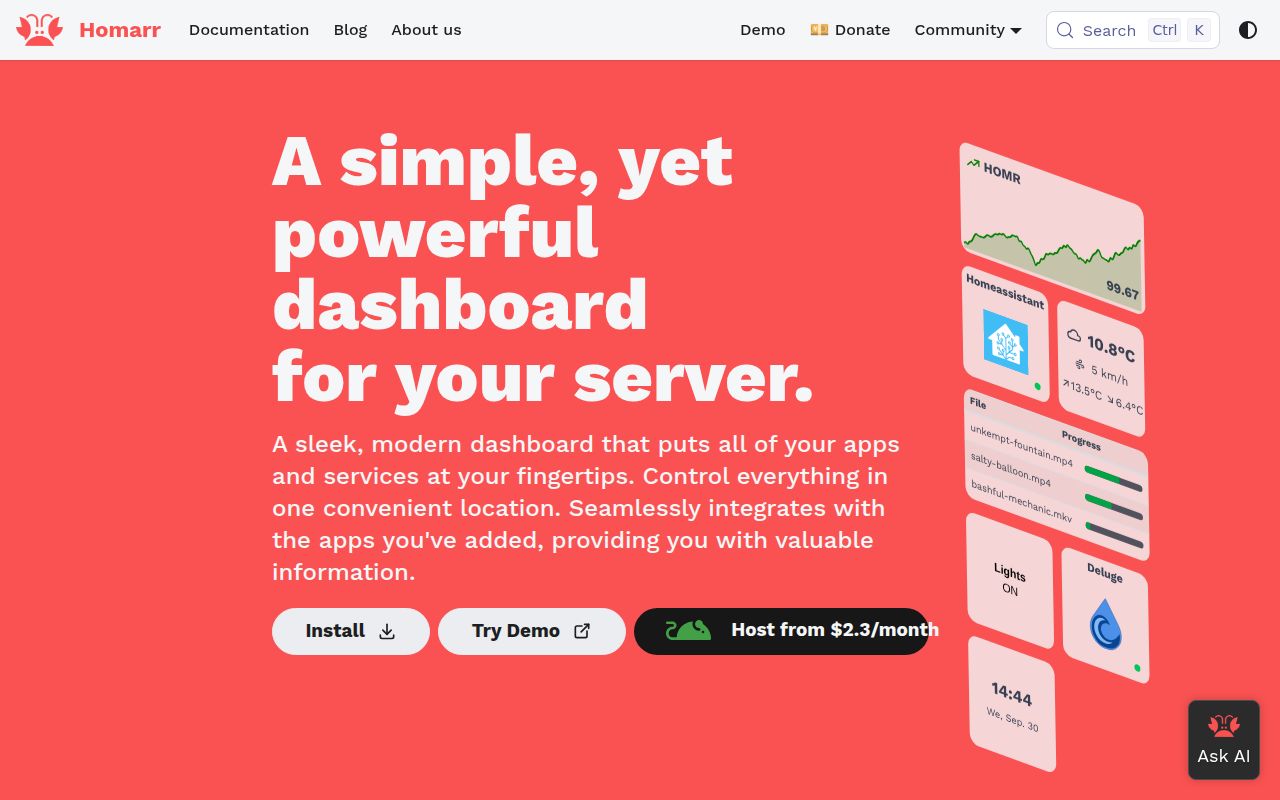
Homarr combines a link dashboard with live data from more than 40 service integrations. The README lists media servers, download managers, DNS tools, storage systems, calendars, notifications, network controllers, and monitoring services. Boards use a drag-and-drop grid, while built-in search can reach Homarr data and supported integrations. This is useful when the first page in your browser should show what the home lab is doing, not merely where each service lives.
The product also has an identity layer. Local users, groups, and permissions can separate shared boards from administrative tools, and OIDC or LDAP can provide single sign-on. Integration secrets are stored with AES-256-CBC encryption, while passwords use BCrypt according to the README. Redis supports live updates, and WebSockets plus tRPC move widget data into the page. That scope explains why Homarr feels closer to a small portal application than a bookmark file.
What happened when we ran it
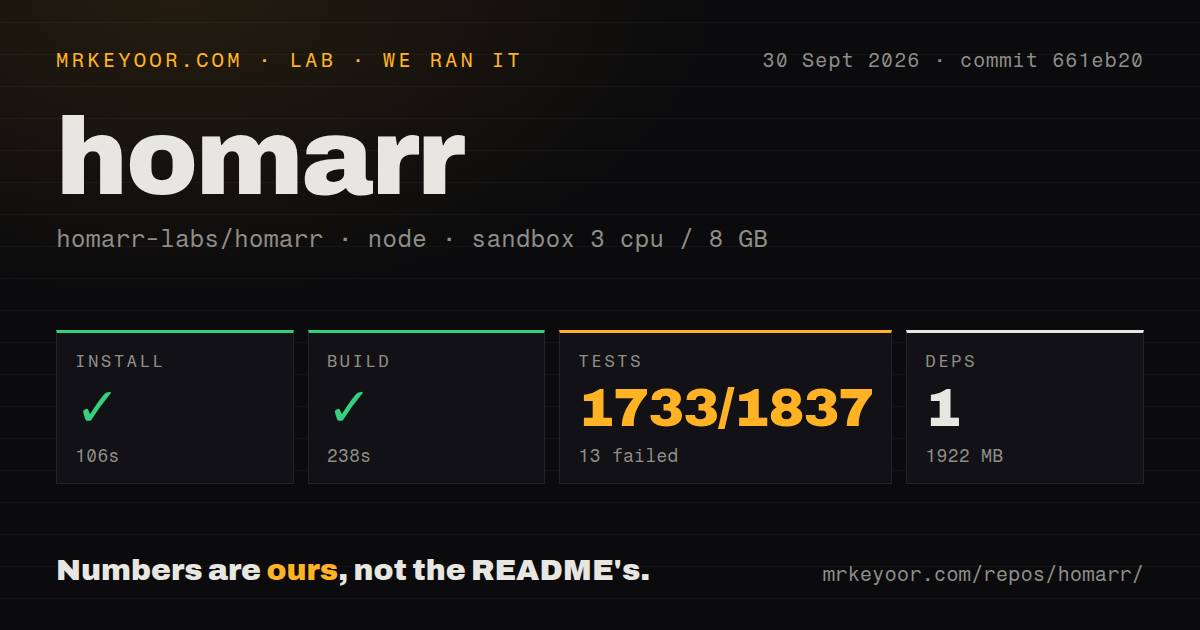
Our sandbox cloned commit 661eb20 and measured 2,768 files, about 151,810 lines of source, and a 58.9 MB checkout. The pnpm workspace install succeeded in 106 seconds, reported 1 package installed, and consumed 1,922 MB on disk. The monorepo then built successfully in 238 seconds. These figures cover repository work in a fresh Debian container, not the size or startup speed of the published Docker image.
The test command failed after 173 seconds. Vitest reported 1,733 passed, 13 failed, and 91 skipped out of 1,837 tests. Ten test files failed while 136 passed. The supplied log tail names 2 failures in proxy-reader.integration.spec.ts, 1 PostgreSQL migration failure, and 1 MySQL migration failure. It does not show the other failure details or the underlying exceptions, so assigning a database or container cause would be guesswork.
Several integration checks were skipped, including 5 Aria2 tests and 2 Home Assistant tests shown in the tail. That is consistent with a suite containing external-service coverage, but the log only establishes that they were skipped. It does not establish why each skip was selected. The repository has 20 CI workflow files, a Dockerfile, a tests directory, and workspace packages. A passing build beside 13 failures is useful evidence, not a green release gate.
Docker avoids the source path's Redis and native-module chores
Homarr recommends Docker for both beginners and experienced operators. The standalone example exposes port 7575, persists /appdata, and requires a 64-character hexadecimal SECRET_ENCRYPTION_KEY. It also mounts the Docker socket for container features. Compose makes updates easier, but network names can confuse integrations when client browsers cannot resolve an internal hostname. The docs recommend using an address or network-wide name that both the container and clients can reach.
The source route is explicitly discouraged for ordinary use. It requires Node, pnpm, Redis, database configuration, migrations, a build, and a manual copy of the better-sqlite3 native file before startup. Our 1,922 MB install and 238-second build put numbers on that warning. Contributors may need the monorepo. A home-lab operator gets fewer moving parts by using the packaged image and keeping the app-data mount outside the container.
SQLite gets built-in restore; MySQL and PostgreSQL do not
Homarr can use SQLite, MySQL, or PostgreSQL. SQLite is the default and the only driver with the web backup and restore page. An administrator can export the database, metadata, Homarr version, and encryption material as a ZIP. Restore previews entity counts and migrations in the browser, then replaces the current database and restarts only the Next.js process. The documentation says MySQL and PostgreSQL instances do not show this feature.
That limitation should decide the database for many small installations. SQLite gives the simplest recovery path, but the exported archive contains the whole portal, including users, boards, settings, and encrypted integration secrets. It still needs protected storage and the encryption key. Larger deployments choosing MySQL or PostgreSQL must bring their own database backup procedure and test a full recovery outside Homarr's UI.
Release v1.77.2 is active while v2 work remains unsettled
GitHub showed 4,914 stars, 146 open issues, and 23 open pull requests on September 30, 2026. The repository was pushed that day. Release v1.77.2 shipped on September 18, while a large v2 pull request and many post-v2 changes remained active. The dates show current maintenance, and the queue also shows that the next major interface is still moving.
Open issue 6942 reports a v2 beta board with roughly 100 items becoming unresponsive for 10 to 20 seconds after load. Issue 6940 says the v2 onboarding flow can hide the restore option after a user advances past the first step. Issue 6919 documents an API and MCP management page crash in a v2 image, with a fix already open. These are beta reports, not proof that v1.77.2 has the same faults.
Homarr is a good fit when one dashboard must serve several people and pull real state from many services. Our run proved that the monorepo installs and builds, then stopped short of a clean suite by 13 tests. Start with Docker, SQLite, a backed-up encryption key, and only the integration credentials each board needs. If the requirement is simply 12 links on one private page, Homepage or Glance will demand less attention.