Short answer: choose your music source first
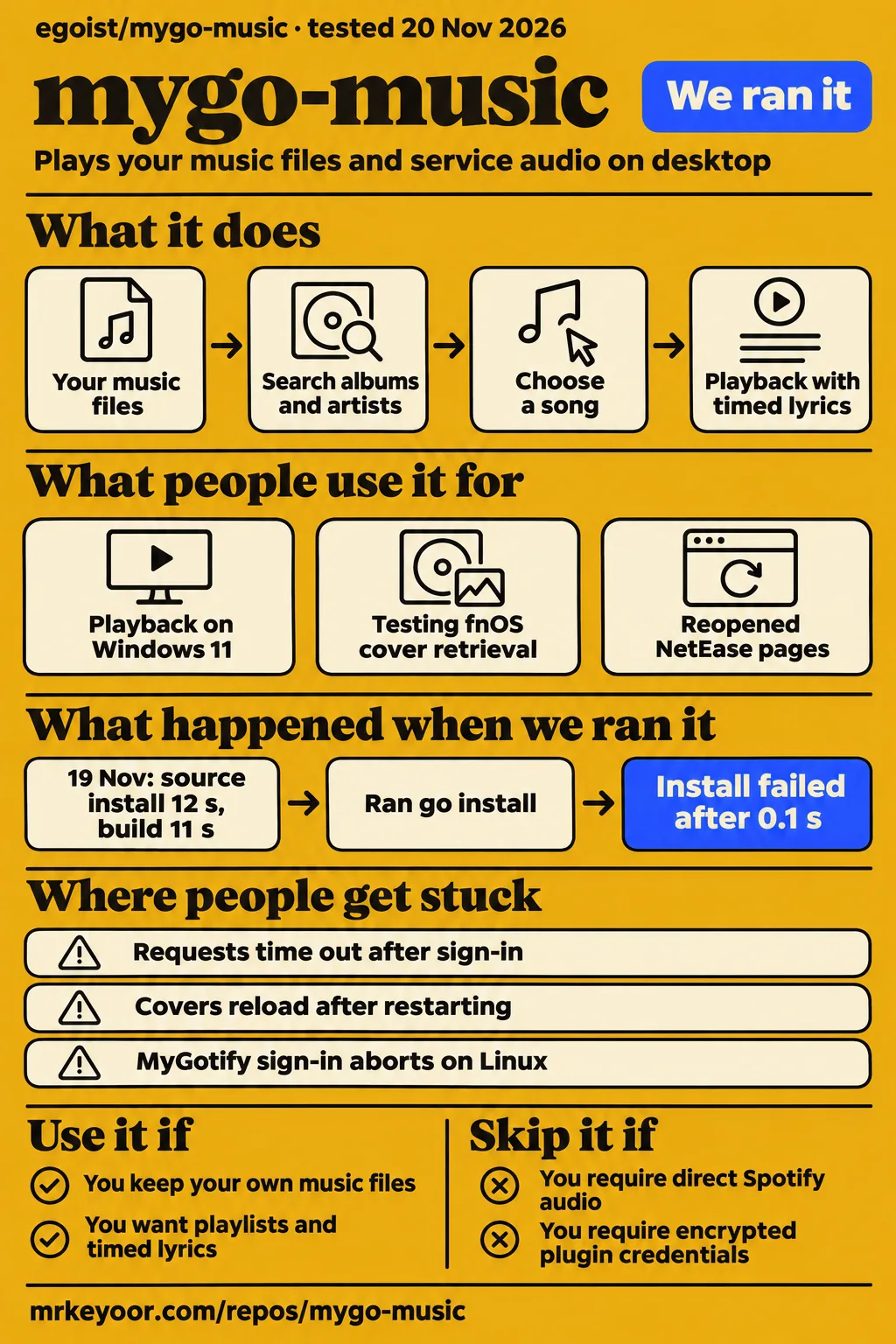
MyGo Music plays local files without a plugin, while MyGotify uses YouTube Music audio for Spotify's catalog and library. Use MyGo Music if you want a native desktop home for your files and can choose a plugin around your service. Skip it if you require direct Spotify audio or encrypted plugin credentials: MyGotify describes a different audio source and unencrypted session storage. Those are documented properties of the integration, rather than preferences the player can change.
Our sandbox recorded a 12-second install and an 11-second build. A later CLI recipe stopped at installation with a malformed-module-path error. For a free player, the practical decision is whether your chosen plugin supplies the audio and library actions you need. A Spotify catalog, a Lossless setting and a successful sign-in describe different parts of that decision; the service matrix below separates them.
What people use mygo-music for
Voemp used the NetEase plugin on Windows 11 and reported that tray-related memory growth stopped after updating to 0.1.20, in issue #31. The discussion connects a concrete listening setup to a version-specific outcome. Other reports cover authenticated NAS artwork, returning to a streaming library after a restart, and Linux window controls. Each identifies a different part of the desktop experience.
- Voemp reported 900 to 1200 MB after backgrounding 0.1.19, then confirmed that the tray-growth symptom stopped after updating to 0.1.20. This was NetEase-backed playback.
- Contributor yusgsysh retrieved a 71 KB JPEG from an authenticated fnOS Music endpoint while testing a proposed cover patch. Upstream subsequently adopted manifest-declared headers.
- The reporter of issue #100 reopened NetEase-backed pages after quitting and saw previously loaded covers download again. The request concerns persistent artwork.
- Hoastar tried the Adwaita dark GTK theme. Window controls improved over the dark song page, while light pages still had a contrast problem.
These uses involve separate dependencies: a streaming account, authentication for a private server, artwork storage and the Linux desktop theme. For a listener choosing a plugin, the relevant question is which of those dependencies their own library introduces. The NetEase report is particularly useful because Voemp returned after updating and described the outcome, rather than leaving the original memory complaint as the last word.
What you can do with MyGo Music
MyGo Music is a native desktop player written in Go, and the official site says local files work out of the box while other sources come through plugins. Its interface uses MyGo without a WebView. The README lists MP3, FLAC, Ogg Vorbis, WAV, and ALAC, FLAC or AAC in M4A and AAC files, along with tags, covers and timed LRC lyrics. Playlists, liked songs, albums, artists and search surround those files.
The service integrations differ in audio origin, helper programs and account features. NetEase's plugin describes playback from NetEase with membership and regional restrictions. MyGotify brings Spotify's catalog into the player while obtaining audio from YouTube Music. A private-server plugin adds another arrangement: the listener supplies the server and credentials. These documented differences are more useful for choosing an integration than treating every plugin as an interchangeable streaming account.
| Source and plugin | Audio and extra programs | Account and platform boundary | Library actions and podcasts |
|---|---|---|---|
| NetEase: AkinoKaede's plugin | NetEase sources; no extra programs or API server | QR sign-in, optional web sign-in; membership, purchase and region restrictions apply | Signed-in playlist editing and podcasts are listed; video playback is excluded |
| YouTube Music: egoist's plugin | Converts audio to MP3 with ffmpeg; documentation names yt-dlp | Google sign-in; starts ffmpeg and yt-dlp | No playlist editing, saved albums, following artists, podcasts or comments |
| Spotify catalog: MyGotify | YouTube Music audio; documentation names ffmpeg and yt-dlp | Spotify session cookie; Linux instructions use cookie entry after a sign-in-window abort | Spotify catalog, library and recommendations |
| Navidrome: bxb100's plugin | Direct decoding for mp3, flac, ogg, wav, m4a and aac; ffmpeg for other formats | Server credentials; a helper opens a local browser sign-in page | Creating, renaming, deleting and editing playlists are documented |
| Soda Music: lane128's plugin | Native FLAC or AAC-LC in M4A, without FFmpeg conversion | Availability depends on membership, region and authorization; macOS and Windows packages are listed | Playlist ordering is documented; podcasts and remote device control are excluded |
A file extension or quality preference does not determine the source's encoding. Soda documents AAC-LC inside M4A and fallback from its Lossless preference. Its README says the plugin reports the actual source quality to the host. YouTube Music's plugin describes conversion to MP3. A listener choosing specifically for lossless streaming therefore needs to consider the service's available source and account entitlement as well as the player's supported formats.
What happened when we ran it
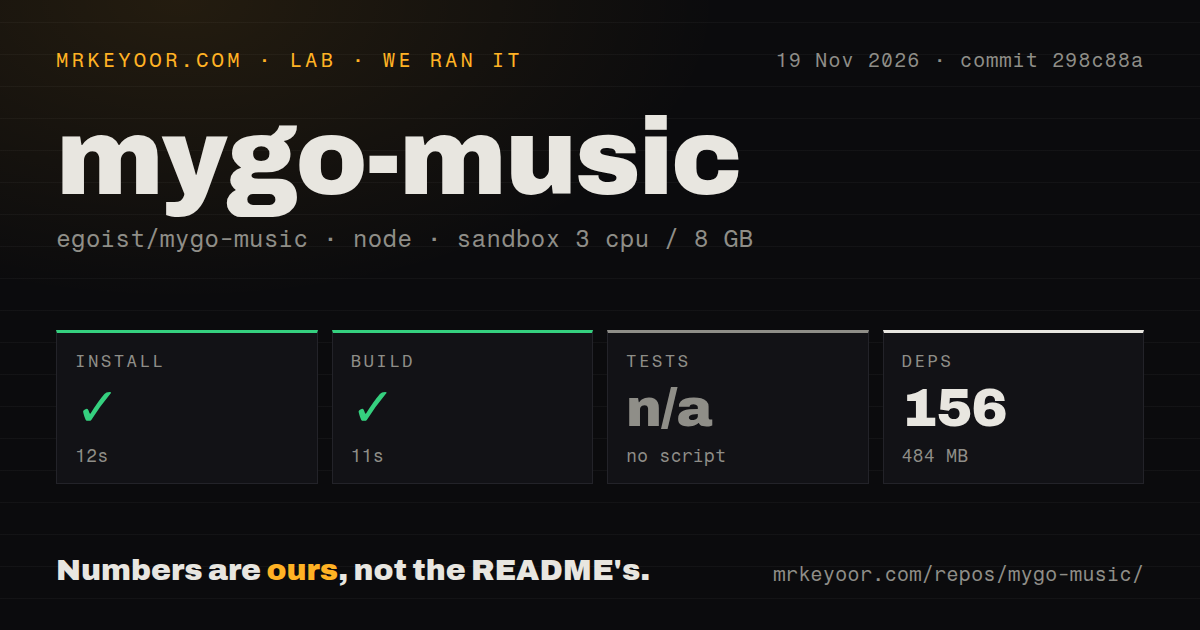
Our November 19 run at commit 298c88a recorded installation in 12 seconds and a build in 11 seconds, with tests skipped because the harness found no test script or target. The recorded Node/Bun workspace configuration used 3 CPUs, 8 GB RAM and image label lab-node:22. These are our repository-run measurements. The harness also recorded dependency size, checkout size and repository signals, shown separately below.
| November 19 repository check | Recorded outcome |
|---|---|
| Install | Succeeded in 12 seconds; 156 dependencies recorded; 484 MB on disk |
| Build | Succeeded in 11 seconds |
| Tests | No tests script or target; skipped |
| Checkout | 227 files; approximately 43,813 source lines; 8.3 MB |
| Repository signals | Two CI workflow files; monorepo workspaces; no Dockerfile or tests directory detected |
On November 20, our lab used commit 298c88a03407 in a fresh unprivileged container configured as golang:1.24-bookworm, with 2 CPUs and 4 GB RAM. The clone took 4 seconds. The quickstart-cli recipe then inferred an installation command from the manifest. That installation step failed in 0.1 seconds with exit code 1, producing this recorded command and error:
go install mygo-music/...@latest
go: mygo-music/...@latest: malformed module path "mygo-music": missing dot in first path element
The lab finding records a stop at installation, and teardown completed successfully. The README instead documents go tool mygo dev, go tool mygo build and go test ./internal/.... The failed command came from the automated recipe, so the observed failure belongs to that recipe. The successful workspace steps and the failed Go installation are distinct recorded outcomes.
Where people get stuck: sign-in, caches and Linux controls
Issue #51 reports that sign-in can follow the system proxy while subsequent music, artwork and plugin requests go direct and time out. The discussion identifies different HTTP behavior across those paths. That explains why reaching a service's login page can coexist with failed requests afterward. The issue describes environment variables as a workaround and a contributor branch with system, custom and direct proxy modes.
| Symptom and reporter | What the discussion or documentation says | Action or recorded status |
|---|---|---|
| Issue #51: sign-in works but subsequent requests time out | App requests go direct while sign-in and the updater follow the system proxy | Environment-variable workaround; contributor branch proposes proxy modes |
| Navidrome plugin: playback immediately ends with EOF | A failed response, including an XML error, can remain in the audio cache | Clear the app's audio cache in Settings |
| Issue #100: covers reload after restarting | Previously loaded covers download again after a full exit | Contributor implementation proposed for persistent artwork |
| Hoastar, #69: faint window controls | GTK theme styling improves dark pages with Adwaita dark but clashes with light pages | Content-aware title-bar appearance proposed |
| Hoastar, #70: bright system menu over Now Playing | The song menu uses system styling | Application-drawn popover proposal awaits maintainer confirmation |
| HUVEI, #111: no Hi-Res setting on macOS 0.1.22 | The maintainer assigns available quality tiers to the plugin | Closed with advice to ask the plugin author; AkinoKaede's README separately lists a hires override |
Artwork caching and audio caching concern different data. Issue #100 describes images downloading again after restarting, while the Navidrome README describes a cached failed song response repeatedly producing EOF. Clearing the audio cache addresses the latter documented failure. It does not implement the persistent image storage requested in issue #100, whose reporter wants the same artwork reused across pages and restarts.
The animation discussion adds a separate interface change: issue #26's recorded outcome makes a bottom-up slide the default and moves cover expansion into experimental settings, disabled by default. The synthesis also records reduced-motion fades. This concerns how Now Playing opens, rather than the GTK control contrast or song-menu styling raised in issues #69 and #70; those discussions describe different interface paths.
Artwork fixes changed the Windows memory story
Voemp confirmed that 0.1.20 stopped the reported Windows tray-related memory growth. The opening report concerned Windows 11, MyGo Music 0.1.19 and AkinoKaede's NetEase plugin. It described 900 to 1200 MB after playback and backgrounding. The maintainer identified oversized cover images as a major cause and discussed requesting images at their display size alongside controls on simultaneous decoding.
In issue #17, the maintainer reports that fix #21 shrinks decoded artwork before constructing its bitmap. For a 2000×2000 JPEG displayed at 96 pixels, the comment reports allocations falling from about 35 MB to about 13 MB. Those figures describe allocations for that operation. They measure something different from the retained memory of an application running a streaming plugin over time.
Authenticated artwork had another failure path. In issue #28, the maintainer says requestHeaders landed in #30 through plugin.json. The design reads the server from a setting and the token from storage when a request goes out. Earlier in the discussion, yusgsysh's proposed implementation fetched a 71 KB JPEG from an authenticated fnOS Music endpoint. That contributor test preceded the final manifest-based design.
Plugins can start programs, and masked credentials stay plaintext
The README requires process permission and approval in Settings before a plugin can start programs. A permission can name particular helpers or request any program, with a warning to the listener. The README explains that a program can do anything the listener can. YouTube Music's ffmpeg and yt-dlp requirements and Navidrome's local sign-in helper explain concrete reasons an integration might request that access.
JavaScript network requests are limited to declared hosts, although the README permits a wildcard host list. After process permission is allowed, requests can also reach the local machine to communicate with helpers. The distinction between specific helper names and permission for any program therefore belongs in the installation decision. A plugin's JavaScript entry point alone does not describe everything its permitted helper can do.
The README states: Storage remains plaintext JSON. Password controls mask input and require saving changes, but storage retains that documented format. MyGotify stores its sp_dc session cookie unencrypted, and the YouTube Music plugin stores its session unencrypted. Both describe forgetting the local session on sign-out. YouTube Music also directs users to remove the device in Google's security settings to end the session on Google's side.
English is supported, while some plugin guidance is Chinese
The README lists English and Simplified Chinese, and AkinoKaede's NetEase plugin says it follows that language setting. The core README documents plugin installation, exports, permissions and translations in English. Plugin text can use locale files, while service content has its own source. Soda's English README specifically directs readers to Chinese validation and roadmap documents for details of development progress.
The X extract contains Aarteiimis's November 17 mobile question. The Bilibili result identifies a MyGo Music video by 秦微迩, alongside results about the similarly named band. Searching with the repository name and the software's full name helps distinguish the desktop player from those music results. The dated mobile question is a reader question, rather than an announcement of a release.
MyGo Music vs MyGO Cloud Music and the official NetEase client
Choose MyGo Music for local files and service plugins, the official NetEase client for NetEase's own interface, and Navidrome when serving your collection is the job. Issue #31 compares MyGo Music with the earlier MyGO Cloud Music and the official NetEase client. Voemp's original complaint favored their observed memory behavior, then the later reply reported that MyGo Music 0.1.20 stopped the tray-growth symptom. Keeping both parts of the discussion gives readers the version sequence behind the comparison and avoids turning the opening complaint into a permanent ranking.
| Option | Why someone would choose it | What the comparison supports |
|---|---|---|
| MyGo Music | Local files with service and private-library plugins | Voemp's 0.1.20 retest reports that tray-related memory growth stopped |
| Earlier MyGO Cloud Music | Historical NetEase-focused application mentioned by Voemp | Its repository announces withdrawal after a NetEase request and directs readers to the official client |
| Official NetEase Cloud Music client | NetEase's own client rather than a separate plugin | Voemp's original memory comparison is a dated user report |
Navidrome is an open source web-based music collection server and streamer. Its README describes listening from a browser or mobile device. Choose that model when serving your collection is the job. MyGo Music's Navidrome plugin addresses the desktop-client side of that arrangement, so the two can be used together: the server holds the collection, and the player connects to it through the integration.
Outdated claims, corrected
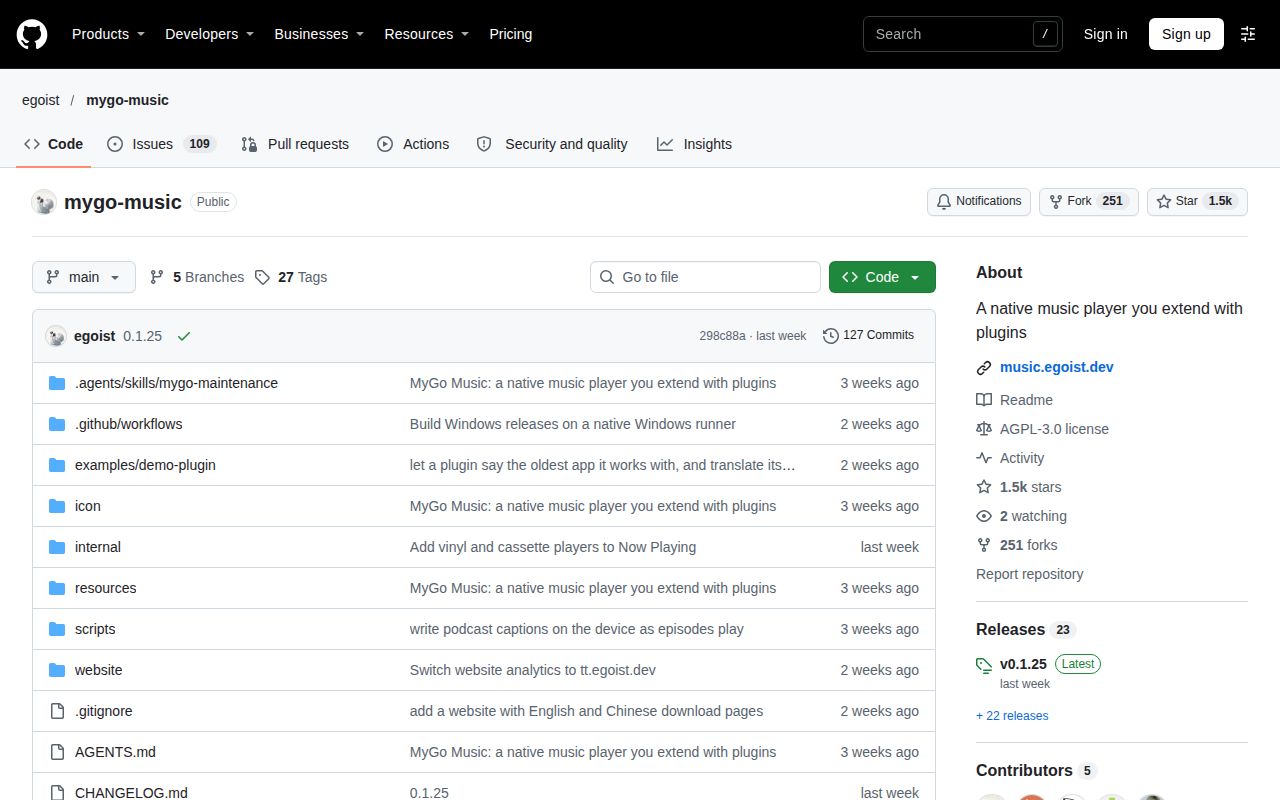
Freewares calls 0.1.22 the current release, while LavX's November 13 article lists v0.1.24. The later dated article makes the Freewares wording stale. Separately, repository metadata observed on November 22 records release tag v0.1.25 with a November 14 timestamp. The measured checkouts remain 298c88a and 298c88a03407; a release listing and a run's commit identify different things.
Freewares calls the native Go app fast and light. Voemp's Windows 0.1.19 complaint and 0.1.20 retest provide a more specific account: the reported tray-growth symptom changed after an update. The Freewares article also repeats that the same plugin runs on every platform. MyGotify's documented Linux sign-in abort and Soda's macOS and Windows package list make platform and authentication details necessary parts of that claim.
Soda Music's README says the player's own interface runs on WebView2, conflicting with the official site's description of MyGo without a WebView. Issue #51 separately identifies the sign-in page as a web view. These statements describe different interfaces: the native player and a service's sign-in window. Treating the latter as the construction of the entire application confuses the two.
FAQ
The official site offers a Download link, so downloading the player and building its source are separate routes. The questions below cover that distinction, desktop platforms, streaming sources, plugin permissions and playback features. They also retain the mobile question found on X and the artwork question raised in issue #100. Their answers draw on the project's documentation and the named discussions.
Can I download MyGo Music, or do I have to build it from source?
The official site offers a download. For source development, the README documents go tool mygo dev; packaging uses go tool mygo build, and its test command is go test ./internal/.... The inferred go install mygo-music/...@latest command in our failed recipe differs from all three. A packaged download is the direct route for someone evaluating the player rather than working on its source.
Which operating systems does MyGo Music support?
The official site lists macOS, Windows and Linux. Individual integrations have their own requirements: Soda lists macOS and Windows packages, and MyGotify directs Linux users to cookie entry after describing an abort when its graphical sign-in opens. The platform list for the player and the installation details for a service plugin therefore answer separate questions about the intended desktop setup.
When will MyGo Music be available on mobile?
MyGo Music's official site describes a desktop app for macOS, Windows and Linux. Aarteiimis asked about mobile on November 17 in the X result. That record contains a question, rather than a developer response or release announcement. For the selection discussed here, the documented product is the desktop player and its plugins, including integrations for a listener's own music server.
Which audio formats can MyGo Music play?
The README lists MP3, FLAC, Ogg Vorbis, WAV, and ALAC, FLAC or AAC in M4A and AAC files. It also lists tags, artwork and LRC lyrics. Soda's README illustrates why container and encoding need separate attention: it passes AAC-LC as M4A and native FLAC unchanged, and reports actual source quality when falling back to a lower-quality source.
Can MyGo Music stream Spotify and other music services?
MyGotify brings Spotify's catalog and library to MyGo Music while playing YouTube Music audio. Other plugins connect to different services: AkinoKaede's NetEase plugin documents NetEase playback, membership restrictions and regional restrictions. Its signed-in features include playlist editing and recommendations. Choosing a service logo alone therefore leaves out the audio source and account actions that distinguish the integrations in the comparison matrix.
How do I extend MyGo Music or write a plugin?
The README defines a plugin as a folder with plugin.json and one JavaScript or TypeScript file. It documents exports for search, streams and library actions, with parameters and return shapes, and links a demo using made-up data. The app leaves out functions the plugin does not export, so an integration's visible capabilities depend on which functions its author implements.
Does MyGo Music have a plugin marketplace?
The README describes a browsable plugins page and installation from GitHub through Settings. Authors add the mygo-music-plugin topic to have a repository listed. Installation can also use a local folder or ZIP. The documented update path takes a release asset, or source when appropriate, and asks the listener again when an update requests more permissions than the installed version.
Can MyGo Music plugins run programs on my computer?
Plugins can start programs after requesting process permission and receiving approval in Settings. The manifest can name particular helpers or request any program, which triggers a warning. The README says programs have the listener's access and end when the plugin does. That permission explains how integrations use tools such as ffmpeg or a local browser sign-in helper alongside their JavaScript code.
Does podcast captioning send my data anywhere?
The README describes caption transcription on the device with sherpa-onnx and Qwen3-ASR. The app downloads those components when the listener requests them. That describes the transcription path, while a podcast plugin supplies the episode itself. These are different operations: obtaining content from a service and writing its speech into captions on the listener's computer as playback proceeds.
What makes MyGo Music different from other players?
MyGo Music combines a native Go/MyGo interface without a WebView, local files in the core and other sources through plugins. The README lets plugins add accounts, catalogs, podcasts, stations, comments and custom pages. That design makes the particular integration central to the choice: the player supplies the interface, while its service plugin supplies account behavior and source-specific features.
What playback extras does MyGo Music include?
The README lists an audio cache, loudness normalization, fades on pause and seek, session restore, a queue, shuffle and repeat. Its interface features include lyric stage styles, a cover wall, tray controls, media keys and a macOS notch player. The format list and the plugin's source still determine what audio reaches those playback controls; these extras describe how the player manages and presents it.
Can covers stay cached after I restart MyGo Music?
Issue #100 reports previously loaded covers downloading again after a full exit and restart. The reporter asks for persistent remote-image storage and reuse across pages. The recorded discussion includes a contributor implementation for review. That request concerns artwork rather than song data, while the Navidrome README's cache-clearing advice concerns failed audio responses that repeatedly end playback with EOF.
What we have not tested yet
Our CLI attempt stopped at installation, so this review has no independent playback, responsiveness or application-memory benchmark. The earlier Node/Bun harness result covers its recorded repository steps. Actual runtime versions require raw toolchain logs; image labels identify configuration. The current README's Go development, packaging and test commands still need a supported-environment run with retained logs. No corrected command shown here is presented as executed.
Service accounts, track matching, quality fallback and playlist writes were outside our runs. Soda explicitly leaves live-account checks for new write operations, full listening checks and some device tests pending. Voemp's memory retest, yusgsysh's fnOS JPEG retrieval and Hoastar's theme comparison are attributed community results. The retrieved JPEG tested the contributor's earlier implementation. Our measurements do not cover large libraries, prolonged background playback, cache recovery or browsing after restarting without a network.
The proxy-settings branch, persistent-artwork implementation and proposed Linux appearance changes have no demonstrated upstream completion in these records. Persistent artwork alone would not make whole album or playlist pages available offline. The Hi-Res discussion does not identify whether HUVEI used AkinoKaede's plugin. These boundaries keep a proposed change, a separate plugin's setting and a shipped feature from being treated as the same result.
Caption model size, download footprint, speed, accuracy and battery use remain unmeasured here. Lockergnome's captions article also discloses no hands-on test. Local transcription is a documented processing claim, rather than our network or security audit. We have not audited credential storage, helper access or traffic across platforms. Rendered layout, resolved links, related links, recommendation modules and template behavior are also outside this text review.
The YouTube records have empty extracts or music captions; the Bilibili result identifies a relevant video without playback findings. There is no usable Reddit playback report here. Neither those search results nor the November 17 mobile question establishes adoption or a mobile release schedule. The next useful evaluation is the packaged app on the intended desktop, with the chosen plugin, a known song and restart-without-network behavior considered separately.