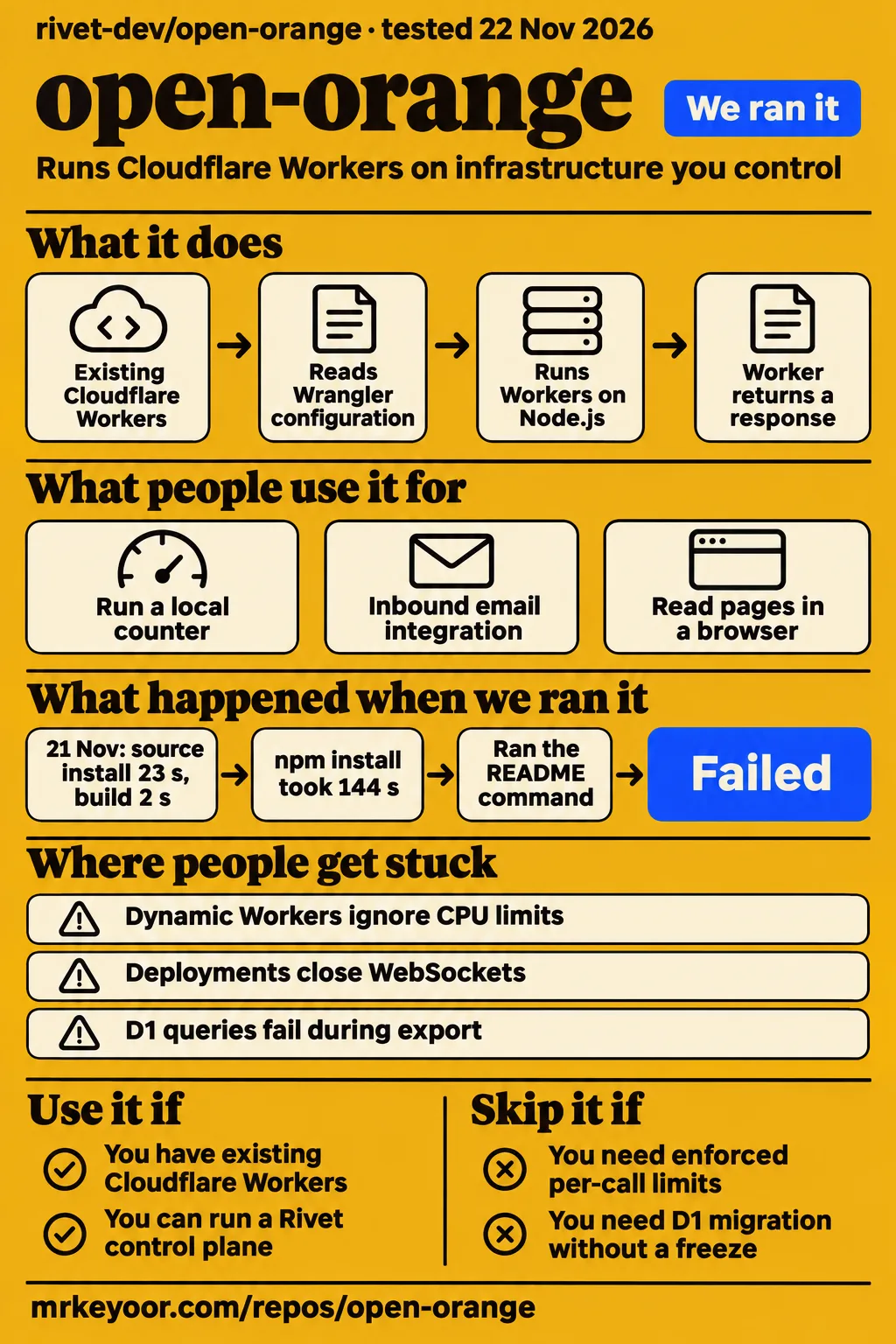
Our source build finished in 2 seconds, but the test command reached its 900-second timeout. Use OpenOrange if you already have Cloudflare Workers and want to evaluate running them on infrastructure you control. Skip it if your platform depends on enforced per-call limits for untrusted dynamic Workers: issue #58 reports those limits are accepted and ignored. The useful question is how much of your application's behavior survives the move, including the parts a hello-world response cannot exercise.
What people use open-orange for
Rivet's OpenOrange reads your Wrangler configuration and runs Cloudflare Workers on Node.js, with each Durable Object backed by a Rivet Actor and its own SQLite database, according to the getting-started documentation. A Worker is your request-handling application. A Durable Object adds an individually addressed piece of state, such as a room, counter or tenant database. Rivet supplies the machinery that places those objects and routes requests to them.
OpenOrange is an implementation of the Workers APIs on Node.js, not a Cloudflare fork running workerd, Cloudflare's open runtime. The README explains that distinction. You can keep familiar configuration and CLI habits while taking responsibility for the replacement services. For example, a Browser Rendering binding needs a browser endpoint, and Hyperdrive needs a reachable database. A binding is the named connection your Worker uses to reach one of these services.
This review concerns rivet-dev/open-orange at openorange.dev. The AI workspace at openorange.ai and the community history archive are different products. Their users and agent workflows tell you nothing about adoption of Rivet's runtime. Search results for the shared name need that distinction before any comparison is useful.
The BitDoze author ran a local counter, and a Groundmail developer reported a working inbound-email integration. Those are more concrete starting points than the promise that all Cloudflare code can move unchanged.
| Who tried it | What they did | What came back |
|---|---|---|
| BitDoze review author | Ran hello-durable-object on open-orange 1.0.1 | Two requests returned visit counts of 1 and 2, demonstrating repeated routing to the same local object. Local counter walkthrough |
| BitDoze review author | Generated self-host deployment artifacts with a dry run | Inspected the Dockerfile and build context; the walkthrough stopped before running a live cluster. Deployment walkthrough |
| Reporter of issue #24 | Evaluated a telemetry application on a self-hosted SQLite-backed Engine | Reported authenticated ingestion, restart persistence and 100 reload cycles with 200 samples accepted and none rejected. The closing comment says the author would not follow up. Telemetry report |
| Groundmail developer in issue #18 | Sent inbound email to open-orange 1.0.1 | Reported the correct envelope and raw message, rejection returning HTTP 400, and a wrong secret returning HTTP 401. Email integration report |
| Project conformance authors | Exercised the Browser Rendering binding | Reported page reading, PNG screenshots and concurrent requests working against a configured browser. Browser Rendering checks |
The counter is a useful first exercise because its second response depends on reaching the same object and reading its existing state. It still leaves the operational questions for later. The telemetry report went further, but its recovery objection and the author's closing disclaimer deserve equal weight. Don't turn a detailed issue report into an independently reproduced customer case study.
What happened when we ran it
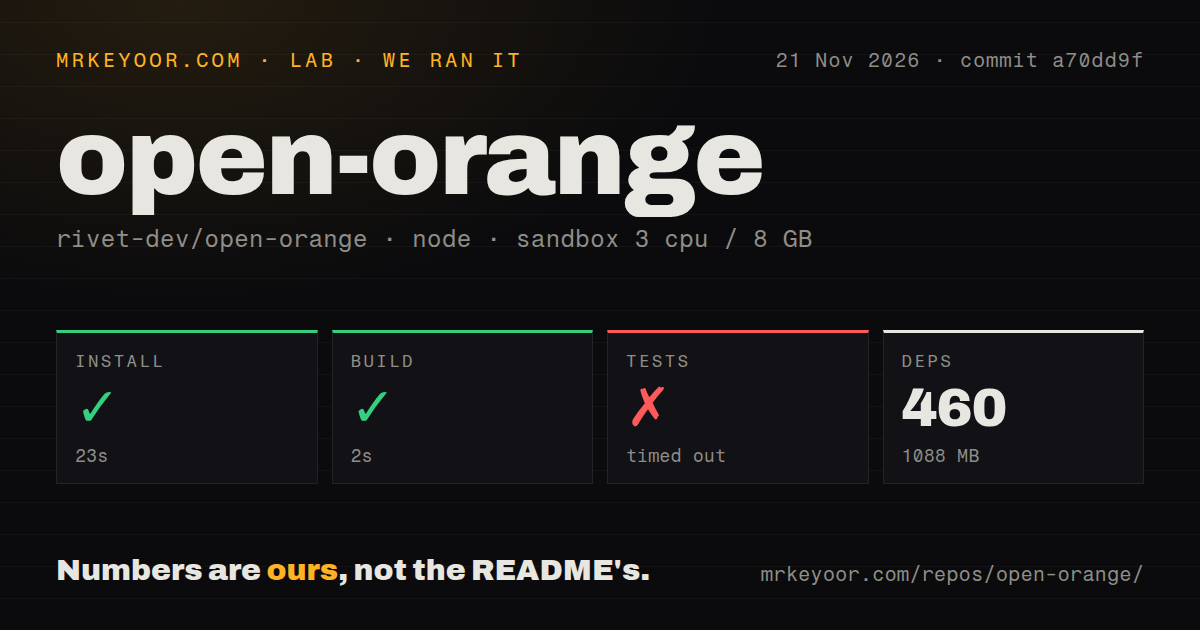
Our November 21 sandbox run installed dependencies in 23 seconds and built the source in 2 seconds, then the tests timed out at 900 seconds. We used commit a70dd9f with 3 CPUs, 8 GB of configured RAM and image label lab-node:22. The label identifies the sandbox configuration; actual runtime and operating-system versions require the raw toolchain logs.
| Source-check step | Our recorded result |
|---|---|
| pnpm installation | Succeeded in 23 seconds; 460 dependencies recorded |
| Installed footprint | 1,088 MB on disk |
| Build | Succeeded in 2 seconds |
| Tests | Timed out at 900 seconds |
| Repository scan | 1,548 files, approximately 161,210 source lines, 27.6 MB checked out |
| Project structure | Monorepo workspaces, a tests directory, four CI workflow files, no Dockerfile detected |
The test tail was still reporting successful individual checks. It includes production Worker building under orange serve, the absence of local email and cron routes, useful D1 actor errors, namespace handling, Prometheus metrics configuration, a missing RIVET_ENDPOINT error, and keeping endpoint credentials out of the Worker. It also reports success for removing stale cron jobs and applying remote D1 migrations. The command never supplied a completed suite result. There is no failing assertion in the tail to explain the timeout.
One R2 preview-bucket check was skipped with the explicit reason: needs Docker or OPEN_ORANGE_TEST_MINIO_BINARY to run a real MinIO server. That skip belongs to that check. It is not an explanation for why the whole command reached the time limit. Likewise, the scan's lack of a Dockerfile is compatible with a deployment command that generates one later.
A separate November 22 CLI run used commit a70dd9f4b451 in a fresh unprivileged container configured with 2 CPUs and 4 GB RAM, without published ports or secrets. Its clone step completed, and its installation step used npm rather than the README's pnpm command. These were separate exercises with different configurations.
The CLI returned version 1.0.6 successfully, and help listed dev, doctor, serve and deploy. Then the task stopped at usage: the automation reported FAILED; no runnable open-orange command in the README's usage/examples sections, as recorded in the usage step. The README itself contains orange dev in Quickstart. The narrower finding is that this recipe failed to select and execute a usage command, so it never demonstrated a working application. The run then completed teardown successfully.
Where people get stuck: SQL and redirects change behavior
The D1 reference documents unsupported SQL syntax, while issue #47 reports incoming requests following redirects that Cloudflare leaves untouched. These are application-level differences you can miss when you only check that a Worker starts.
| Symptom | What the source says | Action and status |
|---|---|---|
near "LIMIT": syntax error |
D1 rejects DELETE ... LIMIT and UPDATE ... LIMIT. |
Select limited rowids in a subquery, then mutate with WHERE rowid IN (...). Documented workaround in the D1 reference. |
D1DeleteEndpoint returns HTTP 500 |
The D1 docs identify chanfana versions before 3.1.0 as generating unsupported SQL. | Upgrade chanfana to 3.1.0 or later; doctor flags affected older installations. D1 compatibility guidance. |
no such function: cos |
Optional SQLite math functions are absent; core abs() and round() work. |
Compute after reading rows in JavaScript, or store precomputed values. SQLite compatibility guidance. |
A forwarding Worker returns a followed response or TypeError: Too many redirects. |
The author of issue #47 reports incoming Request.redirect defaults to follow rather than manual. |
The open issue proposes changing both incoming Request constructors. It contains no merged-fix confirmation. Redirect report. |
For a proxy, the redirect issue is more consequential than it first sounds. Your application may forward the request it received, carrying the default along with it. The reporter observed follow on open-orange 1.0.2 and describes a redirect loop returning HTTP 500 where Workers returns the redirect. Keep a redirecting upstream in your acceptance checks, including a loop and an ordinary hop. A successful origin response exercises neither case.
SQL counters need separate treatment. The D1 reference says rows_read counts returned rows and rows_written omits index and trigger writes. Those values cannot substitute for Cloudflare's scan accounting. For checking index use, the compatibility page recommends EXPLAIN QUERY PLAN. This matters even when every query returns the expected application data.
Open sockets and long queries keep consuming capacity
An accepted WebSocket keeps the underlying Rivet actor awake even when OpenOrange discards the object's in-memory state, according to the compatibility documentation. That is emulated object hibernation: a later message creates a new object instance inside an actor that stayed running. If you are moving a chat room or notification service to save idle capacity, this behavior belongs in the cost calculation.
The same documentation says deployments close sockets and discard object memory while durable storage survives. Clients need to reconnect on closure and recover important state from storage. Old and new runners can overlap during rollout, so a connection opened during deployment can also be cut shortly afterward. Storing session truth only in a JavaScript object leaves the reconnecting client without it.
D1 has a different capacity constraint: the reference gives each database one Rivet Actor and says long SQL queries block the process's Node.js runtime thread. Other Workers and objects in that process wait. Adding machines is not a substitute for deciding how you divide hot databases. The documented scaling suggestion is to split data into multiple databases, for example by tenant.
The default local sandbox has no isolation
The Sandbox documentation explicitly says the default local provider is not isolated. Commands run on the host, while agentOS and the hosted providers offer different execution environments. Choose the provider deliberately before exposing an application that executes someone else's commands; the name Sandbox alone promises more separation than the local default supplies. The provider table describes those boundaries.
Secrets also need deployment configuration. The binding guide says orange deploy excludes .dev.vars from the image and accepts secrets separately. A local service binding working on your machine does not populate the remote runner's credentials. For browser automation, the browser reference says self-hosted Chromium sessions share the default context, including cookies and storage. Give separate Workers their own browsers when they need separate profiles.
For platforms hosting dynamic user code, VM separation and resource budgets are separate questions. Issue #58 reports ignored CPU and subrequest limits, and its proposed agentOS mapping explains why a lifetime CPU budget cannot simply stand in for a per-request budget. The thread is open. A configuration field accepting a value is no assurance that the runtime enforces it.
Open-orange vs Cloudflare Workers, Rivet and workerd
Cloudflare can be cheaper for small, spiky Workers, as OpenOrange's own README acknowledges. The choice changes when you need control of placement or already operate the surrounding infrastructure. These are architectural comparisons, with the project's stated cost assumptions, rather than measured winners on the same application.
| Option | Reason to choose it | Tradeoff against OpenOrange |
|---|---|---|
| Cloudflare Workers and Durable Objects | Keep the managed platform when its small, spiky workload economics fit. | OpenOrange lets you select infrastructure and placement, while taking on replacement-service operation. README comparison. |
| Rivet directly | Start a new backend with native actions, events and realtime connections. | OpenOrange is the project's recommended route for existing Cloudflare code; Rivet uses its own API. Rivet comparison. |
| workerd directly | Run Cloudflare's open runtime when that runtime is the component you need. | OpenOrange adds Rivet-backed services and object placement; the project's comparison says workerd alone leaves those services to you. Runtime comparison. |
| Hosted browser or self-hosted Chromium | Choose a browser provider independently of the Worker runtime. | Browserbase starts separate browsers per session; a self-hosted browser shares its default context. Provider capacity still governs concurrency. Browser provider comparison. |
You don't need to learn Rivet's application API to use OpenOrange: the README says you use orange and your Wrangler configuration. Operating your own control plane is a separate responsibility. The same README's self-host route generates deployment artifacts, then asks you to run the control plane and worker nodes pointed at RIVET_ENDPOINT.
Treat the advertised savings as a bill model. The README prices compute on raw AWS Graviton in us-east-1 with 40% headroom and storage on S3. Your decision also needs the operational work, browser or email providers, and your application's actual utilization. Idle WebSocket actors belong in that calculation. Replacing a metered service with machines changes what you pay for; it does not supply your total cost automatically.
What the other reviews get wrong
BitDoze's review extends the no-downtime migration claim to D1, but OpenOrange's D1 reference explicitly documents query failures during export and a write freeze. The BitDoze migration section makes the broader claim; the D1 reference reports about three minutes of frozen writes for a 1 GB database. That is the project's example, not a duration we measured. Schedule the migration around the database interruption your application can tolerate.
BitDoze's local counter demonstration and artifact inspection remain useful. They answer different questions from whether a live application can migrate without service interruption. Its dry run stopped before a live cluster. The distinction matters when deciding how much operational confidence to take from an otherwise practical walkthrough.
The README's drop-in labels need the binding references
Hyperdrive preserves the connection interface but supplies neither connection pooling nor query caching, according to its binding reference. The README nevertheless lists it as Drop-in and defines that label as running as on Cloudflare. If your database depends on a pooler's connection budget, use the database provider's pooler rather than assuming the binding supplies one.
Several other broad statements need their exceptions beside them:
- The compatibility page's headline is 90.2%, with 38 of 50 real projects unmodified. Its scored set excludes workerd-only cases that fail on plain Node.js, cases the runner could not host and cases cut short by a Cloudflare quota. Those are upstream recorded results, not our passing-test totals or a migration-success probability.
- The configuration introduction says unsupported bindings throw. Its detailed reference says Analytics Engine accepts writes and drops them. Audit telemetry delivery separately from request success.
- Doctor lists unsupported bindings but does not fail on them, even with --strict. A green command exit is not migration approval.
- The homepage's hardware-capacity framing still meets a 128 MiB changed-page limit per D1 commit. The unit describes changed SQLite pages, not simply the size of your request body.
The same caution applies to discussion on social media. In a Chinese-language X post, vintcessun describes reuse of Wrangler configuration and warns about binding coverage. That is commentary about the architecture, not a report of running a production cluster. Unrelated orange-themed videos and posts offer no useful adoption evidence for this runtime.
Questions people ask
OpenOrange implements the Workers APIs on Node.js and does not run workerd, as the README explains. The more specific compatibility questions have different answers.
Can I run Cloudflare Kitesurf inside OpenOrange with isolation?
Issue #29 contains a request and a maintainer's intention to investigate Kitesurf, followed by a request for an update. It contains no completed Kitesurf demonstration. The Kitesurf discussion stays open. For isolation generally, the local Sandbox provider runs host processes; choosing an isolated provider is a separate step from getting Kitesurf working.
Can the project enable GitHub Discussions as an alternative to Discord?
A maintainer welcomed that request in issue #30 and said they would look into enabling Discussions. The closed discussion request records that response, rather than confirmation that the setting changed. If you cannot use Discord, the issue tracker is where this particular exchange occurred.
Which inbound email providers can POST raw messages directly to OpenOrange?
A Groundmail developer reports sending the raw message with its envelope to the email handler on open-orange 1.0.1. Their issue #18 report includes successful handling, rejection returning 400 and an incorrect secret returning 401. The author closed the issue after finding the SendGrid and Mailgun notes already documented. That closure corrects the documentation complaint; the integration result remains the developer's report.
Can I export a consistent backup and restore it into a fresh namespace?
The author of issue #24 reported no supported consistent export and fresh-namespace restore path. Their only reported restore used a stopped, same-namespace filesystem copy in an unsupported format. The closed recovery request ends with the author disclaiming follow-up, without a product-fix demonstration. Ordinary restart persistence and recovery after losing a namespace are different requirements.
What must change before OpenOrange supports real WebSocket hibernation?
The author of issue #46 says accepted sockets keep the actor awake and socket records need persistence and restoration across a real actor sleep. They experimented with an unreleased engine change and an enabled flag; the open hibernation issue explicitly says the experiment does not affect a released configuration. A maintainer says hibernation will be added, without recording a completed fix.
Why does an incoming request follow redirects under orange dev and orange serve?
Issue #47 attributes the behavior to incoming Request constructors omitting the redirect field, leaving the underlying default at follow. Its proposed change sets manual on both constructors. The open redirect issue reports the behavior on specific versions and source revisions; a proposed diff should not be read as a released correction.
Does Worker Loader enforce CPU and subrequest limits on dynamic Workers?
Issue #58 reports that dynamic Workers accept and ignore these limits, including the dispatch-namespace path. The author proposes per-call accounting and describes work still needed around VM pools. The open limits request documents the missing enforcement rather than an implementation. This excludes applications that depend on those fields to contain hostile workloads.
Can a dynamically loaded Worker's Durable Object class back a facet?
Issue #19 reports getDurableObjectClass() throwing NotSupportedError. A facet is a subordinate Durable Object whose class, in this pattern, comes from dynamically loaded application code. Keeping state in the parent Worker is the suggested workaround, but the reporter explains that remote calls make SQL asynchronous and prevent the existing synchronous transaction pattern. The dynamic-class issue stays open.
What we have not tested yet
Our application-level CLI exercise stopped at command selection, and our source test suite timed out. We have not tested a production cluster, a live Cloudflare cutover, fresh-namespace disaster recovery, hostile dynamic-code workloads or a sustained traffic profile. The sandbox image label does not establish the actual toolchain versions. The complete logs are needed to identify them and to investigate the timeout beyond the successful checks visible in the tail.
We have not reproduced the upstream conformance score, the community integrations or the redirect issue on the latest release. The Hyperdrive reference explicitly lacks a deployed-binding test; Browserbase's manual provider measurements sit outside automated conformance. The WebSocket memory figures on the compatibility page predate the current emulation, so they are not a current capacity estimate. No independent total-cost comparison, security audit or production-readiness result comes from our runs.
For an adoption decision, require your own application to pass its SQL and redirect cases, reconnect through a deployment and restore its data into a fresh namespace. A successful response from the counter is the beginning of that evaluation. The restore drill is where a stateful migration has to earn your trust.