280 style IDs replace vague drawing adjectives
Handraw Style gives each visual style a number, a name, a trait description, and reference material. A creator can ask for style 041 instead of trying to reconstruct a long aesthetic description from memory. The same system covers theme colors and layout IDs for social cards, infographics, comic panels, and character design. The result is a bilingual prompt intended for an image model, not an image rendered by the repository itself.
The catalog is the product. Our 48.2 MB checkout contained 728 files and about 7,982 lines of source, with visual sheets and reference assets accounting for much of its practical value. An offline gallery lets you browse the collection locally. The skill can also recommend a style and color when you provide only a topic, although that recommendation remains an AI judgment rather than a measured match.
The English layout count conflicts with itself
The primary documentation is Chinese, and a substantial English version is available. Both explain manual selection, automatic recommendations, poster prompts, article covers, and multi-image article planning. The Chinese README says the library contains 136 layouts. The English introduction says 134, then its later layout section says 136. That small mismatch makes the catalog feel less settled than its detailed presentation suggests.
The Skill file is more precise than the marketing copy. It defines pure-image and graphic-text modes, reference-image rules, output order, and utility commands. It also tells the assistant not to invent style traits or extra scene content. Those constraints are useful because a prompt catalog can drift when an assistant decorates every answer. Still, documentation rules are only as dependable as the agent following them.
What happened when we ran it
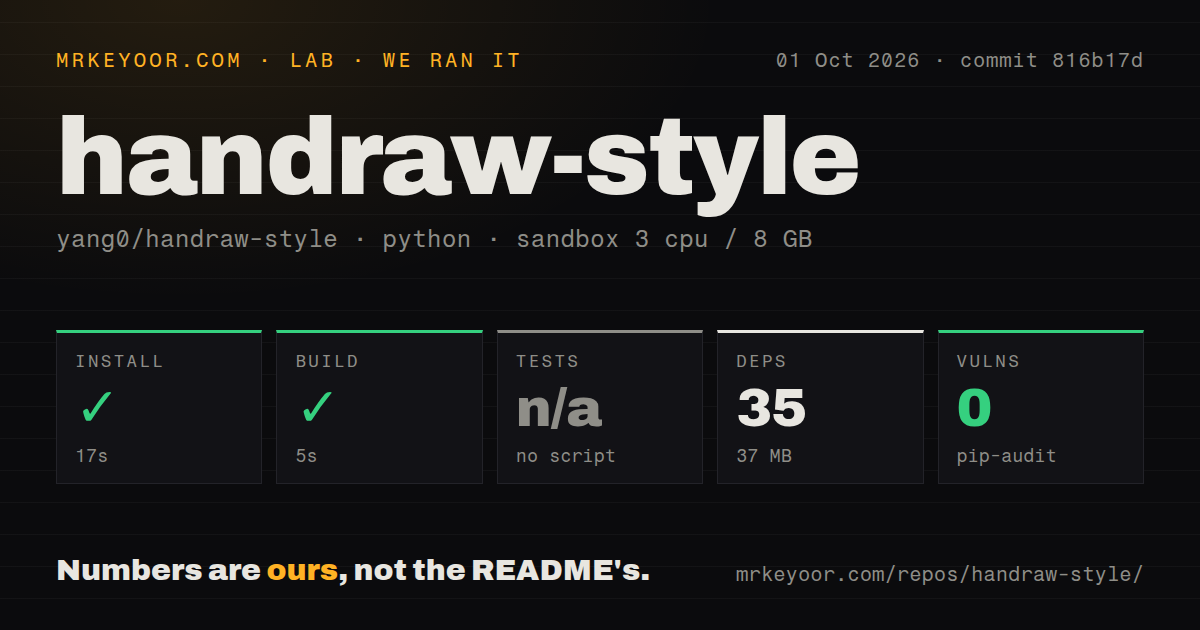
Our sandbox installed commit 816b17d in 17 seconds using Python 3.12 on Debian with 3 CPUs and 8 GB of RAM. Installation brought in 35 packages and occupied 37 MB. The build completed successfully in 5 seconds. Pip-audit reported 0 known vulnerabilities in the installed Python environment.
There was no test script or target, so the harness skipped tests. Our scan also found 0 CI workflow files, no Dockerfile, and no tests directory. A clean install and build establish that the package mechanics worked in our container. They do not prove that 280 styles resolve correctly, that every gallery asset exists, or that prompts produce consistent images across external models.
The Skill writes prompts while another model draws
Normal use can be entirely manual: browse a gallery, choose an ID, copy the generated prompt, and paste it into an image service. Agent integrations can go further by choosing a style, supplying a reference image, generating the picture, and inserting it into Markdown. The English README names Codex, Claude Code, Cursor, WorkBuddy, and OpenCode as installation targets.
That division of labor is important. The skill can specify a 4:3 canvas, a monochrome palette, or a storyboard arrangement, but the selected image model decides whether text is legible and objects remain coherent. Teams should review the output like any commissioned draft. Typography, logos, claims, likenesses, and cultural details need a human check before publication.
Reference images improve control without guaranteeing sameness
The repository describes calibrated handling for a named image model and a reference-image fallback for general models. Reference sheets can communicate line weight, texture, and palette better than a style label alone. They may also pull composition toward the examples or preserve unwanted details. The Skill file tries to limit that effect by separating rendering style from subject and layout instructions.
The README promises 100 percent faithful reproduction for its general-model fallback. That is too strong for a process whose final stage runs in an outside generative model. Seeds, model revisions, safety systems, and reference handling can all change an output. Use the numbered system to make requests more consistent and discussions less ambiguous, then judge the generated pixels rather than treating the ID as a guarantee.
The attribution clause is stricter than standard MIT text
The LICENSE calls itself MIT License (with Attribution Requirement). It permits use, modification, distribution, and commercial work, then requires clear credit to yang0 and the repository in documentation, a product description, a repository, or the user interface. GitHub reports the license as NOASSERTION, which is consistent with the added terms not matching a standard SPDX identifier.
That may be acceptable for a creator's internal skill or an attributed derivative. It can be awkward inside a white-label product or a company with a fixed notice policy. Review the clause before shipping the catalog or a derivative, and distinguish the repository license from rights connected to generated images, model terms, uploaded references, named styles, and any text placed into the artwork.
An October 1 push shows activity without release discipline
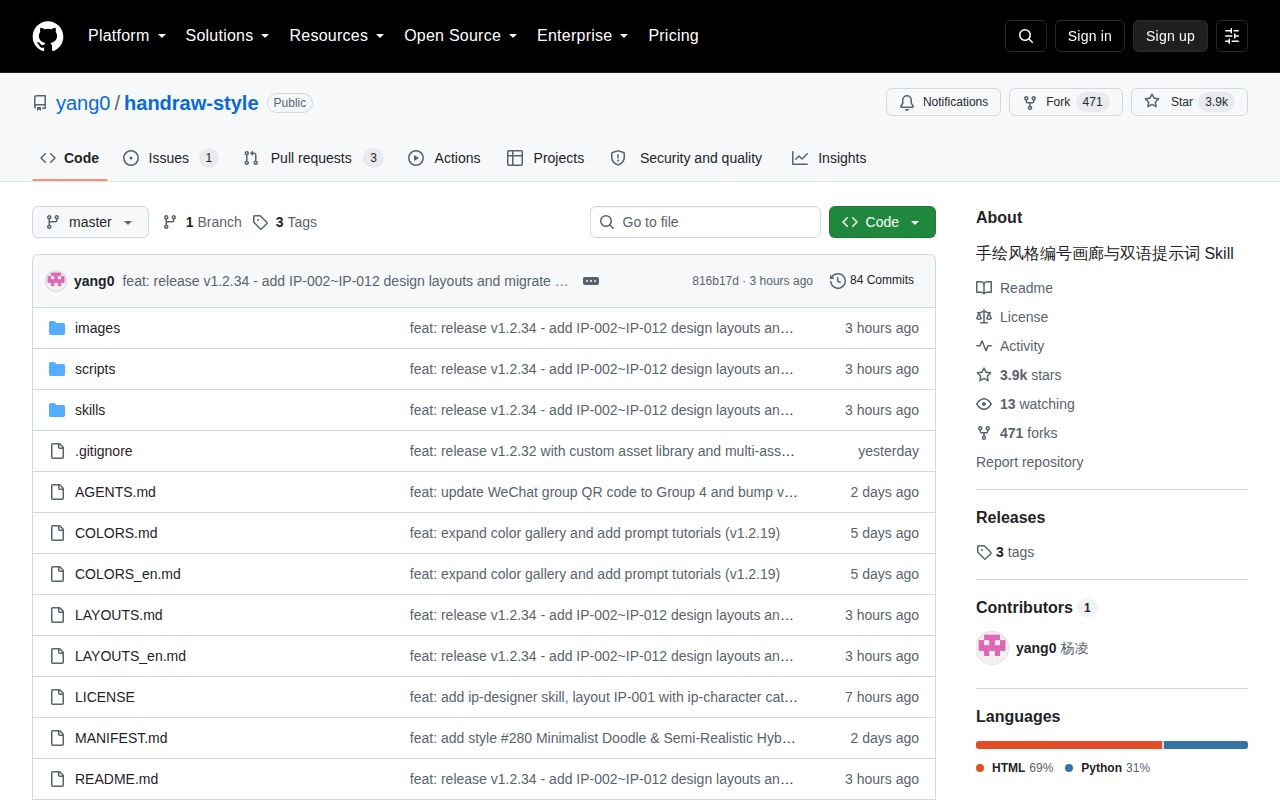
The repository was pushed on October 1, 2026, and GitHub showed 3,896 stars with 4 combined issues and pull requests. The open set contained one issue and three pull requests. No GitHub release was published. Recent work and a small queue suggest active development, while the absence of releases means adopters must pin a commit if they want a repeatable version.
Handraw Style earns a trial because its numbered visual vocabulary is immediately useful. A writer can point to a style, layout, and color without turning every image brief into an art-history exercise. The missing test target and conflicting layout count keep it out of infrastructure territory. Treat it as a curated creative reference, pin commit 816b17d, credit the author as required, and keep a person responsible for the final image.