mrkeyoor.com_
Tue 06 Oct 06:37 UTC
AI Toolsevaluationupdated 06 Oct 2026

guizang-product-video-skill review

Guizang Product Video Skill is a Chinese-first Claude Code and Codex skill. The repository documentation is in Chinese, and the README does not link an English version. It turns a software repository or changelog into a code-rendered product promo, including the story, product UI, animation, music, sound effects, MP4, and editable project.

Verdict

Our run installed 35 packages in 12 seconds and passed the supplied pytest step with 15 passed and 0 failed, so Guizang's repository mechanics are in better shape than its young age suggests. Use it if you work in Chinese, want your real product UI in a 45 to 60 second film, and will supervise the creative decisions. Keep FFmpeg 8.x jobs on a limited volume until the open SFX-stem reports are resolved, and review the AGPL plus BSL split before client work.

We ran it

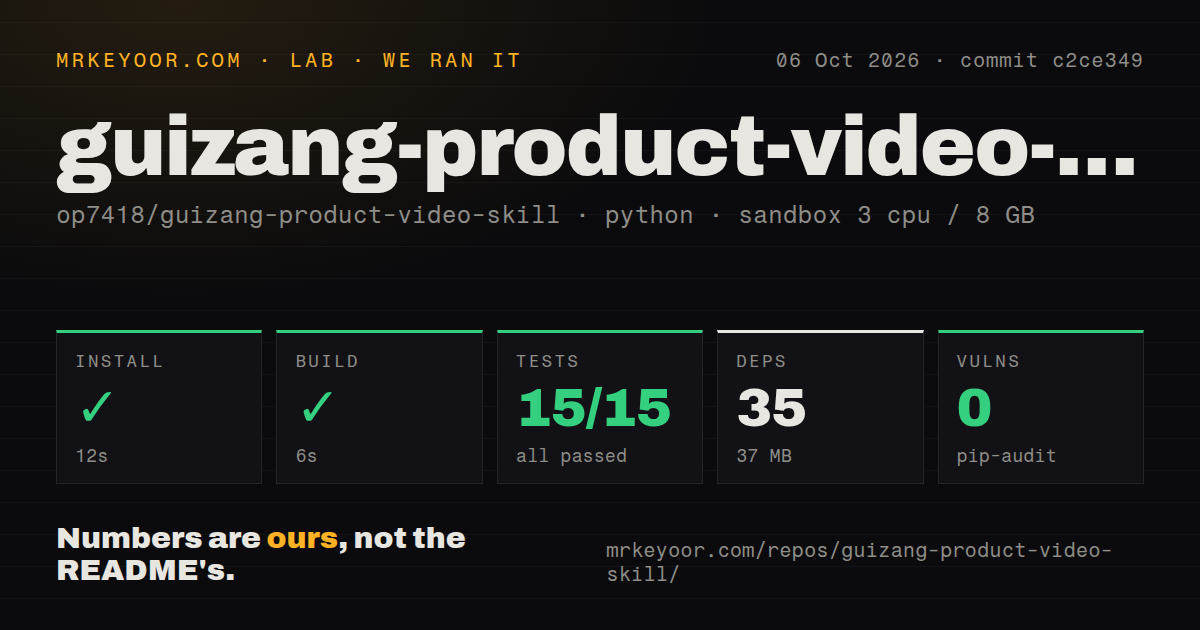
Lab card: what happened when we ran guizang-product-video-skillScreenshot of guizang-product-video-skill (github.com/op7418/guizang-product-video-skill)
Install✓ · 12s35 packages · 37 MB
Build✓ · 6s
Tests✓ · 7s15 passed · 0 failed · 3 skipped of 15 (pytest)
Known vulns0(pip-audit)
Repo90 files~2,036 lines of source · 1.4 MB · 0 CI workflows · tests dir

Answers from our run

Does guizang-product-video-skill build from source?

Dependencies installed in 12 seconds (35 packages), and the build succeeded in 6 seconds. We cloned commit c2ce349 into a clean Debian container with 3 CPUs and no project-specific setup.

Do guizang-product-video-skill's tests pass?

Yes: 15 of 15 passed when we ran the project's own test command (pytest). Some failures need services or credentials a bare container does not have.

Does guizang-product-video-skill have known vulnerabilities in its dependencies?

pip-audit found none in the dependency tree at the time of our run.

Who should not use guizang-product-video-skill?

Teams that need English setup and production guidance: the README, skill instructions, and linked production references are written in Chinese, with no English README linked.

What are the alternatives to guizang-product-video-skill?

video-shotcraft, Remotion, Recordly. Our run installed 35 packages in 12 seconds and passed the supplied pytest step with 15 passed and 0 failed, so Guizang's repository mechanics are in better shape than its young age suggests.

Setup4/512-second install and green checks, with a full media toolchain
Docs4/5Detailed production guidance, but it is Chinese only
Community3/5689 stars and 4 open issues or PRs in a very young project
Maturity2/5No release tags and an open FFmpeg 8.x disk-growth report

Who it’s for

Chinese-speaking Claude Code or Codex users who want an agent to build a software promo from a real repository.
React teams that want their own components, type, color, and interaction states in the finished film.
Developers willing to review storyboards, rendered frames, audio, and license evidence before publishing.
Product teams making 45 to 60 second release videos that need an editable code project after export.

Who it’s NOT for

Teams that need English setup and production guidance: the README, skill instructions, and linked production references are written in Chinese, with no English README linked.
Anyone running FFmpeg 8.x unattended on a valuable disk: open issue 5 reports a 60 second mix producing 112 GB of silence in about 4 minutes.
Buyers expecting a hosted one-click generator: the starter needs Node.js 22 or newer, Python 3.9 or newer, FFmpeg, Playwright Chromium, and the product repository's own dependencies.
Closed-source or white-label teams unwilling to review mixed licensing: the main work is AGPL-3.0, while the CodePilot fallback assets retain BSL 1.1 terms.
Native, server-rendered, or context-heavy interfaces that must drop straight into the film: the README says these may need an adapter or a source-faithful reconstruction.

Setup reality

Our fresh Debian sandbox installed commit c2ce349 in 12 seconds, adding 35 packages and using 37 MB. The build passed in 6 seconds. Pytest passed in 7 seconds with 15 passed, 0 failed, and 3 skipped of 15; pip-audit found 0 known vulnerabilities.

A real film needs Node.js 22 or newer, Python 3.9 or newer, FFmpeg and FFprobe, Playwright Chromium, plus the target product and its dependencies. React, GSAP, Three.js, and esbuild live inside the generated video project. No paid video service is required for the browser pipeline.

The starter renders WebGL through SwiftShader in headless Chromium. Product components may need providers, fixtures, workspace mapping, or a display adapter. FFmpeg 8.x also deserves a guarded trial because two open reports describe SFX-stem jobs growing until disk limits or manual intervention stopped them.

One skill produces a 45 to 60 second editable film

Guizang Product Video Skill gives Claude Code or Codex a production workflow for software promos and release videos. The default brief is a 45 to 60 second Chinese film in horizontal format. The agent reads the repository or changelog, chooses claims a viewer can understand, mounts product components, animates them, builds an audio track, and exports an MP4 plus the project used to render it. The repository documentation is Chinese, and the README does not link an English translation.

Three visual modes control how much of the product's identity survives. repo keeps the existing design, default wraps scenes in the bundled CodePilot look, and hybrid keeps the interface while changing the surrounding composition. Product text must remain at least 22 px in a 1080p film. That rule matters because a technically faithful interface can still become unreadable after it is squeezed into a social video frame.

Seven stages keep the agent inside a reviewable process

The seven-stage workflow starts by fixing the version range, product surface, audience, channel, aspect ratio, language, and style. It then checks the environment, researches the code, mounts one real component, writes a direction file, builds each scene, mixes audio, and reviews the render. Scope must come from the user because a repository cannot decide whether the film should cover one release, three weeks of work, or the entire product.

A formal film needs DIRECTION.md, three distinct creative directions, and 3 to 5 visual choices tied to something specific in the product. The first 5 to 10 frames must already form a complete poster image because X and Threads may use the opening frame as a thumbnail. Delivery checks inspect that opening, the timeline, expected files, and audio evidence. The instructions still require a person to watch the frames and listen to the mix.

What happened when we ran it

Our sandbox installed commit c2ce349 in 12 seconds, pulled 35 packages, and occupied 37 MB on disk. The build succeeded in 6 seconds. Pytest finished in 7 seconds with 15 passed, 0 failed, and 3 skipped of 15. Pip-audit reported 0 known vulnerabilities. The container had 3 CPUs, 8 GB of RAM, Python 3.12 on Debian, no secrets, and no elevated privileges.

The checkout contained 90 files and about 2,036 lines of source, taking 1.4 MB before installation. It had a tests directory, no Dockerfile, and 0 CI workflow files. Those results cover installation, the supplied build, and the supplied tests. They do not grade a finished film, measure browser rendering speed, test a product integration, or prove that the audio workflow behaves on every FFmpeg version.

The browser starter needs four pieces of system software

The documented baseline is Node.js 22 or newer, Python 3.9 or newer, FFmpeg with FFprobe, and Playwright Chromium. Inside the video project, React supplies the UI, GSAP drives the main timeline, Three.js or canvas handles effect layers, and esbuild prepares the browser code. The headless export turns on SwiftShader for WebGL, so a machine without a usable GPU still has a software-rendered path.

React products get the shortest route because the skill includes component integration examples. Monorepo packages and unusual TypeScript options can be mapped in integration.config.mjs without changing the product repository. Server-dependent, native, or context-heavy components may need providers, fixtures, or an adapter. If direct mounting fails, the instructions allow a source-faithful reconstruction, but require the evidence record to say what was rebuilt and why.

An open FFmpeg 8.x report reached 112 GB

Open issue 5 describes a 60 second film with 28 sound cues on FFmpeg 8.1. One of 6 repeated runs kept writing silence, reached 112 GB in about 4 minutes, and stopped only when the disk filled. Open pull request 4 reports a related 48 second, 21-cue case on FFmpeg 8.0.1 that reached 23 GB. Both reports propose bounding the SFX stem more directly than the current apad filter chain.

This is a narrow version-specific report, not a failure from our Debian sandbox. It still changes how we would trial the tool. Put early FFmpeg 8.x runs on a volume with a quota, watch the output size, and test the exact sound plan more than once before leaving a render unattended. A product-video skill that can fill a workstation disk needs that warning near the install command, even when its Python tests pass.

AGPL code and BSL fallback assets need separate review

The main workflow, scripts, starter, and original audio assets use AGPL-3.0. The CodePilot-derived files under assets/fallback/ retain Business Source License 1.1 terms, so the default visual pack does not inherit the main license. The README says generated video is not automatically an AGPL work merely because this skill rendered it. Product components, logos, fonts, music, and other incorporated assets keep their own terms.

The project has 689 stars but no release tag

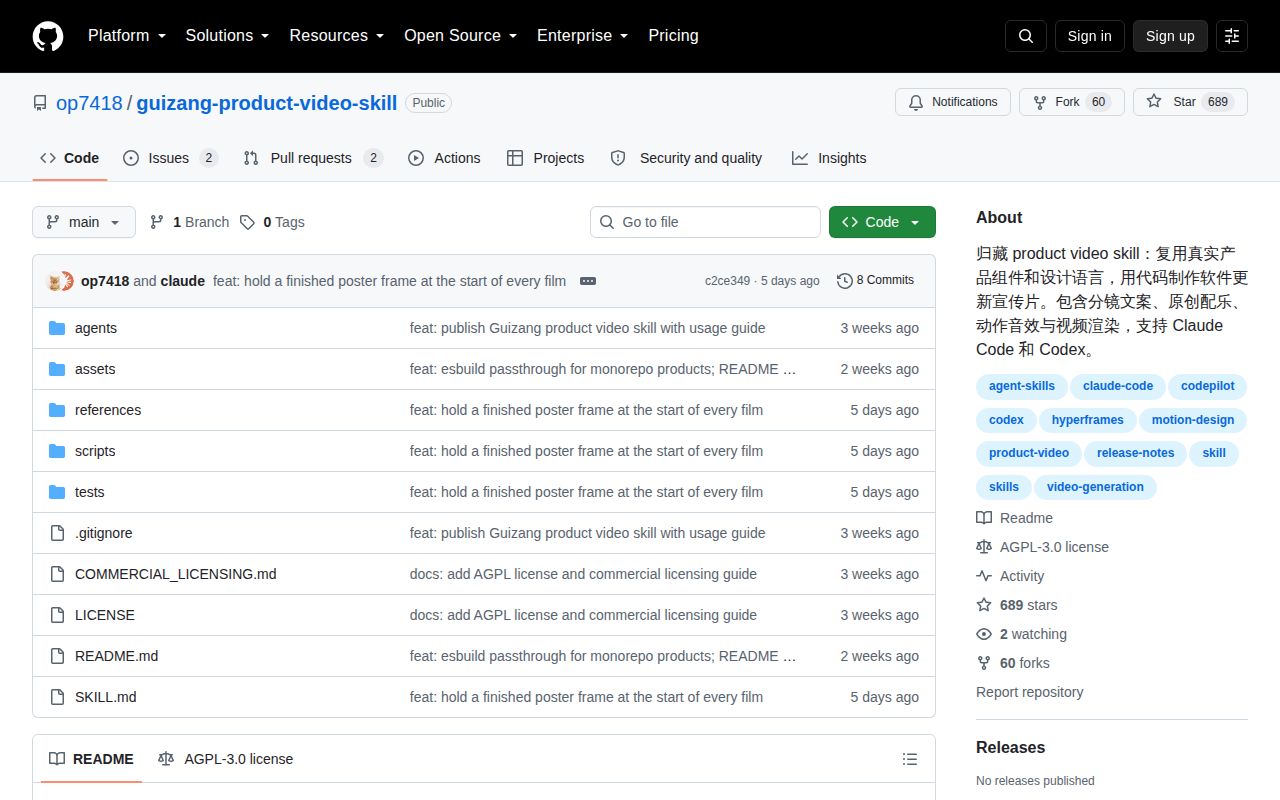
GitHub showed 689 stars, 60 forks, and 4 combined open issues and pull requests on October 6, 2026. The open list contained 2 issues and 2 pull requests. The repository was created on September 18 and last pushed on October 1, when commit c2ce349 added first-frame thumbnail checks. There were no GitHub releases or tags. That is active early work, with a clean small test run and very little release history to judge.

Guizang is best for a developer who wants an agent to make the film while leaving every frame and audio decision open to inspection. Recordly is easier when a polished screen capture is enough. Remotion gives a team a lower-level React foundation. For this skill, the deciding costs are Chinese-only guidance, the local media stack, license review, and a supervised FFmpeg trial.

Alternatives

ProjectWhat it isPick it when
video-shotcraftA Remotion agent skill with English, Chinese, and Japanese docs plus a large motion-recipe catalog.pick this instead when English guidance, many reusable shot recipes, and a browser workbench matter more than Guizang's product-derived direction process.
Remotion gh↗A React framework for authoring, editing, and rendering video with code.pick this instead when your team wants the underlying video framework and will design its own research, storyboard, audio, and review process.
Recordly gh↗A desktop screen recorder and editor for demos with zooms, cursor polish, and timeline editing.pick this instead when recording a working product is easier than mounting its components inside a code-rendered film.

What people are saying

  1. [velocity-scout] op7418/guizang-product-video-skill

Sources

  1. Guizang Product Video Skill README
  2. Guizang Product Video Skill instructions
  3. Commit c2ce349
  4. Open FFmpeg 8.1 disk-growth issue
  5. Open deterministic SFX-stem fix
  6. video-shotcraft repository
  7. Remotion repository
  8. Recordly repository

More ai tools reviews

nimble · localjev · jev-visual · jev-review · laya · artcraft · the whole board →