Recordly v1.3.3 puts capture and demo editing in one desktop app
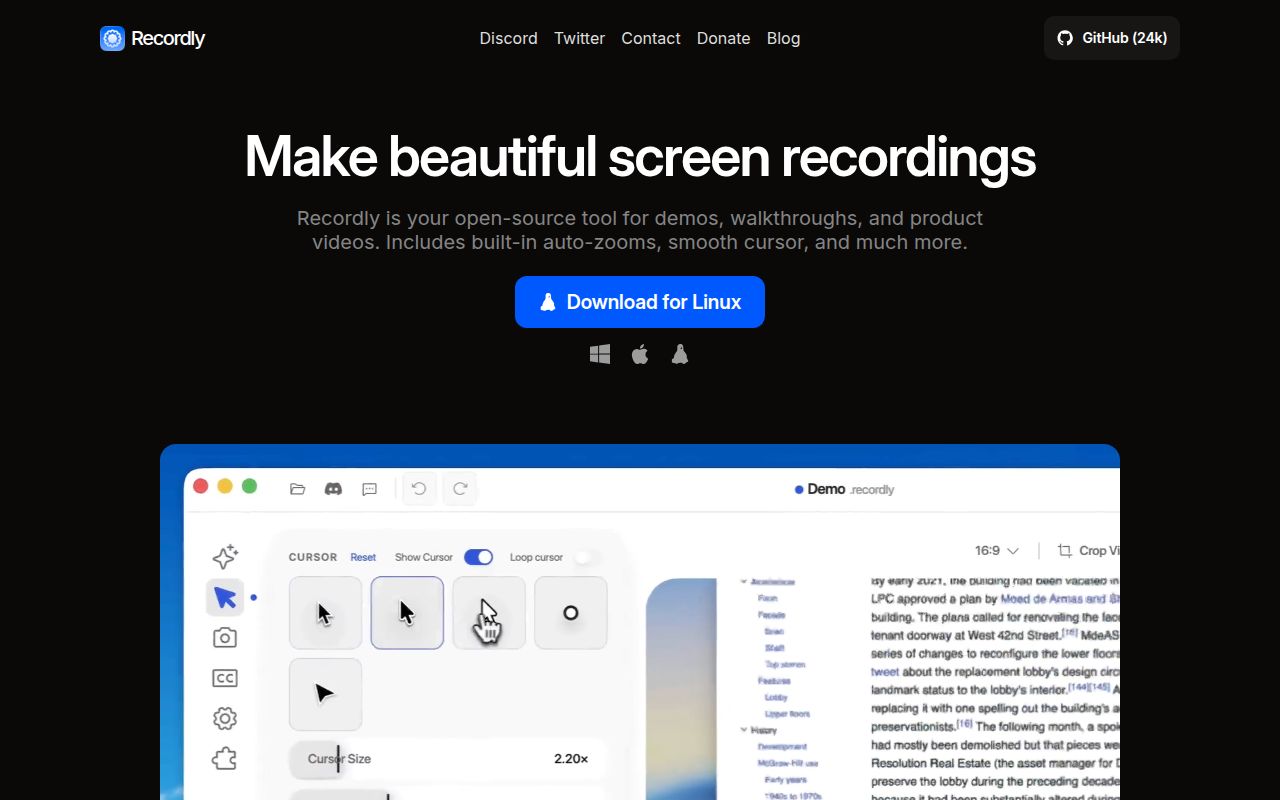
Recordly records a display or app window and opens the result directly in a timeline editor. The useful distinction is its treatment of routine demo-video work: automatic or manual zoom regions, cursor smoothing, annotations, speed changes, webcam placement, crop controls, styled backgrounds, and MP4 or GIF export live in one project. A .recordly file preserves the source-media path and editor state, which makes revisions less fragile than a pile of exported clips and handwritten settings.
The 3 supported desktop systems do not share one capture implementation. macOS uses ScreenCaptureKit helpers, Windows uses Windows Graphics Capture and WASAPI helpers where supported, and Linux falls back to Electron capture APIs. PixiJS handles scene composition, and the same scene logic drives preview and export. This design gives Recordly native help where the operating system offers it, while making platform-specific behavior part of the buying decision rather than an implementation detail.
Two Linux launch reports sit beside a documented cursor limit
2 open issues describe AppImage launch failures. Issue 888 reports that Recordly aborts on Ubuntu 24.04 and later when Electron cannot establish its sandbox under the distribution's user-namespace restrictions. Issue 818 says the AppImage can exit silently when FUSE 2 is missing, with the useful error visible only in a terminal. Both reports include workarounds, but either problem can make a downloaded application appear broken before a user reaches the recorder.
Capture has another Linux-specific compromise. The README says Electron desktop capture cannot hide the operating system cursor, and adding Recordly's styled cursor overlay can leave 2 cursors in an export. Issue 34 reports erratic cursor following on Arch Linux with KDE Wayland. Issue 816 separately describes audio that stopped after a few seconds during a recording longer than 15 minutes. One report does not establish a universal limit, but long sessions need a playback check before the source is discarded.
The 846-file checkout advertises extensions that current code disables
Recordly's README describes a marketplace for click sounds, device frames, wallpapers, render hooks, and settings panels. Open issue 862 says the matching extension-examples directory is missing and the renderer's extension manager is a placeholder stating that installation and marketplace access are disabled. An open documentation pull request proposes dropping the discontinued marketplace text. Until code and documentation agree, buyers should treat extensions as unavailable rather than basing a workflow on the advertised catalog.
The license deserves the same close reading. LICENSE.md contains the GNU Affero General Public License v3 text plus a project summary that bars reuse of the Recordly name and branding and requires user-interface attribution for derived code. Personal use and source modification are allowed under the stated terms. A company planning a branded fork or embedding the editor in a service should have counsel read that file, because the repository's own summary imposes decisions beyond installing a typical desktop utility.
What happened when we ran it
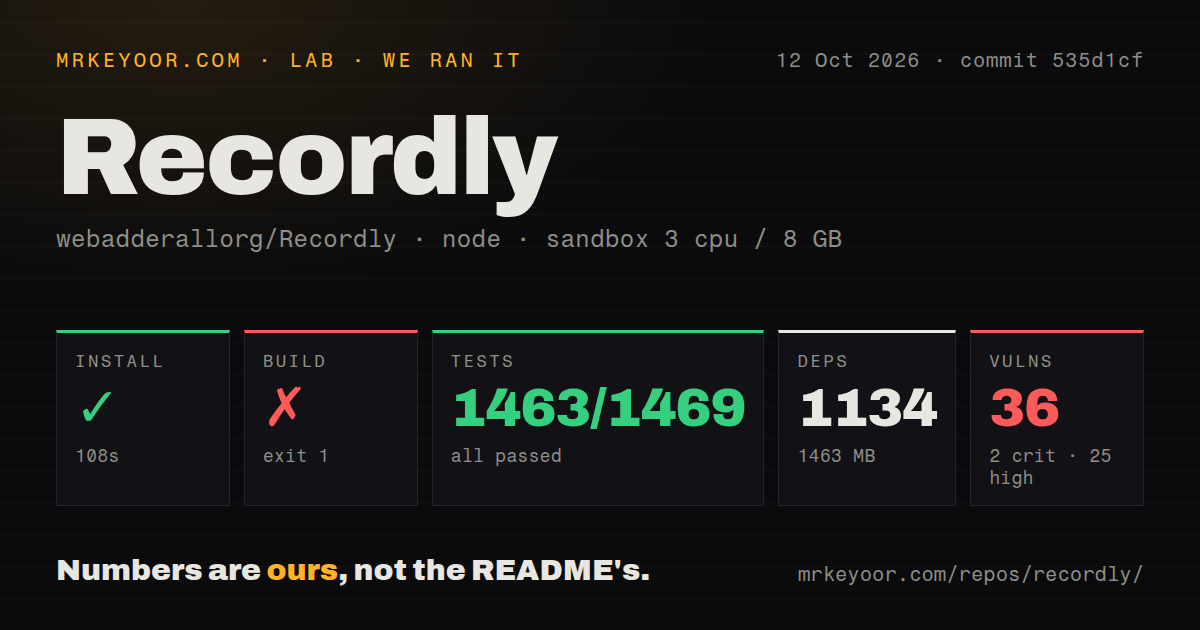
Our sandbox installed 612 npm packages in 140 seconds, and the dependency tree occupied 1,209 MB. The Linux build ran for 83 seconds before electron-builder stopped with exit code 1. It had already prepared uiohook-napi, packaged Electron 43.1.0, downloaded the 125 MB Electron archive, and started producing an AppImage. The final line was specific: a GitHub personal access token was absent both programmatically and from the GH_TOKEN environment variable.
Tests told a much better story. Vitest completed in 29 seconds with 1,083 passed and 0 failed out of 1,083. Npm audit found 27 known vulnerabilities: 0 critical, 23 high, 2 moderate, and 2 low. The checkout at commit 68bca43 was 98.3 MB, with 846 files and about 124,652 source lines. Our measurement setup used 3 CPUs, 8 GB of RAM, Node 22, no secrets, and an unprivileged Debian container.
The repository scan found 7 CI workflow files, no Dockerfile, and no tests directory. The absence of that directory does not conflict with the 1,083 passing tests; it only describes the layout our scanner saw. The failed build also does not show a compiler or native-module error. Its log reached AppImage packaging and then demanded a release credential, so the supported conclusion is that this build target was not cleanly separable from publishing configuration in our no-secret run.
A September 2026 push shows fast work, while 293 items remain open
GitHub showed 23,546 stars and a last push on September 5, 2026. Open issues and pull requests were active on September 6, including Linux AppImage, Wayland HUD, cursor, editor, and audio reports. GitHub's combined count was 293; separate searches found 197 issues and 96 pull requests. That is a busy queue, but the same dates show maintainers and contributors working in it rather than leaving old reports untouched.
The latest release was v1.3.3 on May 28, 2026. Its notes covered webcam bounds, timeline dragging, preset crop restoration, and Linux X11 routing, while September pull requests continued addressing Wayland HUD and focus behavior. Recordly is moving quickly enough to merit a hands-on trial. The passing 1,083-test suite supports that trial, while the failed packaging run, 27 advisories, disabled extensions, and Linux-specific reports argue against rolling it out to a whole team without a pilot on the exact operating systems involved.