Version 0.7.0 puts React on a native GPUI renderer
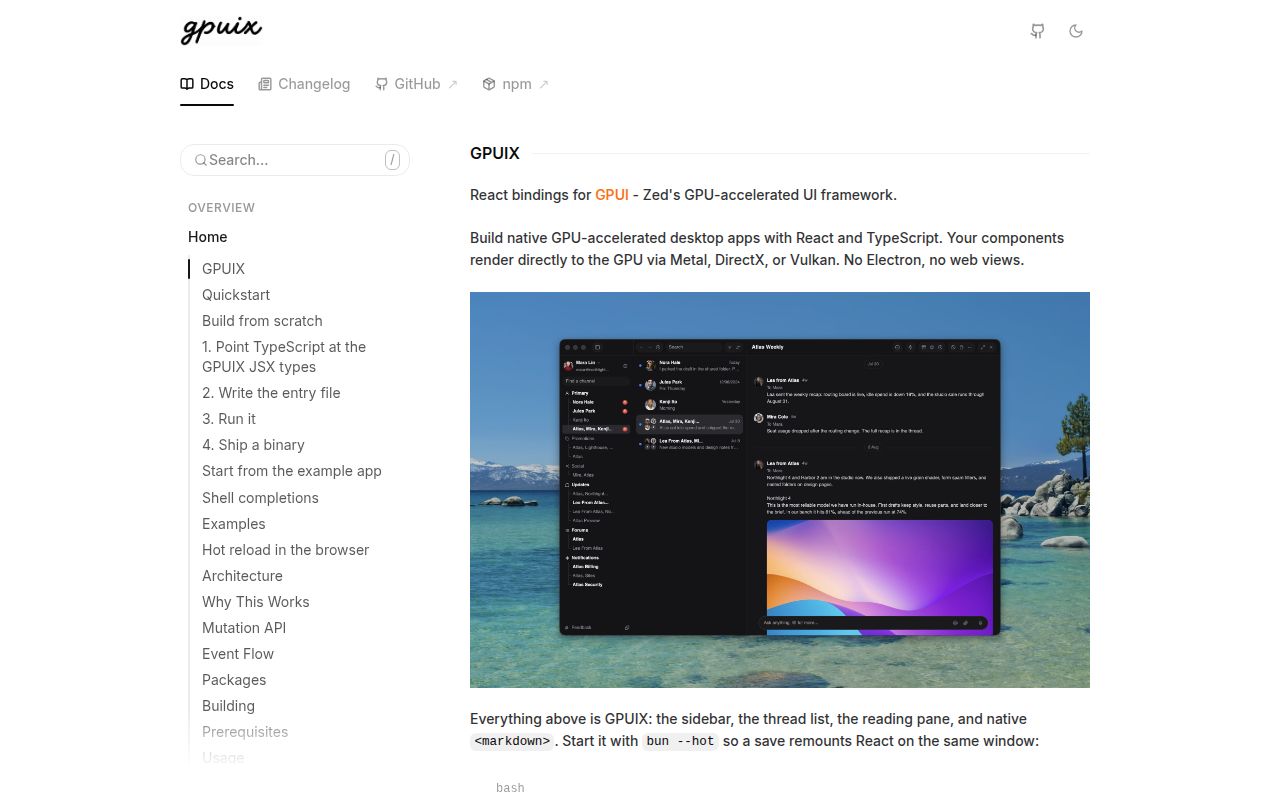
GPUIX 0.7.0 replaces the browser document with a retained Rust tree that GPUI paints through Metal, DirectX, or Vulkan. React still decides which components changed. A custom reconciler sends those changes across a napi bridge on desktop, while a WebAssembly bridge carries the same mutation protocol in the browser. The result is familiar state and component code attached to native text, input, scrolling, and window behavior rather than HTML elements.
The project publishes 3 main packages. @gpuix/react holds the reconciler and TypeScript types, @gpuix/native contains the Rust renderer, and @gpuix/cli copies a starter app. The host element set includes ordinary containers plus native input, textarea, virtual list, image, SVG, code, diff, and markdown elements. That is enough for editors and internal tools, but it is a defined UI vocabulary rather than the full web platform.
Node.js 18 users can start without Rust, but source work is heavier
The quickstart requires Bun and pulls the example with bunx @gpuix/cli new. It does not clone the repository or compile Rust because the React package obtains a native renderer for the current platform. A starter app can run with bun --hot, and Bun can compile it into a binary that carries the renderer. For application developers, that route is far simpler than the size of the monorepo suggests.
Contributors get a different job. Our checkout contained 4,253 files, roughly 1,652,826 lines of source, and 85.9 MB before dependencies. The README requires Rust, Node.js 18 or later, Bun, and the pinned GPUI submodule. On macOS it also calls for Xcode's Metal toolchain. The repository has 1 CI workflow, no Dockerfile, and no tests directory, so there is no checked-in container recipe matching a plain Linux builder.
What happened when we ran it
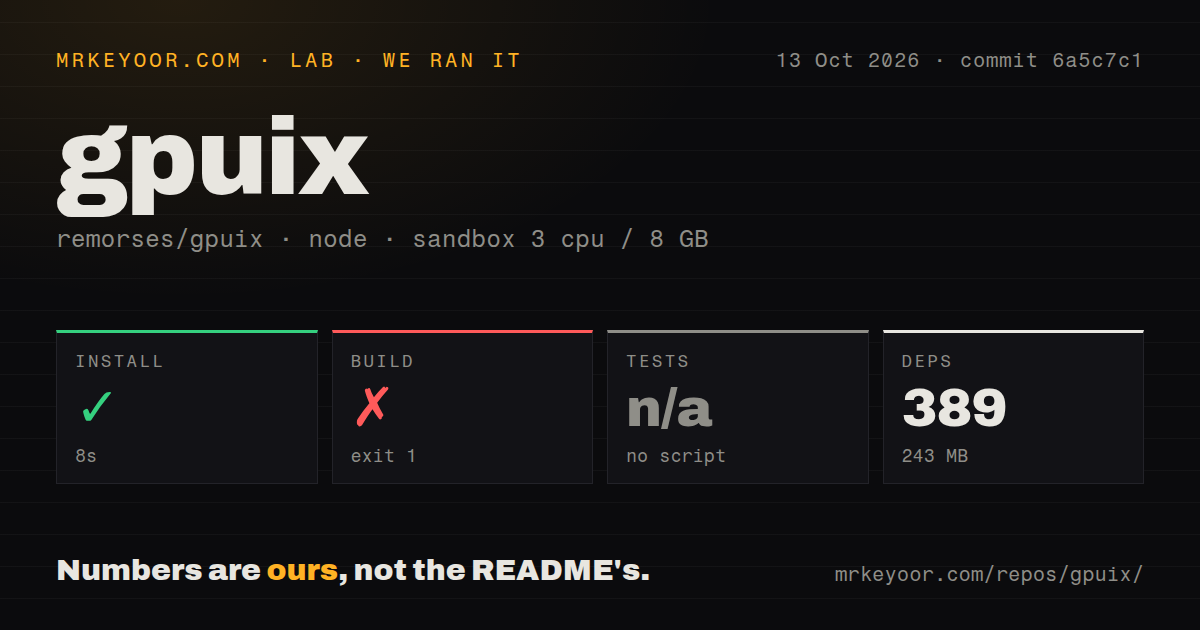
Our sandbox installed 333 Bun packages in 51 seconds and occupied 185 MB. The build ran for 621 seconds, then exited with code 1. No test script or target was present, so the test step was skipped. Those results come from commit 2d6e599 in an unprivileged Debian container with 3 CPUs, 8 GB of RAM, and no secrets.
The failing log does not identify a missing package or unsupported Linux feature. Its final lines say collect2 returned a linker error while compiling gpuix-native; Rust emitted 10 warnings, and the napi CLI reported exit code 101. That is all the evidence supports. The failure may be environment-specific, but a fresh Linux source build did not complete in our run, and the README does not provide a container that would settle the difference.
One window and no Linux test renderer narrow the current fit
The version 0.7.0 status list leaves multiple windows and a canvas element unfinished. One renderer owns one root and one window, so a second root requires unmounting the first. Nested vertical scrolling is also unsupported because overlapping GPUI hitboxes can receive the same wheel event. Those limits are manageable for a focused editor or utility; they are architectural constraints for a mail client with pop-outs, a design tool, or a dashboard full of nested panes.
Linux carries another specific gap. The README's test table lists GPU-backed rendering and PNG capture for macOS and Windows, but marks Linux as unavailable pending GPUI's headless wgpu renderer. Open issue 49 reports that version 0.7.0 windows under GNOME and Mutter have no title bar or window buttons, while the same binary is decorated under other compositors. A Linux product team should test each supported desktop session before choosing GPUIX.
Automation reaches real GPU paths on two desktop platforms
Version 0.7.0 includes locators, mouse and keyboard input, text queries, screenshots, and a controllable motion clock. On macOS and Windows, the documented test renderer paints through the same GPUI view and production event paths. Live applications can expose the same automation commands over standard input. That is a serious advantage for native interface work because tests can inspect text and state while retaining screenshots for visual review.
The repository still gave our runner 0 executable test targets, despite the README linking example test files and describing the test renderer in depth. That distinction matters: a documented test API is useful to adopters, while a project-level command proves the checked-out tree. Linux users also cannot use the GPU screenshot path yet. Treat the automation layer as a feature to validate on your supported host, not as evidence that this commit passed a suite in our container.
September 7 activity is fast, while version 0.7.0 remains early
GitHub showed 1,636 stars, 45 forks, and 26 open issues and pull requests on September 7, 2026. A search limited to issues found 17 open reports. The last push landed that same day, six days after the @gpuix/react 0.7.0 release. That release added two-stop gradients and data URL images, changed Tab handling, addressed high-DPI Windows text, and aligned process exit behavior across platforms.
The issue queue was moving on September 7, with new component-library feedback and discussion of native bundle size. Open issue 37 reports that event callbacks disappear after a bun --hot reload, which cuts against one of the friendliest parts of the quickstart. GPUIX is developing quickly and its documentation is unusually candid about unfinished pieces. For production, pin the package, test the exact operating systems, and keep the native bridge small enough to replace if the project changes direction.