A native toolkit with its own UI language
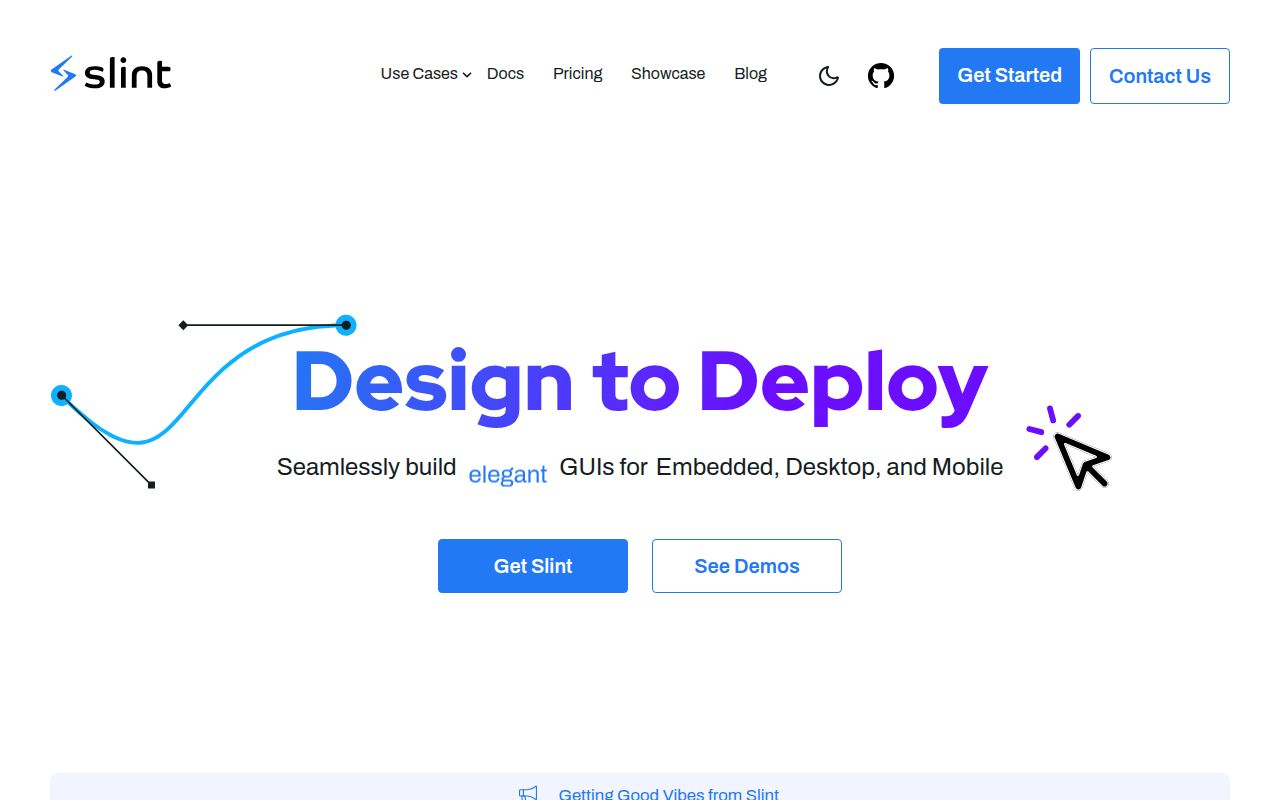
Slint separates interface description from application logic. Layout, visual elements, states, bindings, and callbacks live in .slint files. A compiler turns that markup into code for the selected language, while Rust, C++, JavaScript, or Python handles the rest of the application. The result can run on desktops, mobile devices, browsers through WebAssembly, or embedded hardware.
That separation is the main reason to consider it. A designer or UI engineer can work on the declarative layer while systems developers keep device access and business rules in their normal language. The markup is small enough to read, but it is another language to learn. Teams expecting JSX, QML, or native platform layout files cannot transfer code directly.
The core project says its 1.x APIs are stable. Rust and C++ are the established bindings; JavaScript and Python are explicitly beta. The Node guide warns that APIs will change and important features are still being developed. Choose the binding with that difference in mind rather than treating the four languages as equal surfaces.
Rendering spans GPUs and small devices
Slint can render through FemtoVG on OpenGL ES, Skia, or a CPU-only software backend. That range is useful when the same product family includes a desktop configuration tool and a dedicated device screen. Compile-time selection lets teams avoid shipping every backend and style. If Qt is present, Slint can use Qt's widget style for a more platform-native appearance.
The runtime stores component elements, properties, and related data in a compact region to reduce allocations. The compiler can optimize pure property expressions and generate native code. Those architectural choices suit embedded work, but they do not remove target-specific engineering. Input devices, graphics drivers, fonts, window systems, memory budgets, and cross-compilers still belong to the product team.
Tooling is better than the usual young domain-specific language. Slint has an LSP with completion and live preview, a VS Code extension, a standalone viewer with automatic reload, an online SlintPad editor, and a Figma import plugin. Separate templates exist for Rust, C++, Node.js, and Python.
What happened when we ran it
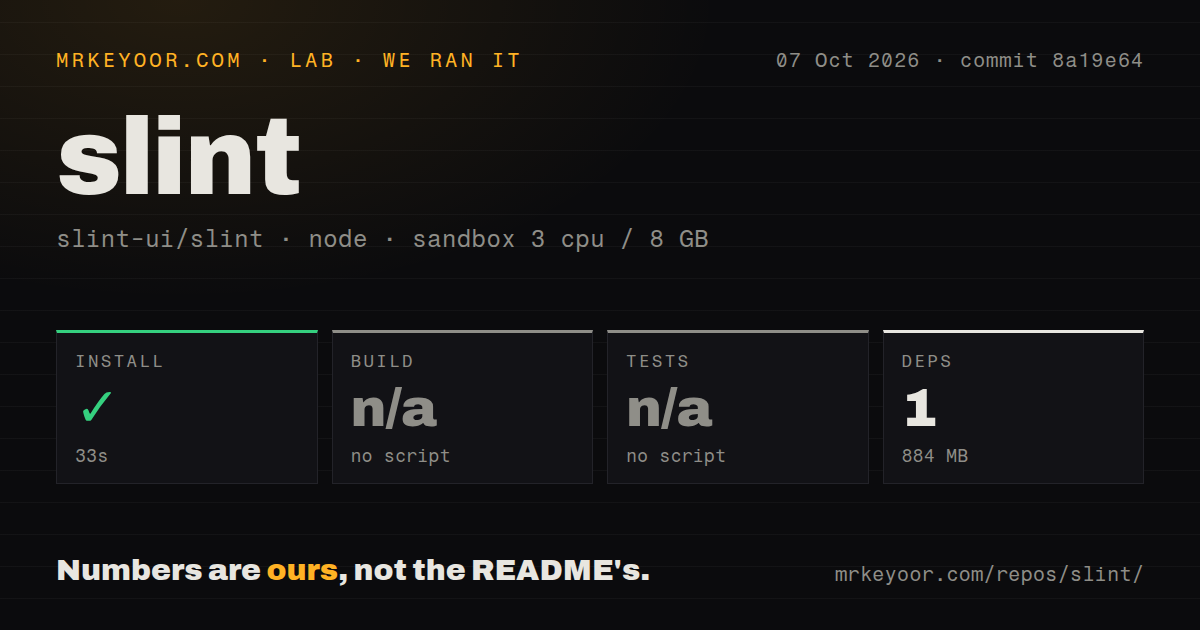
We cloned commit c1ef953 into an unprivileged Debian container with Node 22, 3 CPUs, 8 GB of RAM, and no secrets. The checkout contained 4,756 files, about 355,829 lines of source, and used 36.4 MB before installation.
The pnpm install succeeded in 37 seconds. Our harness recorded 1 installed package and 952 MB on disk. The selected Node workspace had no build script or target, so we skipped the build. It also had no test script or target, so we skipped tests.
Those results cover dependency setup for the measured Node entry point only. They do not show that the Rust compiler, C++ SDK, Python binding, examples, or any graphics backend built or ran in our container. The repository contains a tests directory, monorepo workspaces, and 34 CI workflow files, but our run produced no native build or test result that we can pass on. Buyers should not read a successful pnpm install as a toolkit qualification.
Source builds are platform work
The build guide requires Rust 1.92 or newer. Linux developers may need xcb, xkbcommon, fontconfig, and OpenSSL development packages. C++ work adds CMake 3.21 or newer, a C++20 compiler, and optionally Ninja. Windows needs the MSVC toolchain, and the repository's symbolic links require a correctly configured checkout. Media examples add FFmpeg or GStreamer.
Node 20 or newer is supported for consumers. Prebuilt Node binaries are listed for Linux on x86-64 and ARM64 with glibc, Apple Silicon macOS, and Windows on x86-64 or ARM64. Other platforms need a source build with pnpm, Rust, and the relevant native prerequisites. The source build of the current Node API needs a newer Node 22 release stated in the guide.
This is reasonable for a native toolkit, but it is far removed from installing a browser component package. Evaluate on the actual operating system, renderer, GPU, display server, and target board you intend to ship.
Licensing can decide the purchase
Slint's repository does not fit one standard SPDX label because the framework is offered under three choices. GPLv3 covers open-source applications, including embedded systems. A royalty-free license covers proprietary desktop, mobile, and web applications at no cost when its attribution requirement is met, but excludes embedded systems. Proprietary embedded products require the commercial license.
That boundary is easy to miss because embedded support is central to the technical pitch. A device manufacturer should involve whoever owns licensing before building a product around Slint. Documentation and examples use MIT, and individual third-party assets retain their own terms. The repository records file-level licensing through REUSE metadata.
Health and known limits
Version 1.17.1 was released on 2026-07-07 as a patch for bugs and crashes, with update instructions and prebuilt C++ SDKs and tools for several targets. The repository was pushed on 2026-08-23. Its 830 open issues and pull requests are a large queue, yet recent traffic covers renderer work, platform support, accessibility tests, language bindings, fixes, and new APIs. The dated push and issue activity show a busy project rather than one coasting on old releases.
Current bugs still matter. One Windows report traces a native-menu reference cycle that leaves a window adapter and GPU resources alive after shutdown. Another reproduces word-wrapped text overlapping the next row in box layouts and provides an explicit sizing workaround. A macOS request notes that Slint lacks an API for opening documents through Finder file associations. These are specific platform and layout gaps that should enter an application's acceptance tests.
Slint earns its place on a shortlist when cross-platform native UI and embedded reach outweigh the cost of a new markup language. Rust and C++ teams get the most settled path. Prototype the hardest target first, confirm the license, and test the renderer and widgets your product will actually ship.