A successful Python install does not validate PS3 gameplay
The RPCS3 sandbox installed an embedded Python project in 19 seconds and skipped its tests. It did not compile the native emulator or run a PS3 game. That distinction limits what this review can recommend.
RPCS3 is an open-source PlayStation 3 emulator and debugger written in C++ for Windows, Linux, macOS and FreeBSD. Players should evaluate it for their particular game and computer. Contributors need the native development environment described by upstream. The supplied run establishes neither gameplay suitability nor native setup effort.
What happened when we ran it
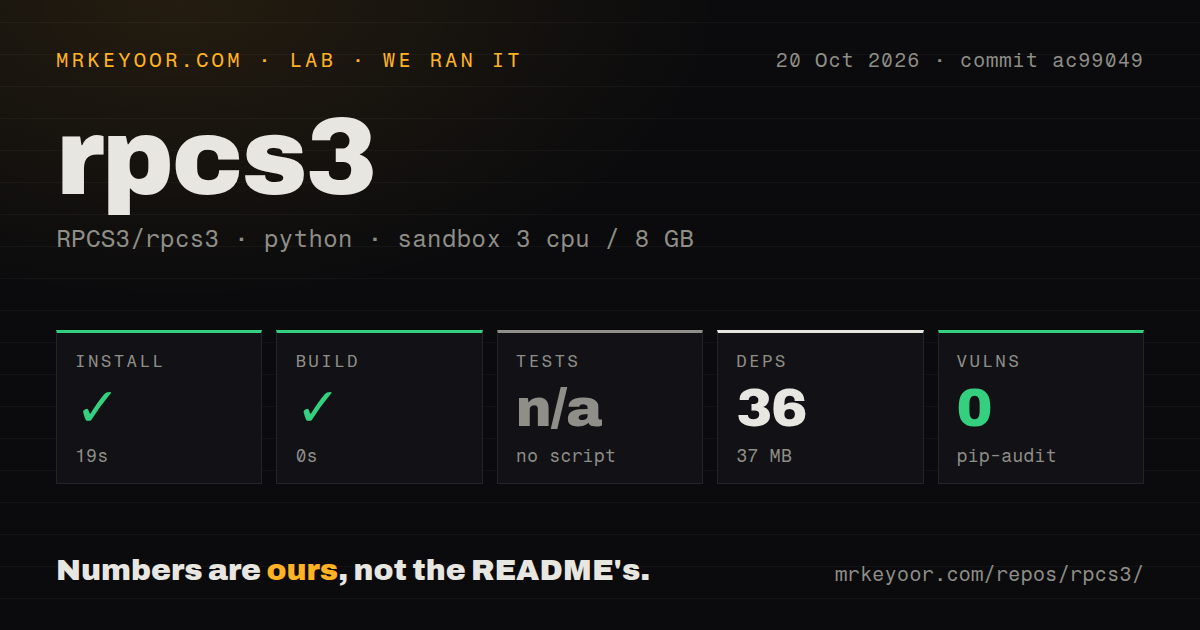
On October 20, 2026, the sandbox installed the Python project at 3rdparty/fusion/fusion in commit ac99049 in 19 seconds. It recorded 36 dependencies and 37 MB on disk. The build step reported success in 0 seconds. Tests were skipped because no tests script or target was available for the measured project.
Pip-audit reported 0 known vulnerabilities, with 36 packages scanned, 36 reported and 0 skipped. That coverage belongs to the measured Python environment. It does not establish the security of RPCS3's native code or every bundled component.
The recorded sandbox configuration was 3 CPUs, 8 GB RAM and image ghcr.io/astral-sh/uv:python3.12-bookworm. Actual runtime and operating-system versions require the raw toolchain logs; the image label alone does not establish them.
The repository scan recorded 194,113 files, approximately 22,694,946 source lines and a 2,576.5 MB checkout. It found 4 CI workflow files, no Dockerfile and no tests directory. These are scan observations, not a complete account of upstream verification. There is no measured game launch, frame rate or sustained play result in the supplied evidence.
Native setup follows a separate build guide
The native build guide officially supports Windows and Linux for building, while noting that other platforms can build RPCS3. The README's runtime platform list also includes macOS and FreeBSD. Runtime availability and official source-build support answer different questions.
Windows instructions call for Visual Studio, Python, Qt and the Vulkan SDK. Linux instructions list a native compiler, CMake, Qt, the Vulkan SDK and SDL3. Checkout preparation includes recursive submodules. These documented requirements give contributors a starting point, but the supplied run provides no measured time, dependency count or disk estimate for a native build.
The README tells users to update graphics drivers and install the Visual C++ Redistributable on Windows. The supplied evidence does not include the quick-start guide, so its hardware and game-setup requirements were not verified. This review therefore provides no checked hardware minimum, firmware procedure or title-specific configuration.
Record the build when evaluating a game
The v0.0.43 release notes describe RPCS3 as rolling-release software without stable builds. They direct users to the official download page for the latest build and tell packagers not to use branches from those tags. A GitHub release marked latest should not be treated as a stable edition.
This release policy makes RPCS3 a poor fit for users who require a conventional stable release channel. When evaluating a game, keep the exact emulator build identifier with the result so a later comparison or bug report identifies what was used. The measured checkout remains ac99049; the supplied evidence does not establish it as a known-good emulator build.
An issue opened on October 22, 2026 reports Yakuza 5 freezing on a Mac Air M1. This is the author's report about one game and configuration, not a sandbox finding or evidence of the same behavior on other machines. Repository metadata also records a push on October 22, 2026. Activity alone does not settle compatibility or support quality.
The README points readers to the wiki for game information and to community channels for compatibility reports. Check reports relevant to the title and hardware you intend to use.
Choose for the console library
PCSX2 is a PlayStation 2 emulator. Consider it when you want to play PS2 games. Xenia is an experimental Xbox 360 emulator. Consider it when your intended game is the Xbox 360 version. These projects target different console libraries; neither is a substitute for running your PS3 copy. No comparative performance measurements were supplied.
For RPCS3, follow the upstream distribution guidance, identify your game and hardware, and record the build identifier. A useful next step is a game-specific trial that reaches representative gameplay and checks saving and loading. That is a proposed evaluation, not a test performed for this review.