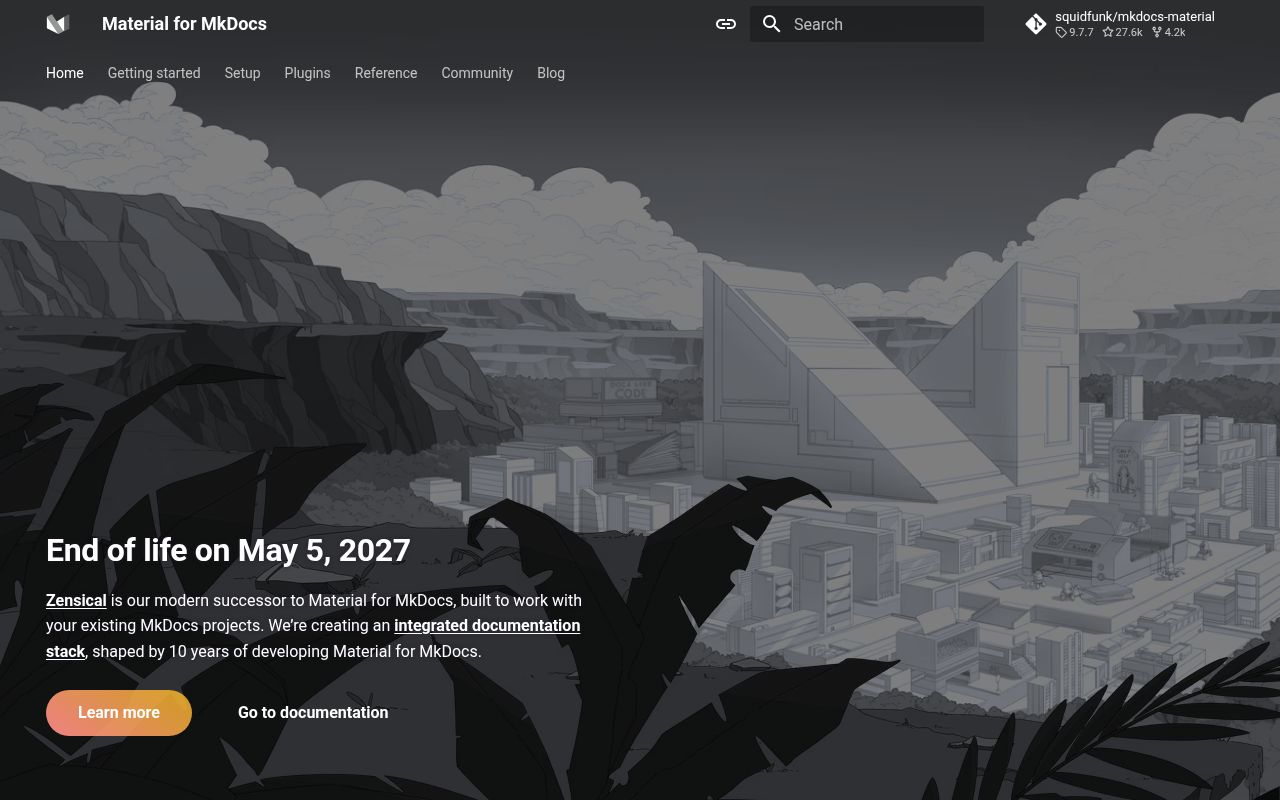
Existing sites have until May 5, 2027 to plan their transition
Material for MkDocs reaches end of life on May 5, 2027. That date, stated in the current getting-started guide, changes the recommendation more than its theme options do. I would keep an existing documentation site running while checking a successor. I wouldn't start a new project on Material expecting an open-ended feature roadmap.
Material turns Markdown into a searchable static site through MkDocs. The getting-started guide identifies it as a documentation framework built on MkDocs and supplies a Python package route. That suits a project manual whose maintainers want Markdown content and a configurable theme. The decision now includes a maintenance deadline, even if the existing site already does its job well.
Critical fixes continue, while new features belong to Zensical
The owner's maintenance notice extends critical bug fixes and security updates through May 5, 2027. New feature development remains focused on Zensical. It also says minor issues may not receive a fix and invites organizations with business-critical documentation to discuss support options. Keeping Material temporarily is reasonable if that policy fits your needs.
July's 9.7.7 release notes still name November 5, 2026 as end of life. The current setup guide and updated owner notice agree on the later date. Use May 5, 2027 for transition planning. This is an explicit change in maintenance policy, not a conclusion drawn from a quiet release feed. It doesn't promise that every reported defect will be addressed before the deadline.
What happened when we ran it
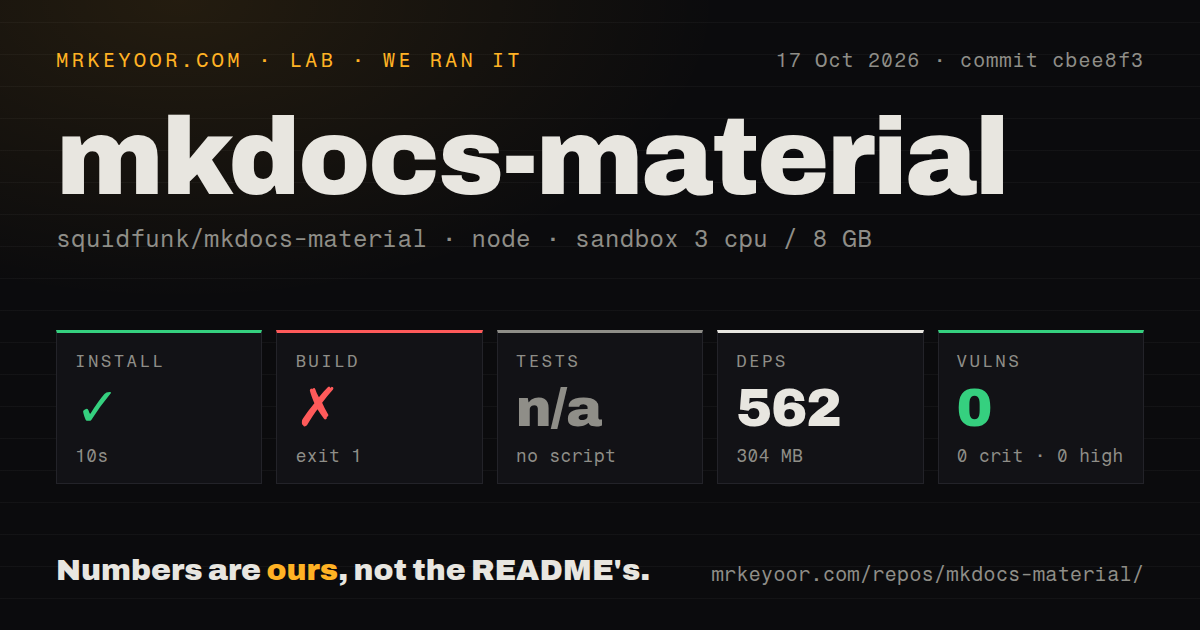
Our sandbox installed Material for MkDocs at commit cbee8f3 in 10 seconds, recording 562 npm dependencies and 304 MB on disk. The build failed with exit 1 after 2 seconds. Tests were skipped because the run found no test script or target. Npm audit reported 0 known vulnerabilities across critical, high, moderate and low severities. That audit concerns this npm dependency tree, not the security of an independently configured Python site.
The supplied stack trace runs through TypeScript build tooling and ts-node, ending with ERR_REQUIRE_ESM. It doesn't name the offending module in the lines supplied, establish the installed runtime version, or support a package-specific repair. Calling the whole documentation framework broken would go beyond the evidence. We have a failed source-build step with a recorded error, and the documented Python author route remains unassessed.
The October 17, 2026 run used 3 CPUs, 8 GB of RAM and image lab-node:22. That image name doesn't establish the actual runtime or operating-system version. The checkout contained 15,291 files, about 47,394 source lines and occupied 33.9 MB. The scan found 2 CI workflow files and a Dockerfile, without a dedicated tests directory. A missing npm test target doesn't establish that the entire project has no tests.
Documentation authors use the Python package or Docker
The official quick start uses pip install mkdocs-material and selects material as the theme in mkdocs.yml. The fuller guide recommends a virtual environment, explains restricting upgrades to the current major version and shows how to record Python dependencies. These are documented instructions, not a Python setup result from our sandbox.
There is no hosted documentation credential in that local route. You'll supply Markdown, configuration and somewhere to publish the resulting files. For an existing site, preserve its configuration and dependency record before comparing another generator. Include a page with your actual extensions or custom layout in that comparison. A fresh sample page won't reveal whether your manual's special cases survive.
The official Docker container is for local previews
The setup guide explicitly says the Docker container is unsuitable for deployment because MkDocs' live-preview server is not designed for production. Publish generated static files through your chosen hosting setup. A working preview is useful during editing, but exposing it would contradict the project's own deployment guidance.
On our documentation scale, 1 means missing task instructions, 3 means usable instructions with a consequential inconsistency, and 5 means consistent guidance across setup and lifecycle decisions. Material earns 3: the Python and Docker paths are explained clearly, while the latest release warning retains the superseded end-of-life date.
Zensical is the successor to evaluate first
Zensical is a static site generator built by Material's creators. The Material setup guide says you can run it alongside MkDocs with existing content and configuration before switching. That makes it the first comparison I'd make for an existing site. It doesn't guarantee compatibility with every local customization. Check the pages and behaviors your readers depend on before changing the production generator.
Docusaurus includes a docs section, blog and customizable pages. Consider it when the project needs a broader website and you're willing to evaluate another framework. This review doesn't establish that either alternative would complete our failed source-build step or preserve your site without changes.
An October push shows maintenance within the stated boundary
GitHub recorded a push on October 17, 2026 and listed 1 open issue or PR. The issue feed also showed closed reports updated on October 18 alongside the open maintenance notice. Those facts show continuing activity, while the owner's policy defines its limits. For an existing site, use the remaining maintenance period to compare a representative copy with Zensical. Keep the current publication path until that copy meets your actual documentation needs.