Tauri uses the operating system webview instead of bundling Chromium
Tauri wraps a web interface in a Rust application and renders it with the webview already available on the device. WKWebView handles Apple platforms, WebView2 handles Windows, WebKitGTK handles Linux, and Android uses its system webview. That decision is the main reason to consider Tauri. A team can keep its HTML, CSS, and JavaScript interface while moving file access, menus, windows, and other native work behind a Rust boundary.
It is also the first tradeoff to accept. Four webview families do not behave like one fixed Chromium release. CSS, media support, accessibility behavior, and browser bugs can vary with the operating system. The README lists Windows 7 and later, macOS 10.15 and later, iOS 9 and later, plus Android 7 and later with a note that current support starts at 8. Those targets deserve separate release testing, not one browser pass on a developer laptop.
Native packaging is included, but platform work remains
The built-in bundler produces macOS app and disk-image formats, Linux deb, rpm, and AppImage packages, plus Windows NSIS and WiX installers. Tauri also documents tray icons, notifications, a native webview protocol, and a self-updater for desktop. These are the unglamorous pieces that make a web interface feel like an installed application. Having them in one framework is more useful than adding unrelated wrappers for each feature.
Packaging is not the same as shipping. Apple and Microsoft signing, store accounts, mobile SDKs, entitlements, update endpoints, and CI secrets remain the application owner's job. The starter command is only npm create tauri-app@latest, but the README tells users to install the prerequisites first. Rust is part of the application architecture, so a team that cannot debug Cargo errors or review native permissions will eventually depend on a specialist.
What happened when we ran it
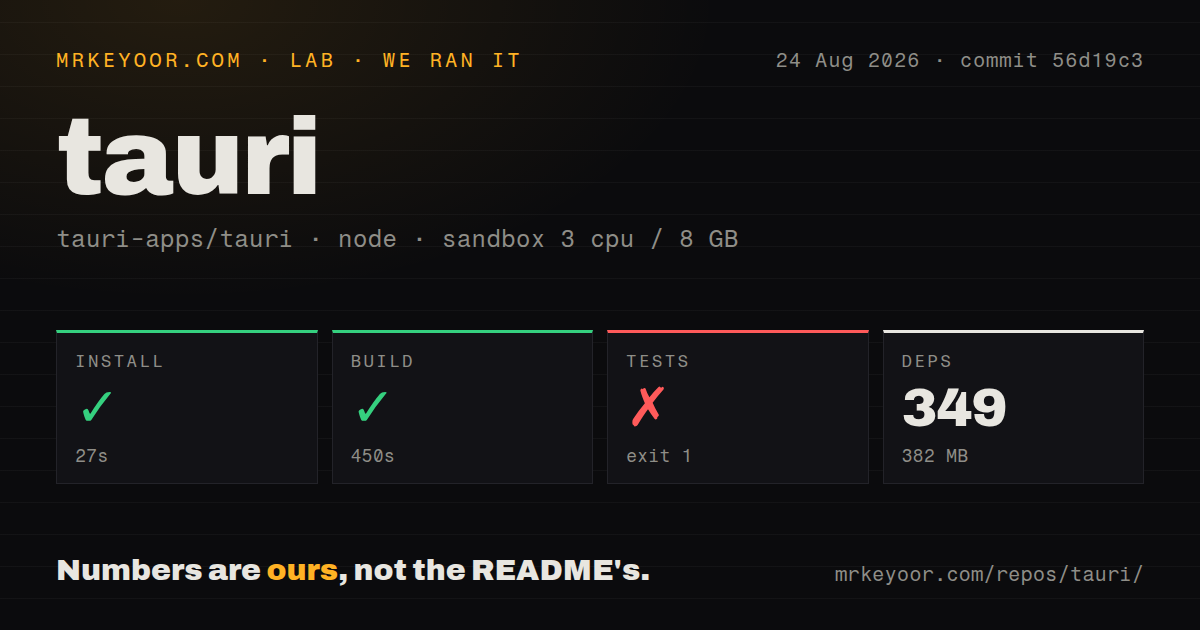
Our sandbox installed 349 pnpm packages in 27 seconds and used 382 MB on disk. The checkout itself contained 1,113 files, about 117,970 lines of source, and occupied 21.8 MB. Installation was straightforward in the supplied Node 22 lab image. The repository is a workspace monorepo with 21 CI workflow files, no Dockerfile, and no top-level tests directory.
The build passed, but it took 450 seconds on 3 CPUs with 8 GB of RAM. Tests then exited with code 1 after 32 seconds. Vitest reported one test file and one test, both failed: packages/cli/__tests__/template.spec.ts. The tail says the template test ran for about 21 seconds and then the recursive pnpm command stopped. It does not say why the assertion failed, so we cannot responsibly turn this into a diagnosis.
That result separates app setup from framework contribution. Creating a starter may be quick, while validating a change in this 117,970-line repository has a much longer feedback loop. A passing build proves the checked-out commit compiled in our container. The failed template test means commit 56d19c3 did not clear the complete command we ran, even though the compiler stage succeeded.
Rust controls the trust boundary
Tauri does not serve the interface from a localhost HTTP server. Its native webview protocol loads the frontend, while the Rust process exposes selected commands and APIs. This split can reduce the surface exposed to arbitrary web content, but it is only as safe as the permissions an application grants. A broad command that accepts unchecked paths remains broad whether it is called from a small binary or a large one.
For an existing web product, migration therefore involves more than changing the build target. Browser-only assumptions need review, native capabilities need explicit command design, and plugins need version management on both JavaScript and Rust sides. The 2.11.5 release is a useful example: its only listed change unpinned a Rust dependency after a fixed version appeared. Tauri applications inherit two package ecosystems, and keeping their corresponding pieces aligned is regular maintenance.
Current activity supports adoption, not zero-risk maintenance
GitHub showed 110,577 stars and 1,445 combined open issues and pull requests when we fetched the repository. The last push was August 26, 2026, while the latest release, tauri-v2.11.5, was published July 1, 2026. The same-day code activity and a busy issue queue describe a maintained project with a large user base. The combined count is not a count of confirmed bugs.
The queue still shows why platform testing matters. An open Linux issue reports incorrect IME window placement, and another reports a Wayland protocol error. Those reports do not prove every Tauri app has either problem. They do show that the system-webview and native-window approach meets operating-system details that a bundled browser framework may hide. Tauri is a good fit when package size and Rust control are worth that matrix, and a poor shortcut when the team only wants its website in a desktop window.