Use a binary release unless you are changing Go itself
The golang/go repository is the source of the compiler, runtime, command-line tools, and standard library. It is not the normal installation route for an application developer. The README points users to official binaries on go.dev, then sends source builders to a separate guide. That distinction matters because the development branch can require a toolchain newer than the latest public release.
Go is attractive for software that must be understandable by a broad team and easy to deploy. Its standard tools handle formatting, testing, packages, documentation, profiling, and module dependencies. Goroutines and channels make concurrent network work approachable, while the compiler produces native programs without requiring a language VM on the target. The trade is a deliberately small language with garbage collection and fewer abstraction mechanisms than Rust or C++.
The GitHub repository had 136,463 stars and 10,119 open issues on 2026-08-25. Unlike most projects we review, that open count does not include an active GitHub pull-request stream because this repository is a mirror. Go's canonical Git host is go.googlesource.com, code review happens in Gerrit, and GitHub primarily carries issues plus the mirrored tree. Health should be judged from those channels together.
The standard library is part of the buying case
Go ships much of what service teams need: HTTP clients and servers, cryptography, JSON, templates, SQL interfaces, testing, archives, compression, and OS integration. A small language plus a substantial standard library reduces the number of choices required to start a service. The compatibility promise also makes routine upgrades less disruptive than ecosystems where language and core libraries change independently.
The cost shows up around specialized work. Rust gives finer ownership and allocation control without a garbage collector. Zig stays closer to C and exposes allocator decisions. Crystal offers more Ruby-like expressiveness. Go usually wins when operational clarity, compile speed, and team readability matter more than squeezing every lifetime or type relationship into the language. It is a poor choice if those omitted controls are central requirements.
Go's repository includes 2 modules under src, named std and cmd, with vendored copies of selected external packages. The vendor documentation warns that standard-library imports resolve differently from ordinary application modules and recommends building Go from source before updating those copies. This is toolchain maintenance, not ordinary go mod tidy work in an application repository.
What happened when we ran it
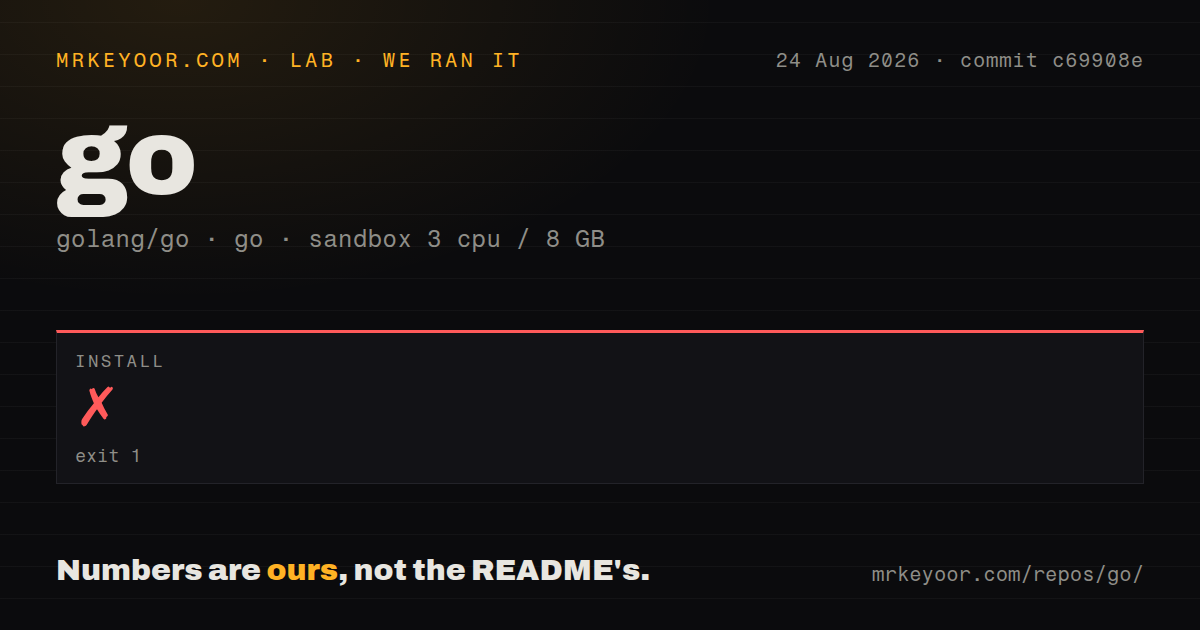
Our run used golang:1.24-bookworm with 3 CPUs and 8 GB of RAM. The checkout was 131.8 MB, with 14,705 files and about 2,514,986 lines of source. The project lives under ./src/, and the module there declares go 1.28. Installation failed with exit code 1 after 10 seconds.
The entire useful log is direct: the Go command began downloading go1.28.0 for linux/amd64, then said that toolchain was unavailable. No build or test step followed, so we have no build timing, test result, or dependency count to report. The failure does not say the source is broken. It says this development checkout could not be prepared by that stable container through automatic toolchain download.
The official release history listed Go 1.27.0 as released on 2026-08-19, 6 days before our check. That makes master a moving compiler-development target rather than a substitute for the current release archive. A developer wanting Go should download 1.27.0 or another supported release from go.dev. A contributor should follow the source guide and choose a bootstrap toolchain suitable for the branch being built.
Source builds need a bootstrap compiler and native tools
Go is self-hosted, so its source guide requires an earlier working Go compiler. The documented rule says versions 1.N use a bootstrap version derived from N, and it offers a binary release, cross-compilation, gccgo, or the old Go 1.4 C-based tree as routes. Git is required. Builds with cgo support also need a C compiler such as GCC or Clang; CGO_ENABLED=0 avoids that part.
The actual build starts inside src with make.bash. all.bash adds the important test suite and takes longer. That process differs from running go build ./... inside a normal module. Our harness encountered the module's toolchain request before reaching those scripts, which is useful evidence that a generic Go-project recipe does not fit the Go compiler repository.
The GitHub mirror showed 0 workflow files and no Dockerfile. That should not be read as missing automation. Go operates its own builders, Gerrit reviews, dashboards, and release process outside GitHub Actions. The repository also had a tests directory and same-day issue updates covering compilers, networking, ports, regressions, and release blockers. Its visible workflow simply does not use the conventions our generic scanner looks for.
Contributions use Gerrit and a proposal process
A first contribution requires a signed individual or corporate CLA, Gerrit registration, and the git-codereview tool. The guide asks contributors to connect nontrivial changes to an issue, compile and test a clean checkout, and send changes through Gerrit. Language changes, incompatible library changes, and other large work go through a formal proposal process before code is accepted.
This process is heavier than opening a GitHub pull request, but it matches a language with millions of source lines and a compatibility commitment. The issue tracker had updates within minutes of our 2026-08-25 query, including release blockers and backport candidates. A total of 10,119 open issues reflects the compiler, standard library, tools, ports, and proposals together, not 10,119 confirmed defects in the current release.
For application teams, none of that contributor machinery is a reason to avoid Go. Use the released toolchain, keep modules separate from the Go source tree, and judge the language against the service or CLI you need to ship. Clone master only when the compiler or standard library is the product you intend to work on.